Key Takeaways
- Google's Gemini AI agent in Android Studio can generate working Wear OS watch face code from a screenshot and natural language prompts
- The AI handles programming logic while users focus on design elements like characters, fonts, and visual assets
- Vibe coding isn't about AI doing everything—it's about letting non-programmers bypass the technical barriers they can't clear alone
Joe Fedewa, a tech writer at How-To Geek, built a custom Wear OS watch face using Google's Gemini AI coding assistant in Android Studio. He has no programming background. The project took a few hours rather than the weeks it would require to learn Android development from scratch.
The trigger was jealousy. Fedewa's son wears a Fitbit Ace LTE smartwatch with animated characters that circle the display as the kid hits step goals. A hot dog named Frank inches toward prizes. It looked fun. Fitness rings on adult smartwatches do not.
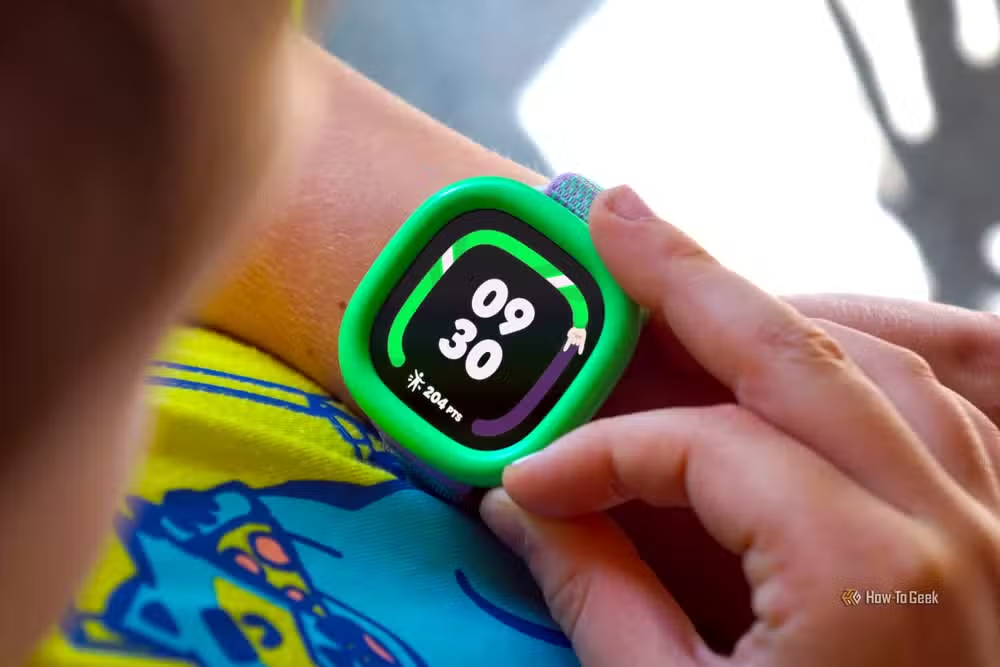
So Fedewa installed Android Studio, created a blank watch face project, opened the Gemini "Agent" sidebar, pasted a screenshot of the Fitbit face, and asked the AI to replicate it. The only detail he specified: the character should move around a ring tied to step count.
How accurate was Gemini's first attempt?
Not perfect. Gemini can't generate images from nothing, so it couldn't draw Frank the hot dog. But the AI produced a functional skeleton: a working ring, step count integration, and animation logic. Fedewa estimates this baseline would have taken him many hours to build manually, if he could build it at all.
From there, he iterated. He designed his own version of Frank in an image editor, chose a font he liked, and asked Gemini to wire them in. Then he got ambitious.
"I want to be able to choose from multiple characters for the progress ring," he typed. A few minutes later, the code was ready for his images. He asked for prizes to appear when the step goal hit 80%. He asked for a new character version at 100% completion. He asked for multiple typeface options. Each request became working code.
What does 'vibe coding' actually mean?
The term describes using AI to write code through conversation rather than syntax. You describe what you want. The AI figures out how to implement it. Fedewa's takeaway: vibe coding isn't about outsourcing all the work to a machine. It's about removing the one barrier you can't clear yourself.
He can design graphics. He can conceptualize features. He can test and tweak. What he couldn't do was translate those ideas into Android code. Gemini fills that gap.
Errors still occurred. Sometimes Gemini's code didn't work on the first try. But the AI agent handled debugging too. When Fedewa needed to make manual adjustments, Android Studio highlighted and explained what each code block did. He learned along the way, even if learning wasn't the point.
Why this matters beyond one watch face
Google announced these AI-powered Android Studio tools at its developer conference last month alongside Android 17. The company is betting that lowering the barrier to app development will expand its ecosystem. More watch faces, more apps, more reasons to buy Wear OS devices.
According to Stack Overflow's 2024 developer survey, 67% of developers now use AI coding assistants in their workflow. But Fedewa's experiment suggests the more interesting shift is among non-developers. The 33% who couldn't write code before might now build things anyway.
Watch faces are a small canvas. The principles scale. If you can describe a feature clearly, and you're willing to handle the design and testing, Gemini can handle the code. That's a meaningful change in who gets to build software.
The limits of the approach
Fedewa's watch face is relatively simple. One character, one ring, one data source. More complex apps with backend logic, user authentication, or API integrations would require more sophisticated prompting and more manual intervention. AI coding assistants work best when the scope is constrained and the output is verifiable.
There's also the question of code quality. Gemini generates functional code, but functional isn't the same as efficient, secure, or maintainable. For a personal watch face, that's fine. For production software, you'd still want a human developer reviewing the output.
Frequently Asked Questions
Do I need any coding knowledge to build a Wear OS watch face with Gemini?
No. Fedewa had no programming background. He used screenshots and natural language prompts to describe what he wanted. Gemini generated the code.
How long does it take to create a custom watch face with AI assistance?
Fedewa completed his project in a few hours, including design work and iteration. A similar project without AI would require weeks of learning Android development.
Is the Gemini coding assistant free to use in Android Studio?
Google's AI tools in Android Studio are available to developers, though specific pricing and access tiers may vary. The base Android Studio IDE is free.
Can Gemini create the graphics for my watch face?
No. Gemini can't generate images. You need to design characters, icons, and visual assets yourself or source them elsewhere. The AI handles code, not graphics.
Will watch faces built this way work on all Wear OS smartwatches?
Standard Wear OS watch faces should work across compatible devices, though specific features may vary by hardware and OS version.
Logicity's Take
This experiment reveals something bigger than one watch face: the death of the minimum viable skill threshold. Previously, building any app required crossing a competency floor in programming. AI coding assistants don't just lower that floor—they remove it entirely for certain project types. The interesting question isn't whether professionals should use these tools. It's what happens when millions of non-programmers realize they can build functional software by describing it in plain English.
Another story about creative tools becoming more accessible to non-professionals
Need Help Implementing This?
Want to build your own Wear OS watch face or explore AI-assisted development for your projects? Logicity's team tracks the tools reshaping how software gets built. Subscribe to our newsletter for weekly coverage of practical AI applications, or reach out directly if you're evaluating these tools for your organization.
Source: How-To Geek
Huma Shazia
Senior AI & Tech Writer
Produced with AI assistance and reviewed by the Logicity editorial team. Learn more in our Editorial Policy.