Google Cloud announced that Looker's semantic layer now governs structured data queries inside Gemini Enterprise, its AI chat interface for workplace productivity. The integration uses Google's Agent-to-Agent (A2A) protocol to route natural language questions through Looker's predefined business logic before they ever touch a database. The goal: eliminate the hallucinations that plague generic NL2SQL models, and keep row-level access controls intact.
The change matters because most large language models guess at database schemas. Ask two analysts to query "revenue" and they may get different answers, depending on which tables the model joined and which filters it applied. Looker's semantic layer removes that ambiguity by codifying metric definitions in advance. When a Gemini Enterprise user asks for revenue, the system generates deterministic SQL against version-controlled logic, not a best-effort interpretation.
How the architecture works
Looker Conversational Analytics Tutorial | Gemini Enterprise for BI Users
Looker admins publish conversational agents directly into Gemini Enterprise via A2A. When a user submits a business KPI request, the request routes to the Looker agent, which generates SQL from the semantic layer and queries the underlying data store. BigQuery, AlloyDB, and Spanner are all supported.
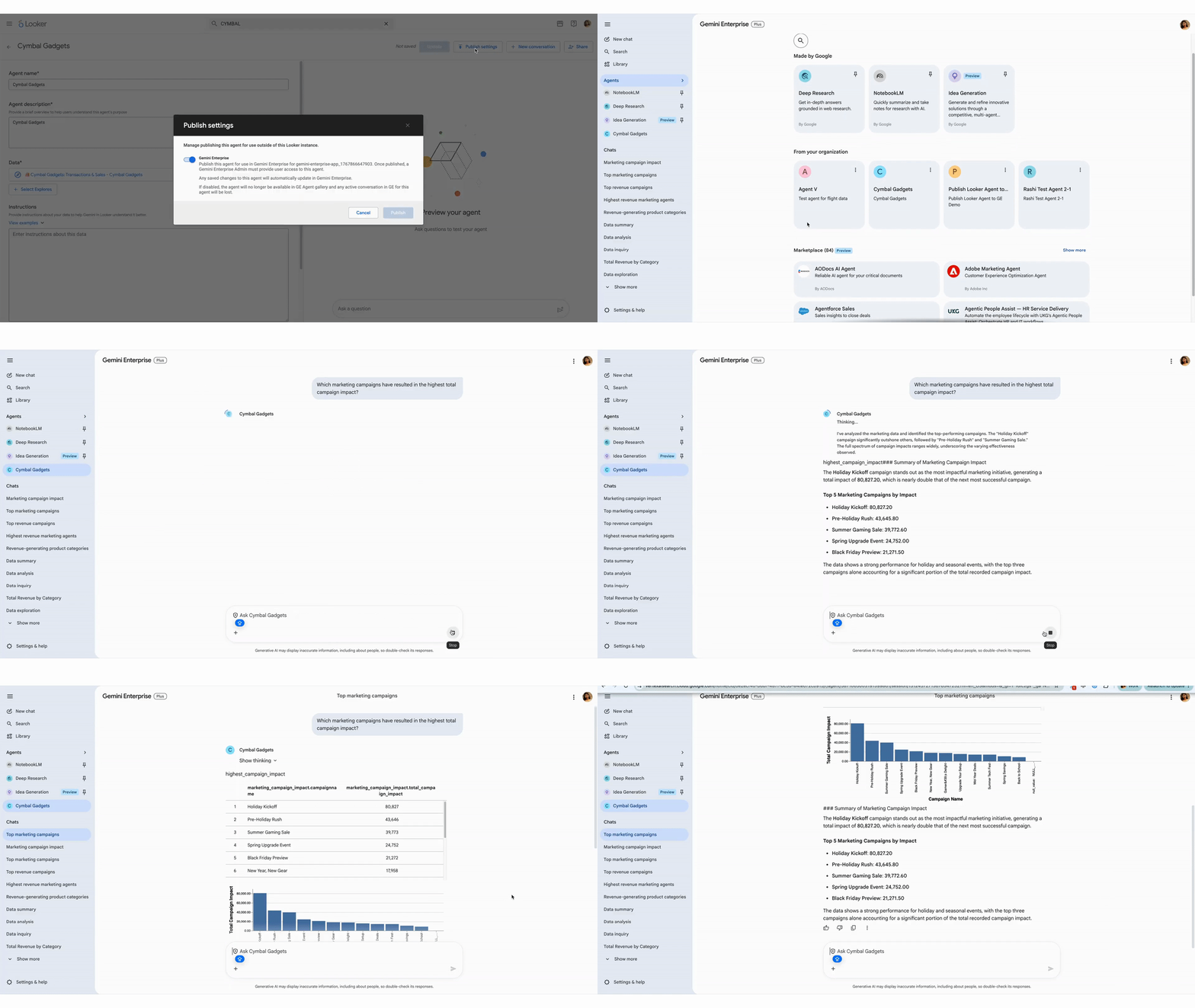
Google describes this as a "zero-risk pass-through architecture." Gemini Enterprise does not ingest, replicate, or store the underlying database records. It processes the data in transit and returns the result. The company explicitly positions this against competitors that index enterprise data into their own storage.
Security model and access controls
Users authenticate via one-time OAuth consent, binding their Gemini session to their Looker credentials. Because queries execute live through Looker, existing row-level and column-level access controls carry over. If a user lacks permission to view sensitive payroll data in Looker, the Looker agent withholds that data in Gemini. Publishing an agent to the Agent Gallery does not bypass these restrictions.
This is the pitch for regulated industries. Finance and healthcare teams can expose AI-driven analytics without opening new attack surfaces or compliance gaps.
What the release includes
The integration ships with support for rich visual interactivity, including charts rendered inline in Gemini's chat interface. Google says this expands discoverability for analytics beyond dedicated dashboard users. Teams that live in Gemini for daily work can now pull live metrics without switching contexts.
Google acquired Looker in 2020 for $2.6 billion. The semantic layer has since become central to the company's enterprise BI strategy, competing against dbt's semantic layer and Cube for the "single source of truth" positioning. This Gemini integration is the clearest signal yet that Google sees the semantic layer as infrastructure for AI agents, not just dashboards.
Logicity's Take
For engineering leaders evaluating enterprise AI rollouts, this integration addresses a real pain point: NL2SQL models produce unpredictable results when they guess at schema relationships. Looker's semantic layer solves that by centralizing metric definitions. The trade-off is that you must maintain Looker infrastructure and its LookML modeling layer. Competing approaches include dbt's semantic layer (open-source, works with multiple BI tools) and Cube (cloud-native, GraphQL-friendly). Google's advantage is tight vertical integration; the disadvantage is lock-in to the Google Cloud stack.
What Google did not say
The announcement does not include pricing changes. Looker and Gemini Enterprise remain separate products with their own billing. Google also did not publish latency benchmarks for live queries routed through the semantic layer, nor did it clarify whether the integration supports complex multi-step analytical workflows or is limited to single-turn Q&A.
The blog post references a "rich visual interactivity" feature for charts but cuts off mid-sentence, suggesting the full capabilities will follow in a more detailed technical doc. Teams considering the integration should wait for that before committing to migration timelines.
Enterprise platform strategy and vertical integration lessons relevant to Google's BI consolidation
Need Help Implementing This?
Logicity helps engineering teams evaluate enterprise AI integrations and BI modernization strategies. Reach out at hello@logicity.in for a free 30-minute consultation.
Source: Cloud Blog
Manaal Khan
Tech & Innovation Writer
Produced with AI assistance and reviewed by the Logicity editorial team. Learn more in our Editorial Policy.