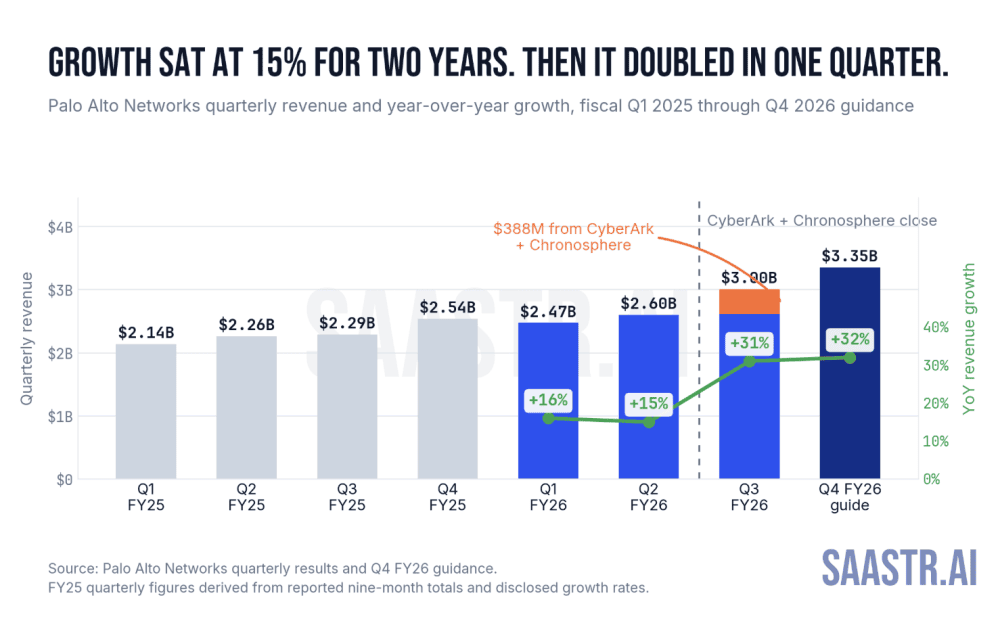
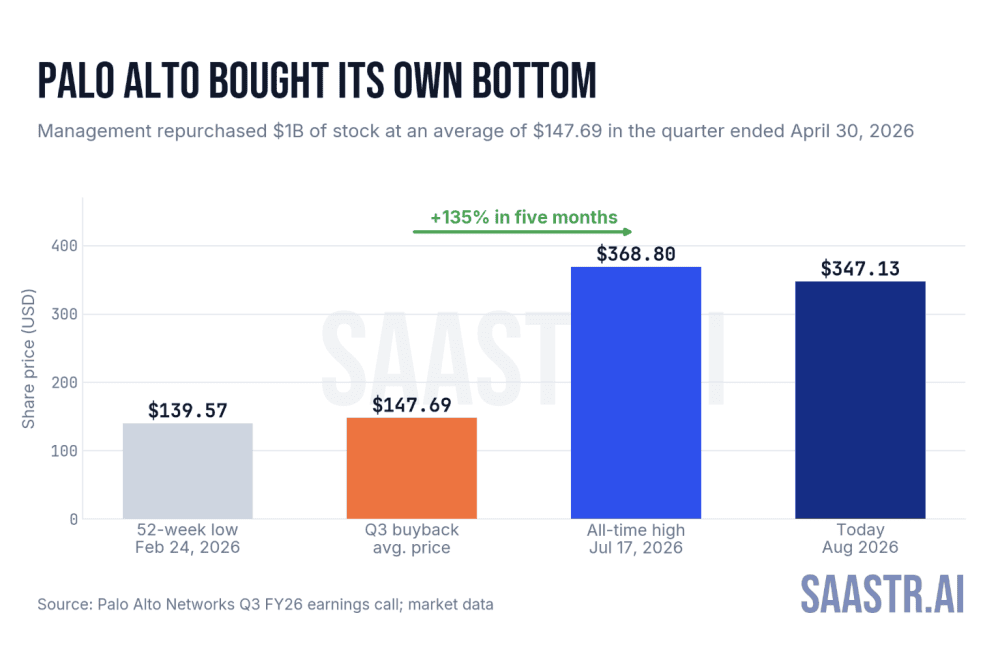
Palo Alto Networks now trades at a $265 billion market cap. The stock is up roughly 100% over the past twelve months and hit an all-time high of $368.80 in July 2026. But the path was ugly: a $29 billion acquisition spree, a GAAP loss, 14% shareholder dilution, slashed EPS guidance, and a February low of $139. The recovery only came when the core business accelerated through the chaos.
For SaaS founders, the story is not about security. It is about what happens when you bet the company on M&A at scale, take the hit, and come out the other side. Here are five lessons from the ride.
1. The stock doubled, but it fell 25% first
The sequence matters more than the outcome. In July 2025, Palo Alto announced it was buying CyberArk for $25 billion, the largest deal in the history of the security industry. The market hated it. The stock dropped 12.5% in a month.
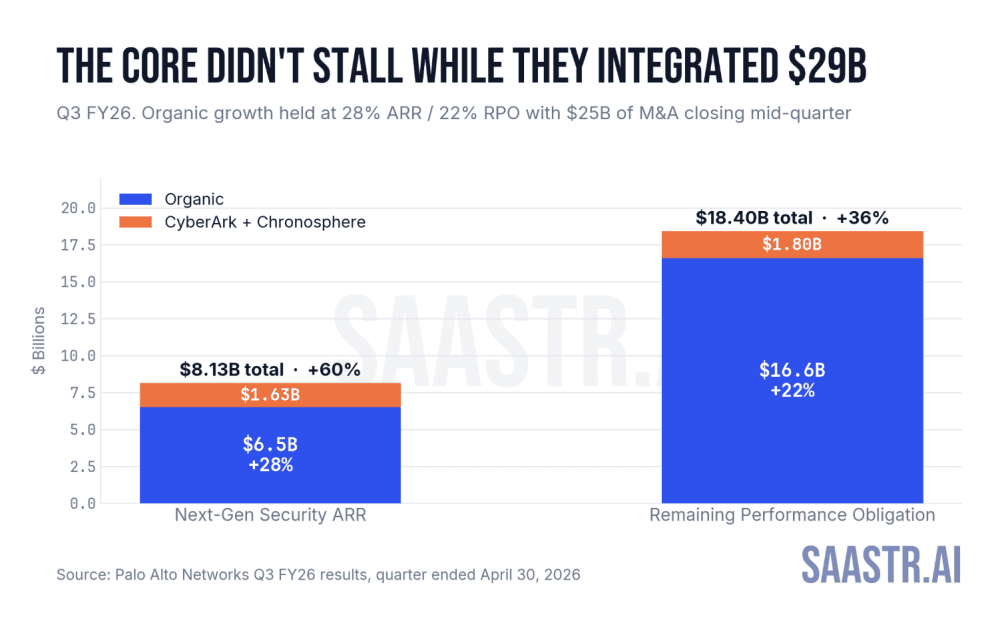
By November, the company reported a GAAP loss. It cut EPS guidance. The stock kept falling, bottoming at $139 in February 2026. Then the quarterly numbers came out: Next-Gen Security ARR was up 60%. Net revenue retention hit 120%. The organic business was growing 28% even before counting the acquisitions.
Wall Street re-rated the whole thing. The stock doubled from the February low.
The lesson: a messy M&A quarter does not doom a company if the core flywheel keeps spinning. But surviving that window takes nerve. Management was buying stock at the bottom.
2. Platform consolidation is working, and the numbers prove it
Under CEO Nikesh Arora, Palo Alto has spent eight years turning from a firewall vendor into a five-pillar platform. The pillars now cover network security (Strata), security operations (Cortex/XSIAM), cloud security (Cortex Cloud), identity (CyberArk), and observability (Chronosphere).
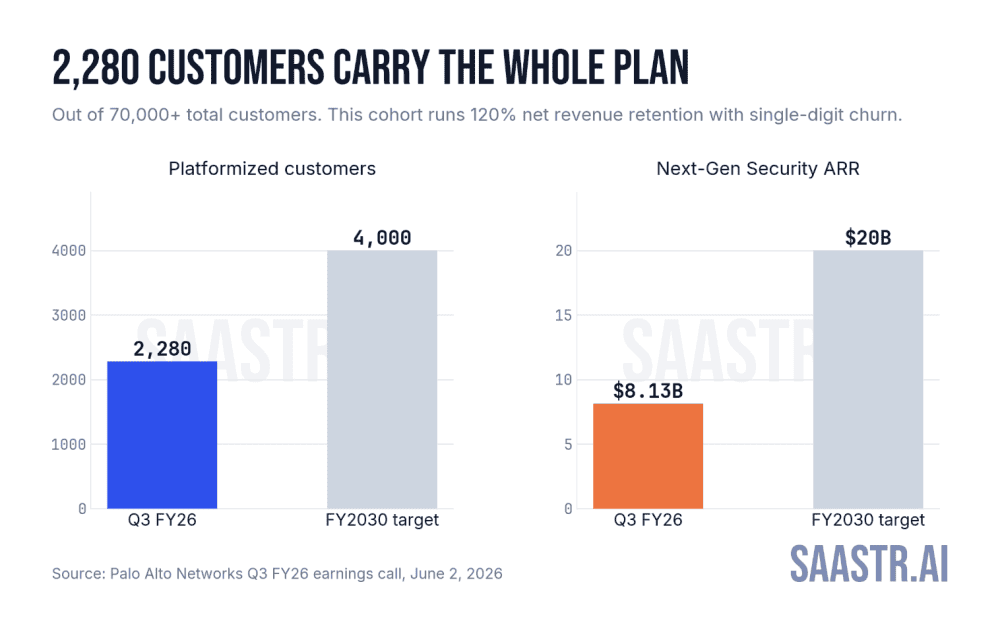
The proof is in the retention math. Roughly 2,280 customers have "platformized," meaning they buy across multiple pillars. Those customers show 120% net revenue retention. That is not just low churn. That is meaningful expansion revenue inside existing accounts.
For comparison, most vertical SaaS companies target 110-115% NRR as excellent. Hitting 120% at a $11.4 billion revenue base, with enterprise security buyers who are famously slow to expand, is a signal that the platform thesis is landing.
3. AI is a tailwind for security, not a threat
Most software categories face a hard question right now: does AI compress your value? Security is getting the opposite question.
The mechanics are concrete. Agents create far more traffic to inspect. A single conversational AI prompt generates one request and one response. An autonomous agent completing a workflow triggers hundreds of machine-to-machine calls. That is why Palo Alto's "declining" hardware line just had its best quarter in ten years.
Attacks got faster than humans can respond. Palo Alto's Unit 42 researchers simulated a full ransomware campaign, from initial entry to data exfiltration, in 25 minutes. The typical enterprise still takes days to identify a breach. You cannot close a days-to-minutes gap by hiring analysts. You close it with an automated platform.
Every agent is a new identity. Enterprise identity used to mean securing a few hundred privileged human administrators. Autonomous agents with credentials multiply that by orders of magnitude. That is the entire strategic logic of paying $25 billion for CyberArk.
“AI increases the number of things to protect, the speed at which they must be protected, and the volume of data produced in protecting them.”
— SaaStr analysis of Palo Alto's Q3 FY26 results
Logicity's Take
Palo Alto is building for a world where every company runs dozens of AI agents with production credentials. That is not a security upsell. It is a new category. If you are a SaaS founder whose product touches customer data, the question is not whether you need better identity management. It is whether you are pricing for the audit and compliance overhead that enterprise buyers will soon demand. Watch what happens to SOC2 certification costs over the next 18 months.
4. The Q3 FY26 numbers at a glance
For the quarter ended April 30, 2026, reported in June:
- Revenue: $3.0B, up 31% year-over-year
- FY26 revenue guide: $11.42B, up 24%
- Next-Gen Security ARR: $8.13B, up 60% (28% organic)
- RPO (remaining performance obligations): $18.4B, up 36% (22% organic)
- Adjusted free cash flow margin: 38.5% trailing twelve months
- Platformized customers: ~2,280 at 120% net revenue retention
- Total customers: 70,000+
- Employees: ~16,000
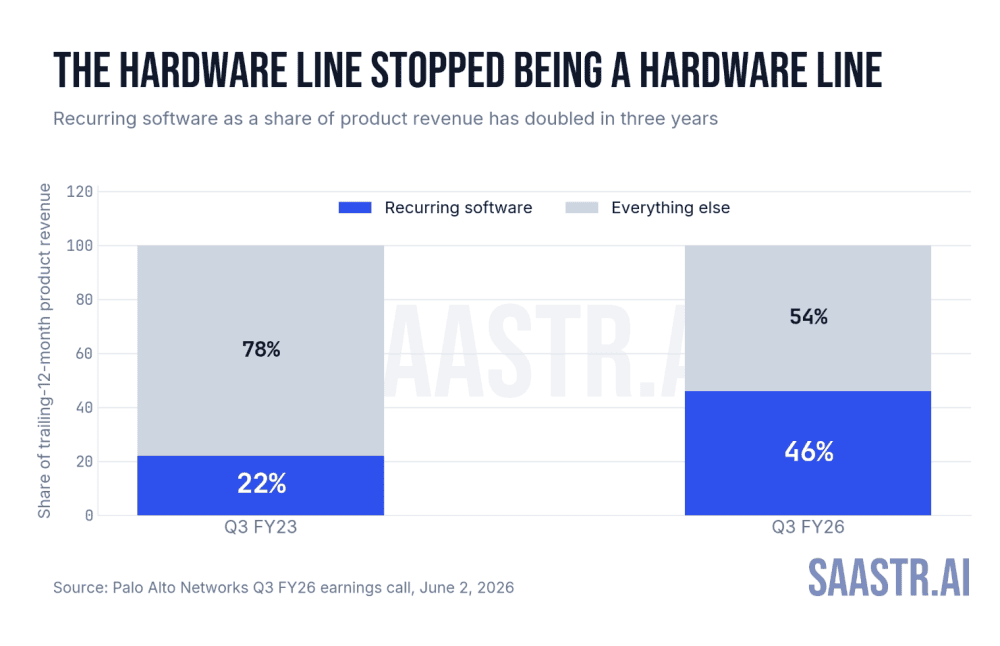
Hardware is now only about 10% of revenue. The rest is subscription and support. That mix is why the company trades at a software multiple, not a hardware one.
5. $29 billion in acquisitions reshaped the company
Palo Alto spent approximately $29 billion on acquisitions over twelve months. The two largest deals: CyberArk for $25 billion (closed February 2026) and Chronosphere for $3.35 billion (closed January 2026).
CyberArk brings privileged access management, controlling and auditing who, or what, is allowed to touch critical systems. Chronosphere brings observability, monitoring whether infrastructure is healthy at AI-era data volumes. Together, they complete the platform vision.
The cost was real: a GAAP loss, 14% dilution, and months of stock pain. But Palo Alto now offers a unified security platform that most competitors cannot match without their own acquisition spree.
What founders should take from this
Palo Alto's playbook has three moves that apply beyond security.
First, platform beats point solution at scale. The 120% NRR among platformized customers is not an accident. Once a buyer consolidates vendors, switching costs compound. If you are building a product that could become a platform, think about the second and third modules now.
Second, M&A can work if the core business keeps accelerating. Palo Alto survived its stock collapse because organic growth stayed at 28%. If the base had slowed, no acquisition strategy would have saved the narrative.
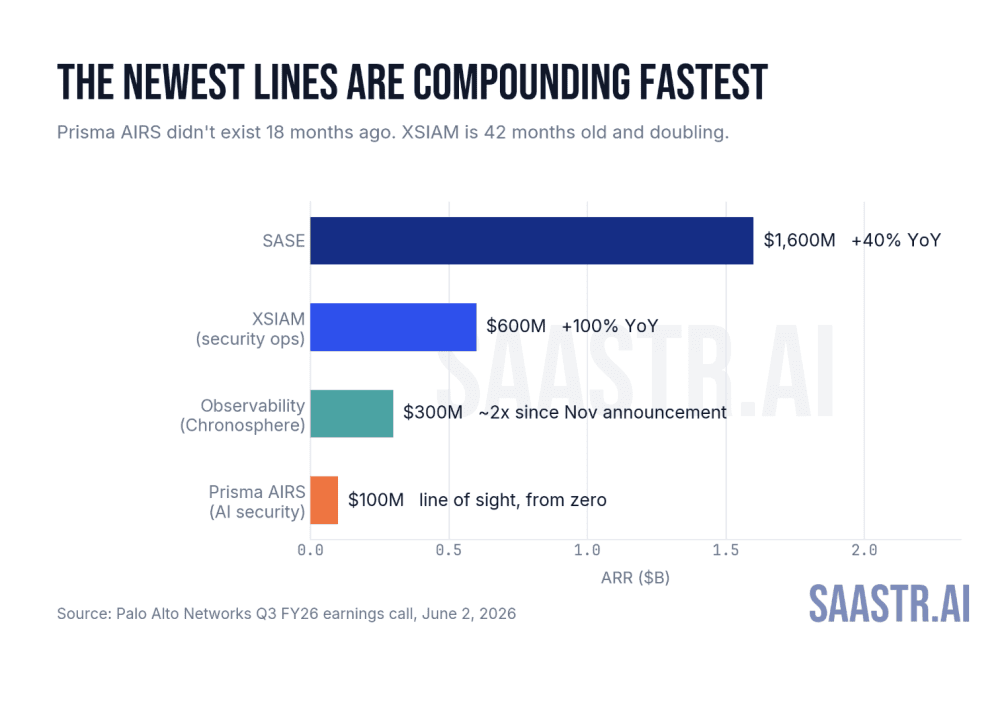
Third, AI is creating new categories faster than it is destroying old ones. The fastest-growing product in company history, Prisma AIRS, did not exist eighteen months ago. It secures AI applications and agents, a market that barely had a name in 2024.
The question for any SaaS founder: are you building where AI creates new surface area, or where it compresses existing value? Palo Alto bet correctly. The stock says so.
Shows how AI vendors are monetizing enterprise features, relevant to the agent-driven security demand Palo Alto is capitalizing on
Need Help Implementing This?
If you're a SaaS founder thinking about platform strategy, M&A timing, or how AI reshapes your product category, drop us a note. Logicity covers these transitions in depth and connects readers with operators who've navigated them.
Source: SaaStrAI
Huma Shazia
Senior AI & Tech Writer
Produced with AI assistance and reviewed by the Logicity editorial team. Learn more in our Editorial Policy.