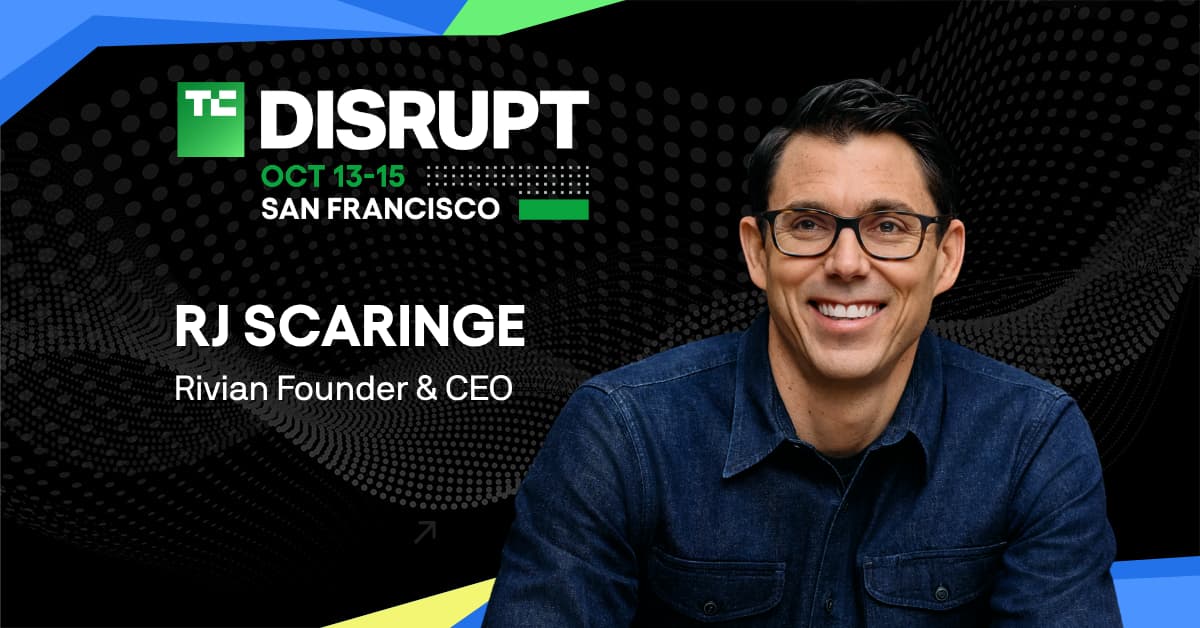
Rivian CEO RJ Scaringe will take the Disrupt Stage in October to explain how the company's push into lower-cost EVs, Level 4 autonomy, and humanoid robotics all connect. TechCrunch announced the session today, positioning Scaringe as a speaker who can articulate what it takes to build AI into physical products rather than the other way around.
The timing matters. Rivian has begun rolling out the R2, a roughly $58,000 SUV that Scaringe calls "maybe the most important thing we've launched to date." The company needs a hit. Its earlier R1T and R1S trucks sold well to early adopters but never broke out of the premium niche. Cheaper Chinese EVs are eating into the broader market, and demand for expensive electrics has softened.
Three bets running in parallel
Scaringe isn't just running a car company. He's placed three simultaneous wagers that each demand capital, talent, and operational focus.
First, the R2 must prove Rivian can compete on price without gutting margins. At $58,000, it undercuts the R1 line but still sits above mass-market EVs from legacy automakers. Second, Rivian has laid out a roadmap to full Level 4 autonomy by 2028, a target that puts it in direct competition with Tesla's FSD ambitions and Waymo's robotaxi fleet. Third, Scaringe founded Mind Robotics, a humanoid robotics startup that has raised $900 million in 2026 alone. Rivian is both a large shareholder and the launch customer, planning to deploy robots on its factory floor in Normal, Illinois.
Scaringe is also building out Rivian's own charging network with plans to make it one of the largest in the U.S. That's four capital-intensive initiatives for a company that, while publicly traded, has never posted consistent profitability.
Why robots on the factory floor?
The Mind Robotics play reflects a specific thesis: that automakers will face a structural labor shortage, and whoever solves human-robot collaboration on assembly lines first gains a durable advantage. Scaringe wants Rivian's Normal facility to become a proving ground for that coexistence.
It's an unusual move for a CEO already running a publicly traded automaker. Scaringe serves as executive chair and acting CEO of Mind Robotics while leading Rivian. The $900 million raise suggests investors see enough potential to fund that juggling act.
What Disrupt attendees will hear
TechCrunch is billing Scaringe's session as a breakdown of how physical-world manufacturing and AI development interact. Most AI companies start with software and try to move into hardware. Scaringe started with trucks and is layering AI on top. That inversion creates different constraints: supply chains, factory logistics, and regulatory approvals that software startups never face.
Disrupt 2026 runs October 13-15 at San Francisco's Moscone Center. Ticket prices increase on August 22.
Context on where Rivian-adjacent robotics funding fits in the broader capital picture
Logicity's Take
Scaringe is betting that vertical integration across EVs, autonomy, charging, and robotics creates compounding advantages. The risk is obvious: each initiative could drain focus and capital from the others. For CTOs watching the EV space, the real question is whether Rivian's software and autonomy stack can catch Tesla's head start before the R2 needs to carry the company's margins alone.
The competitive pressure Scaringe won't escape
Chinese EV makers like BYD and Nio are shipping capable vehicles at price points Rivian can't match. Tesla continues to dominate U.S. EV sales despite political noise around its CEO. Legacy automakers are finally shipping credible electric options. Rivian's pitch has always been adventure-vehicle identity and software polish, but those differentiators erode when competitors improve and prices compress.
Scaringe's Disrupt appearance is partly a recruiting and investor-relations exercise. Showing up at a tech conference signals that Rivian sees itself as a technology company that happens to make cars, not a car company bolting on software. Whether that framing holds depends on execution over the next two years.
Need Help Implementing This?
Logicity can connect you with consultants specializing in EV infrastructure, autonomy systems, and robotics integration. Reach out at consulting@logicity.in.
Source: TechCrunch / TechCrunch Events
Manaal Khan
Tech & Innovation Writer
Produced with AI assistance and reviewed by the Logicity editorial team. Learn more in our Editorial Policy.