Key Takeaways
How to Use Google Gemini Al (Full Tutorial)

- Gemini now charges by compute intensity, not request count. Complex prompts burn credits faster.
- Four paid tiers: AI Plus ($8/mo), AI Pro ($20/mo), AI Ultra ($100 or $200/mo) with 2x, 4x, and 5-20x the free limits.
- Usage resets on two cycles: every five hours for burst limits, every week for the cap.
Google has overhauled how it meters Gemini AI. Instead of counting requests, the system now tracks compute intensity. A simple weather query costs less than a code-generation prompt or a video render. The change makes billing more efficient for Google but leaves users guessing when they'll hit their ceiling.

Why Google switched to compute-based credits
The old model was blunt: X image generations per day, Y prompts per hour. That ignored the reality that generating a two-minute video eats far more GPU cycles than summarizing an email. Under the new system, each request drains a variable amount of credit based on the model you select, the thinking depth you choose, and the length and complexity of your prompt.
Google's support docs are candid about the tradeoff. Limits are 'subject to change or may be limited based on testing, experimentation or availability.' Translation: on busy days, you might hit walls earlier. Free users sit first in line for throttling.
The four paid tiers and what they include
Google offers three subscriptions in the US, stacked on top of a free tier:
- AI Plus ($8/month): 2× the free limits.
- AI Pro ($20/month): 4× the free limits.
- AI Ultra ($100 or $200/month): 5× or 20× the AI Pro limits, depending on which Ultra plan you pick.
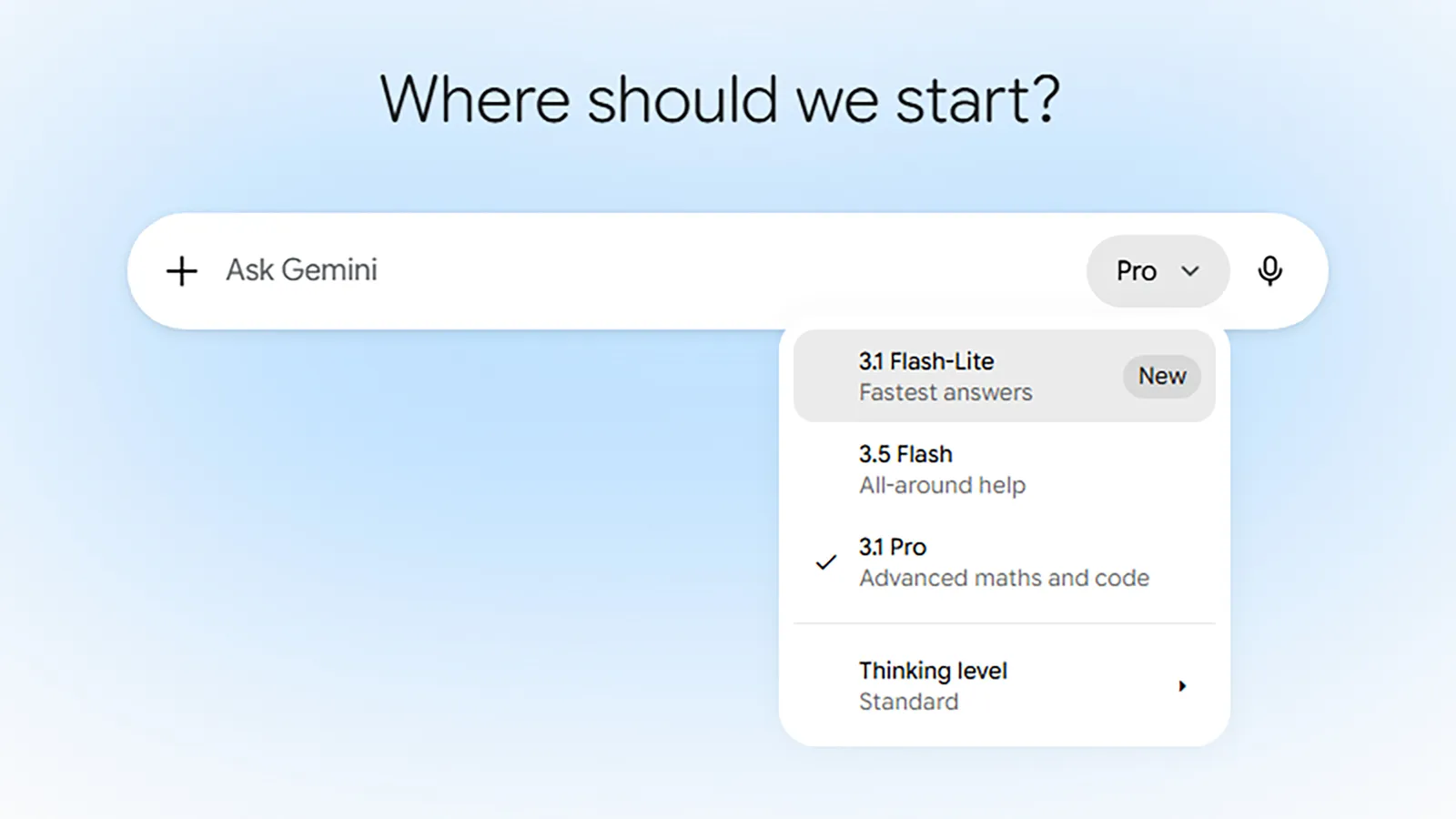
All tiers unlock every Gemini model: Flash-Lite, Flash, and Pro. Higher models are smarter but drain credits faster. Each model also offers three thinking modes: Standard, Extended, and Deep Think. Extended and Deep Think produce more nuanced answers at the cost of speed and usage budget.
Context windows by tier
Context window size determines how much text Gemini can hold in memory during a single conversation. Here's the breakdown:
| Tier | Context Window | Approx. Word Count |
|---|---|---|
| Free | 32K tokens | ~24,000 words |
| AI Plus | 128K tokens | ~96,000 words |
| AI Pro / Ultra | 1M tokens | ~750,000 words |
For builders shipping agentic workflows or long-document analysis, that jump from 32K to 1M tokens is the headline feature. It's what separates a toy demo from a production system.

How to check your Gemini usage
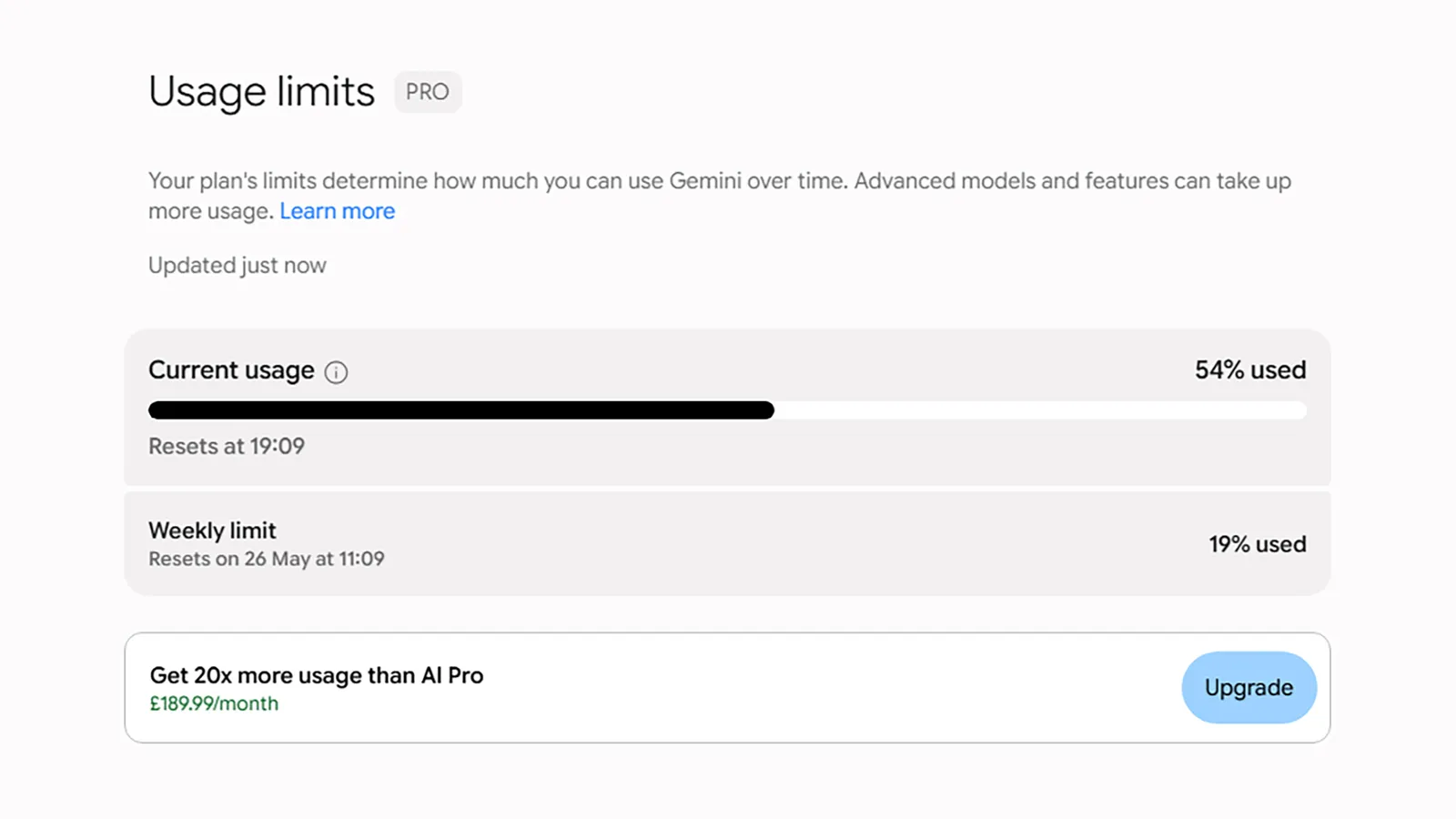
Google at least makes monitoring easy. On the web app, click the cog icon in the lower left and select Usage limits. On Android or iOS, tap the menu button, then the cog, then Usage limits.
You'll see two progress bars. The first tracks your rolling five-hour quota. If you burn through it, you wait until the next reset. The second bar shows your weekly cap. Exhaust that on a paid plan and you're demoted to the most basic model until the week rolls over.
What this means for teams building on Gemini
If you're prototyping on the free tier and suddenly hitting walls, the new credit math is probably the culprit. A workflow that ran fine last month might now stall because it involves heavier prompts or more video calls. Budget accordingly: for any production use, AI Pro or Ultra is the realistic floor.
The opacity is the real problem. Google publishes multipliers but not absolute numbers. You can't plan a sprint when you don't know your actual capacity. Competitors like OpenAI publish explicit rate limits for API tiers. Google's consumer-first framing doesn't translate well to engineering estimates.
Logicity's Take
Google's shift to compute-based billing mirrors how cloud providers charge for GPU instances: pay for what you use, not what you request. That's fair in principle, but the vagueness undermines planning. Teams comparing Gemini to OpenAI's ChatGPT Pro ($20/month) or Claude Pro ($20/month) should test actual workloads before committing. At $200/month, Gemini Ultra competes with OpenAI's ChatGPT Pro ($200/month) for power users, but Google's unclear limits make apples-to-apples comparisons impossible. If you're orchestrating prompts with tools like [Zapier](https://logicity.in/r/zapier), [Make](https://logicity.in/r/make), or [n8n](https://logicity.in/r/n8n), build in fallback logic for throttled responses.
Disclosure
Some links in this post are affiliate links — Logicity earns a commission if you sign up, at no extra cost to you. We only link products we have used or actively recommend.
Frequently Asked Questions
How does Google Gemini's new credit system work?
Gemini now measures usage by compute intensity, not request count. Complex prompts, video generation, and advanced models consume more credits than simple text queries.
What are the Gemini subscription tiers and prices?
Google offers AI Plus at $8/month, AI Pro at $20/month, and AI Ultra at $100 or $200/month. Each tier multiplies the free tier's limits by 2×, 4×, or 5-20× respectively.
How often do Gemini usage limits reset?
There are two resets: a burst limit that refreshes every five hours and a weekly cap. Both are visible in the Usage limits section of the Gemini app.
What happens when I hit my Gemini usage limit?
Paid users get demoted to the most basic AI model until the next reset. Free users may face longer waits or stricter throttling during high-demand periods.
What is Gemini's context window size by tier?
Free users get 32K tokens (~24,000 words). AI Plus gets 128K tokens. AI Pro and Ultra users get 1 million tokens, roughly 750,000 words per conversation thread.
Another AI lab navigating scale and pricing as usage explodes.
Need Help Implementing This?
Planning AI workflows around rate limits? Logicity's team advises startups on model selection, cost optimization, and fallback architectures. Reach out at logicity.in/contact.
Source: Feed: Artificial Intelligence Latest / David Nield
Huma Shazia
Senior AI & Tech Writer
Produced with AI assistance and reviewed by the Logicity editorial team. Learn more in our Editorial Policy.