Key Takeaways
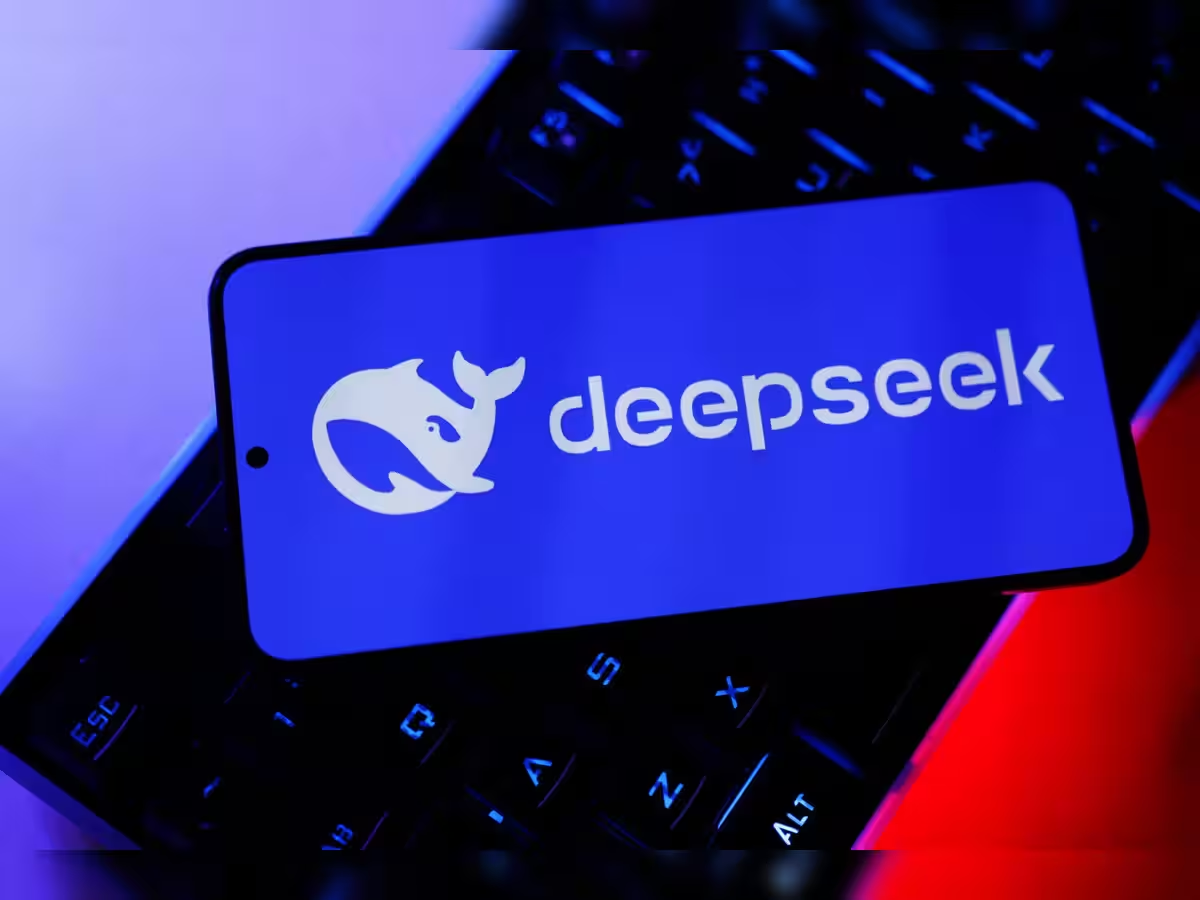
- DeepSeek targets a $74 billion valuation for its next funding round, up from $52 billion just weeks ago
- The company aims to file for a Shanghai STAR Market IPO by year-end, keeping equity within China's financial system
- Rising AI costs and domestic competition from ByteDance, Alibaba, and well-funded startups forced DeepSeek to abandon its no-outside-funding policy
DeepSeek, the Chinese AI startup that rattled global tech markets in January with its low-cost models rivaling OpenAI, is preparing to raise fresh capital at a valuation of roughly $74 billion. The company has also begun early work on a Shanghai STAR Market IPO, with an internal target to file by year-end, according to Reuters sources.
The timing is aggressive. DeepSeek closed a $7.4 billion round in June at a post-money valuation of about 450 billion yuan. Chinese investor filings later pegged the company at 350.88 billion yuan, or around $52 billion. Now it's targeting 500 billion yuan for the next round, a 42% jump in weeks.
Why is DeepSeek raising again so quickly?
The answer is straightforward: staying at the frontier of AI is expensive. DeepSeek made headlines by training competitive models at a fraction of US costs, but that efficiency edge only delays the capital requirements. It doesn't eliminate them.
The company plans to double headcount across departments, including data centers and AI agents. Reuters reported earlier this month that DeepSeek is developing its own AI inference chip and quietly hiring chip-design engineers. These are billion-dollar initiatives.
Competition at home has intensified. ByteDance and Alibaba are pouring resources into AI. Well-funded startups like Z.ai, Moonshot, and MiniMax are fighting for the same talent pool and compute capacity. DeepSeek founder Liang Wenfeng, who bankrolled the company through his quantitative hedge fund High-Flyer, has apparently concluded that self-funding won't be enough.
Who's backing the company?
The June round revealed DeepSeek's investor base. Liang himself committed 20 billion yuan. Tencent put in 10 billion yuan; battery giant CATL contributed 5 billion yuan, making them the largest external shareholders. Other investors include China's national AI fund, NetEase, JD.com, IDG Capital, Loyal Valley Capital, Monolith Management, and Shixiang Capital.
The state-backed AI fund's participation signals Beijing's strategic interest. DeepSeek is a domestic champion Beijing wants to succeed, particularly as US chip export controls tighten.
What does a STAR Market IPO mean?
A Shanghai STAR Market listing keeps DeepSeek's equity within China's financial system. Unlike a Hong Kong or US listing, a mainland IPO restricts foreign ownership and aligns the company more closely with Chinese government priorities.
For international investors hoping to buy into China's leading AI play, this is a barrier. For Beijing, it's a feature. The STAR Market, often called China's Nasdaq, was designed specifically to fund strategic technology companies.
The IPO timeline is ambitious. Filing by year-end means DeepSeek would need to finalize audited financials, undergo regulatory review, and lock down its cap table within months. Plans at this stage are preliminary, and Reuters sources caution that terms and timing may shift.
How did DeepSeek get here?
DeepSeek burst onto the global stage in January 2025 when it released its R1 reasoning model. The model matched or exceeded OpenAI's o1 performance at a reported training cost of $5.6 million, a fraction of the hundreds of millions US labs spend. The release briefly wiped nearly $1 trillion from US tech stocks and forced a reassessment of the AI race.
The company achieved this using a Mixture-of-Experts architecture and efficient training methods that worked around US chip export restrictions. DeepSeek-V3, its flagship model, runs 671 billion parameters.
Marc Andreessen called it "AI's Sputnik moment." Yann LeCun, Meta's AI chief, publicly discussed DeepSeek's technical approach. The company went from obscure Hangzhou startup to global talking point in weeks.
What's the risk?
DeepSeek's valuation trajectory assumes continued technical leadership and successful execution on chips, hiring, and data center expansion. Any of these could stall.
Geopolitical risk is the other factor. Tighter US export controls could constrain DeepSeek's access to advanced semiconductors. The company has shown ingenuity in working around current restrictions, but future rules are unpredictable.
A $74 billion valuation prices in a lot of optimism. Investors in the next round are betting DeepSeek can outrun both domestic competitors and US export policy.
Logicity's Take
DeepSeek's back-to-back fundraises suggest the "low-cost AI" narrative has limits. Efficiency gains delay the capital crunch; they don't eliminate it. The STAR Market IPO choice is equally telling. DeepSeek is building for a future where Chinese AI operates largely within Chinese capital markets and under Chinese regulatory oversight. For tech leaders watching the AI supply chain, this is another data point: the industry is bifurcating. Western enterprises should expect that DeepSeek models, however capable, will come with geopolitical strings attached.
Frequently Asked Questions
What is DeepSeek's current valuation?
DeepSeek is targeting a valuation of 500 billion yuan (approximately $74 billion) for its upcoming funding round, up from a reported $52 billion valuation in its June 2025 round.
When will DeepSeek IPO?
DeepSeek has set an internal target to file for a Shanghai STAR Market IPO by the end of 2025, though plans are preliminary and timing may change.
Who are DeepSeek's largest investors?
Founder Liang Wenfeng is the largest investor with a 20 billion yuan personal commitment. Tencent and CATL are the largest external shareholders, having invested 10 billion yuan and 5 billion yuan respectively.
How much has DeepSeek raised in total?
DeepSeek raised approximately $7.4 billion in its June 2025 funding round. The company is now seeking to raise up to 50 billion yuan (about $7.4 billion) in a new round.
Why is DeepSeek raising money so quickly after its last round?
The company plans to double staff, expand data centers, build AI agents, and develop its own inference chips. These capital-intensive initiatives, combined with intense domestic competition, require significant funding.
For context on how Western AI leaders are approaching governance as Chinese competitors scale
Need Help Implementing This?
Tracking AI developments across US and Chinese ecosystems is a full-time job. Reach out to the Logicity research team for briefings on how the bifurcating AI landscape affects your technology stack and vendor strategy.
Source: Tech-Economic Times / ET
Huma Shazia
Senior AI & Tech Writer
Produced with AI assistance and reviewed by the Logicity editorial team. Learn more in our Editorial Policy.