Key Takeaways
Scaling AI with Google Cloud's TPUs
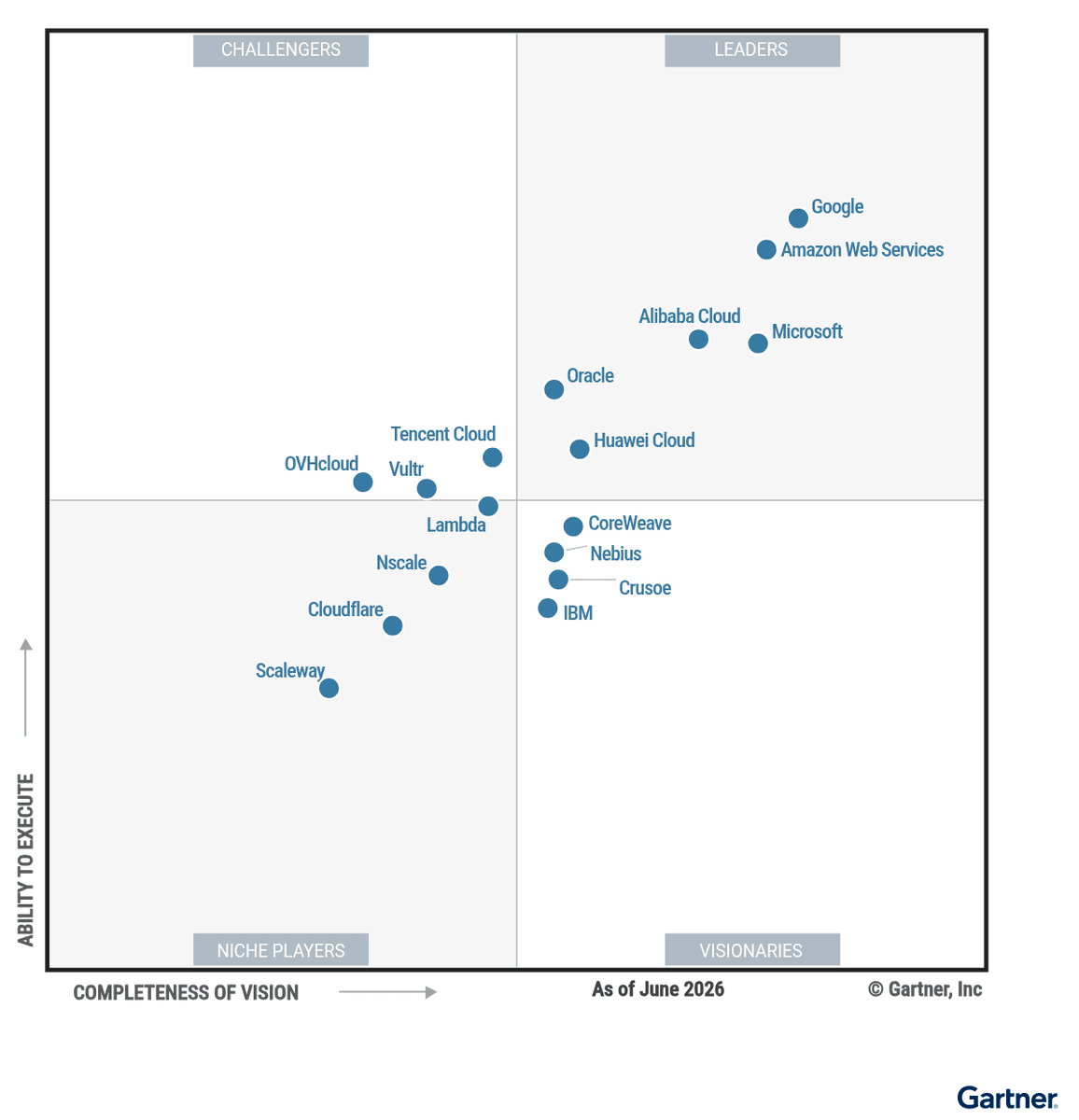
- Google Cloud placed highest for 'Ability to Execute' in Gartner's first AI Infrastructure Magic Quadrant
- New TPU 8t and TPU 8i chips deliver 3x compute and memory gains over previous generation
- Google Cloud Managed Lustre now delivers 10 TB/s bandwidth, claiming 20x faster speeds than competing hyperscalers
Google Cloud secured the top position for execution capability in Gartner's inaugural Magic Quadrant for AI Infrastructure, released July 9, 2026. The analyst firm also placed Google furthest right for completeness of vision, a double distinction that validates the company's decade-long bet on custom silicon and tightly integrated software.
The recognition matters because it arrives as enterprises struggle to run agentic AI workloads. Reasoning models that loop, plan, and act demand different infrastructure than chatbots that answer and exit. Google's pitch: we built that infrastructure for Gemini, YouTube, and Search internally, now you can rent it.
What's new in TPU 8t and TPU 8i?
Google announced two eighth-generation TPU variants earlier this year. TPU 8t targets training. A single superpod packs 9,600 chips and delivers nearly 3x the compute performance per pod compared to the seventh generation. That density shrinks training timelines for frontier models without proportionally inflating rack space or power.
TPU 8i targets inference, specifically the iterative, multi-step loops that agentic workloads require. It ships with 288 GB of high-bandwidth memory and 384 MB of on-chip SRAM, both 3x larger than before. The extra memory keeps a model's working set resident on silicon, avoiding off-chip fetches that stall real-time agents mid-reasoning.
Mark Lohmeyer, VP and GM of AI and Computing Infrastructure at Google Cloud, framed the goal plainly: "Companies who want to lead in this next phase of AI need computing infrastructure that's designed and optimized for these new requirements."
How does Google Cloud compare to NVIDIA-based alternatives?
Google isn't abandoning NVIDIA. The company confirmed it will be among the first to offer A5X instances on NVIDIA's upcoming Vera Rubin platform. But Google's argument is that TPUs let it control the full stack, from chip architecture to TensorFlow and JAX optimization, in ways that commodity GPU clusters can't match.
For teams committed to PyTorch, Google recently shipped TorchTPU. The project lets PyTorch code run on TPUs without major rewrites. It's a concession to reality: most ML teams standardized on PyTorch years ago, and asking them to port everything to JAX was a non-starter.
Google also contributes to open-source inference engines like vLLM and llm-d, signaling that it doesn't expect customers to adopt a fully proprietary stack. The hybrid strategy, own the silicon, share the software, mirrors what Apple does with Metal and Swift.
Storage and networking gains matter as much as accelerators
A cluster is only as fast as its slowest bottleneck. Gartner's report credited Google's AI Hypercomputer, which bundles compute, storage, and networking into a single managed system.
Google Cloud Managed Lustre now delivers 10 TB/s of bandwidth using new C4NX instances and Hyperdisk Exapools. Google claims that's up to 20x faster than competing hyperscalers. For training jobs that checkpoint frequently, faster storage means faster recovery from node failures, a common headache at scale.
Rapid Buckets, a new object storage tier, handles 20 million operations per second. The Virgo Network fabric can connect over one million TPUs across multiple data centers into a single training cluster, or up to 960,000 GPUs. Those numbers sound absurd until you remember that GPT-4 class models already train on tens of thousands of accelerators.
Who's already using this infrastructure?
Google says 9 out of 10 frontier AI labs run on its infrastructure. It named Citadel Securities and Mercedes-Benz as enterprise customers. The financial services use case makes sense: low-latency inference for trading models rewards exactly the kind of memory and compute density that TPU 8i provides.
Mercedes-Benz likely uses the stack for in-vehicle AI and manufacturing optimization. Neither customer provided on-the-record performance numbers, so take the name-drops as endorsements of partnership, not proof of superiority.
What does the Gartner ranking actually mean?
Gartner's Magic Quadrant plots vendors on two axes: ability to execute (vertical) and completeness of vision (horizontal). Leaders land in the upper-right. But placement reflects analyst judgment based on briefings, reference calls, and vendor documentation. It is not a benchmark.
The quadrant is new for AI infrastructure, so there's no historical baseline. AWS, Azure, and Oracle almost certainly appear somewhere on the chart, but Google's blog post doesn't name competitors. If you're evaluating platforms, read the full Gartner report and run your own workload tests.
Logicity's Take
For engineering leaders, the real question isn't who Gartner crowned. It's whether TPU lock-in is acceptable for your workloads. Google's TorchTPU and open-source inference contributions reduce switching costs, but your trained models still deploy fastest on the hardware they were optimized for. If you're evaluating multi-cloud strategies, consider that AWS Trainium and Azure Maia custom silicon will compete directly by 2027. Price transparency remains murky across all three, so negotiate hard and demand per-token or per-FLOP cost breakdowns before committing capacity reservations.
Frequently Asked Questions
What is the Gartner Magic Quadrant for AI Infrastructure?
It's an analyst report evaluating cloud and on-premises platforms that deliver compute, storage, and networking optimized for AI training and inference. The 2026 edition is the first time Gartner published this specific quadrant.
How does TPU 8 compare to NVIDIA H100?
Google claims 3x memory and compute gains over its previous TPU generation, but direct TPU-to-H100 benchmarks depend on workload. TPU 8i's 288 GB HBM targets inference memory walls; H100 offers 80 GB HBM3 but broader software ecosystem support.
Can I run PyTorch on Google TPUs?
Yes. TorchTPU lets PyTorch code execute on TPUs without major rewrites, though JAX remains Google's native framework for maximum performance.
Which frontier AI labs use Google Cloud?
Google claims 9 out of 10 frontier labs use its infrastructure but does not name them publicly. Anthropic, DeepMind (internal), and Cohere have disclosed Google Cloud partnerships.
Is Google Cloud cheaper than AWS or Azure for AI workloads?
Pricing varies by region, commitment length, and accelerator type. Google's AI Hypercomputer bundles storage and networking, which can lower total cost if those components were previously separate line items. Always request custom quotes.
Need Help Implementing This?
If you're planning a large-scale AI infrastructure deployment, Logicity works with architecture consultants who specialize in multi-cloud and hybrid accelerator strategies. Reach out to our team for introductions.
Source: Cloud Blog
Manaal Khan
Tech & Innovation Writer
Produced with AI assistance and reviewed by the Logicity editorial team. Learn more in our Editorial Policy.