Google shipped Gemini 3.7 Flash on August 13, pricing the model at $0.75 per million input tokens and $3.75 per million output tokens. That is half what Gemini 3.6 Flash cost at launch three weeks ago. The company claims 3.7 Flash now beats Claude Sonnet 5 and GPT-5.6 Terra on coding benchmarks, making it one of the most aggressive price-performance moves in the API market this year.

What the benchmarks show
Gemini 3.7 Flash Explained in 5 Minutes - Benchmarks , Cost, First Impressions
Google points to two coding benchmarks to back its performance claims. On FrontierCode, 3.7 Flash scores 43.6%, up from 34.4% on the previous version. On DeepSWE, it hits 65.3% versus 49.0%. According to Google's own measurements, those numbers put the model ahead of both Claude Sonnet 5 and OpenAI's GPT-5.6 Terra.
The company also reports gains in web development, document comprehension, and business process automation, though it did not publish specific figures for those categories.
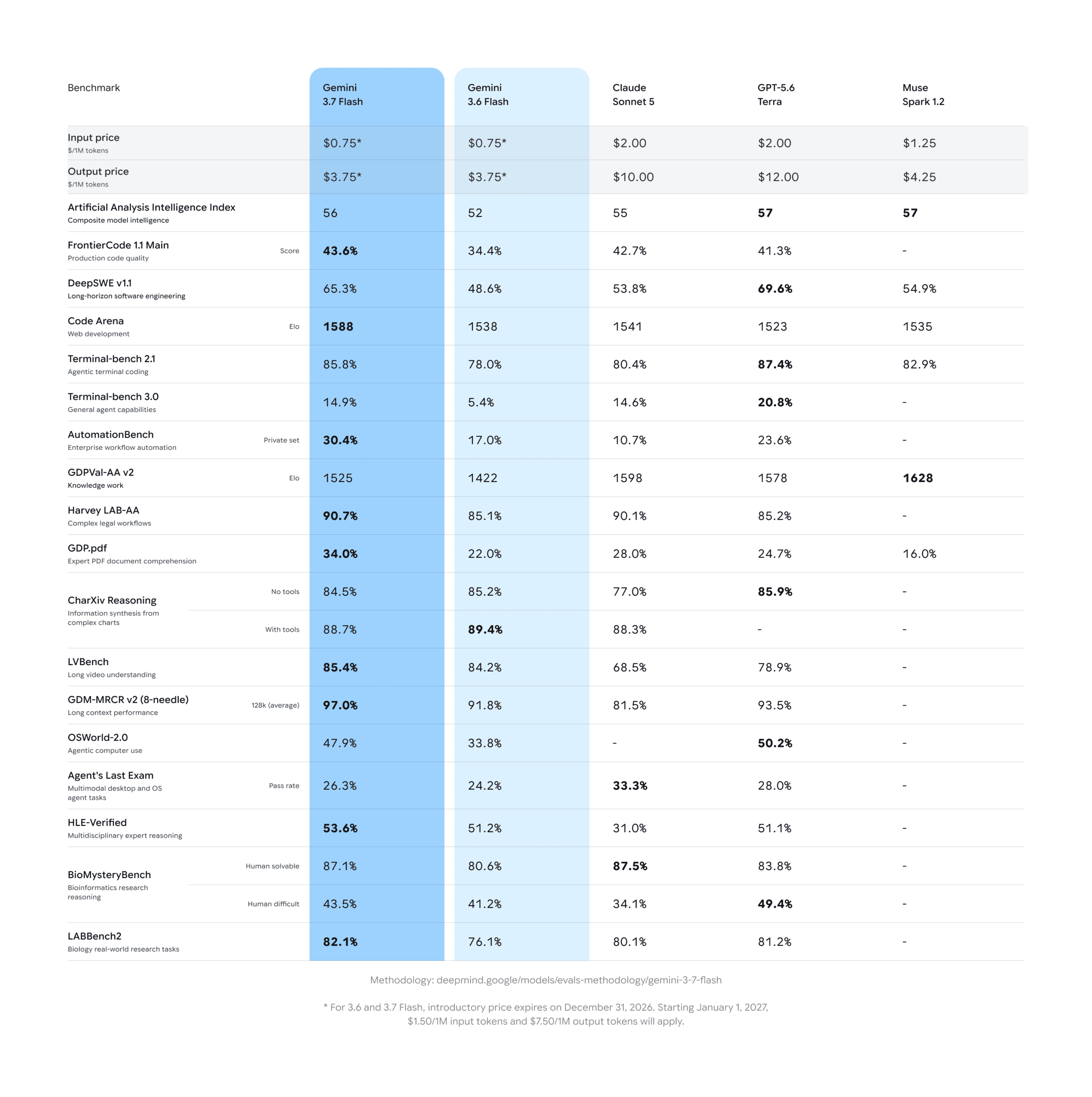
A caveat: these are Google's benchmarks on Google's model. Independent evaluations have not yet appeared. The claim that 3.7 Flash beats Anthropic and OpenAI's latest should be treated as a marketing assertion until third-party testing confirms it.
Where to access it
The model is available now through the Gemini API, AI Studio, and Antigravity. Google says the launch pricing holds through the end of the year, but the company's phrasing suggests both the price and the model lineup could shift after that. Three weeks between Flash releases is a fast cadence.
The pricing math for agent builders
For teams running AI agents or coding assistants at scale, the cost delta matters. At $0.75 per million input tokens, 3.7 Flash sits well below OpenAI's comparable tiers. A typical coding agent processing 10 million input tokens daily would pay roughly $225 per month on 3.7 Flash. The same workload on higher-priced alternatives runs into the thousands.
Google is clearly targeting high-volume, latency-sensitive use cases: agentic workflows, code generation pipelines, and document processing at scale. The "workhorse" framing is intentional. This is not positioned as the smartest model in the lineup, but as the one you can afford to call thousands of times per minute.
Earlier coverage of the pricing strategy behind this release
Logicity's Take
The real story is not the benchmark scores. It is the velocity. Google shipped a major Flash revision in three weeks, matching Anthropic's recent pace with Claude updates. For teams building production systems, this creates a planning problem: which model do you optimize for when the lineup changes monthly? The safe move is to abstract your model calls behind a switching layer and treat specific versions as disposable. The price war benefits buyers, but only if you are not locked into last month's winner.
What Google did not say
The release mentions "awesome algorithmic improvements" without detail. Google did not disclose whether the model uses a new architecture, different training data, or simply better optimization. The company also did not address context window size, rate limits at the new price tier, or how long 3.6 Flash will remain available.
If the pattern holds, 3.6 Flash may quietly disappear once 3.7 gains traction. Teams with production dependencies on 3.6 should test 3.7 compatibility now rather than scrambling later.
Anthropic's parallel move on developer tooling
Need Help Implementing This?
If your team is evaluating Gemini 3.7 Flash for production workloads or needs help building model-switching infrastructure, reach out to Logicity's consulting partners for implementation support.
Source: The Decoder / Matthias Bastian
Manaal Khan
Tech & Innovation Writer
Produced with AI assistance and reviewed by the Logicity editorial team. Learn more in our Editorial Policy.