Anthropic has been running Claude Code on daily maintenance tasks across its own software for several weeks, generating 388 pull requests with 180 merged after human review. That's a 46 percent merge rate on real production code, including iOS, Android, desktop, web, CLI, and the Agent SDK.

Boris Cherny, the Anthropic engineer who created Claude Code, described the results as "surprisingly positive" in a LinkedIn post. The setup runs through a dedicated Slack channel called "proj-claude-maintains-apps" and executes 12 specialized routines daily.
What does Claude Code actually maintain?
Testing The New Claude Code Rate Limits
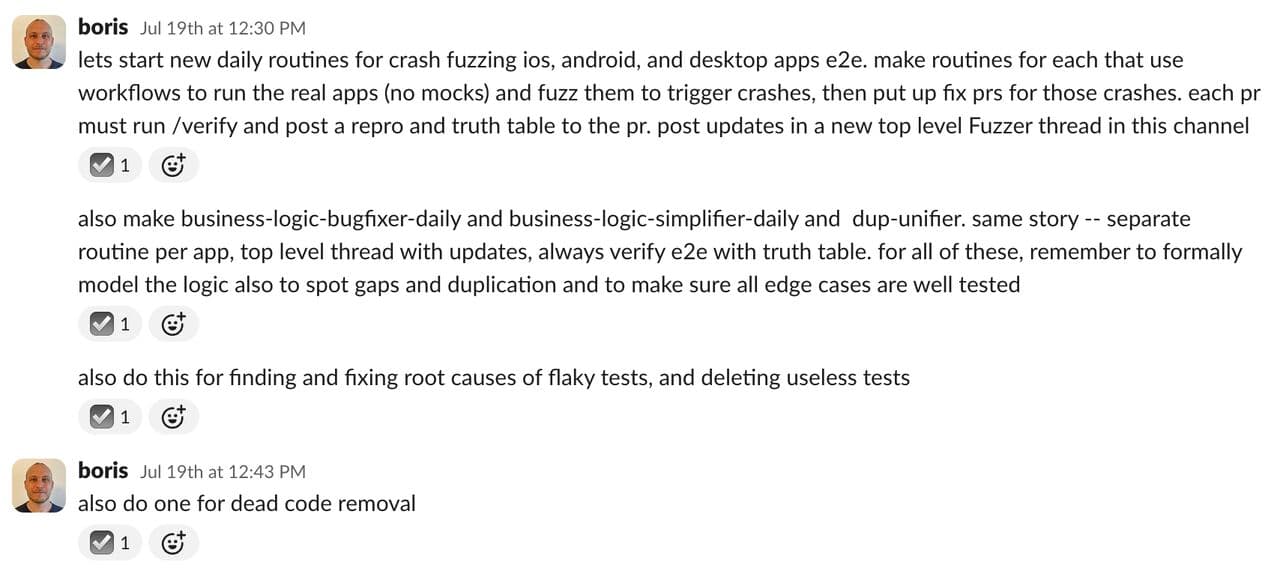
The 12 routines cover everything from crash detection to architecture enforcement. A "Crash Fuzzer" opens apps in a simulator, taps around randomly to trigger crashes, analyzes root causes, and creates fixes. The "Dup Unifier" scans for similar but slightly different abstractions and proposes merging them. A "Dead-Code Remover" strips out statically unreachable code, but first adds logging to suspicious sections so it can verify the next day whether the code is actually unused.
Other routines include a "Logic Bug Fixer" that models complex logic to find errors, a "Flaky-Test Fixer" that analyzes and repairs unstable CI tests, and an "Abstraction Police" that catches layer violations in the architecture. The "Shipped-Feature Inliner" removes feature flags for features that have fully rolled out.
Cherny shared some of his prompts, and there's no elaborate prompt engineering involved. He tells Claude in plain language to start daily routines for crash fuzzing on iOS, Android, and desktop, to use real apps without mocks, to trigger crashes, and to create pull requests with fixes.
How the review process works
Pull requests go through a combination of automated Claude Code review and human review before merging. Claude usually gets the pull requests right on the first try, according to Cherny. When it doesn't, the team tweaks the routine so the AI performs better the next day. That tuning sometimes takes a few days.
Anthropic is now looking at ways to speed up the merge process for these kinds of mechanical changes. The fact that more than half the auto-generated pull requests didn't make it through says something about both the limits and the potential of the approach.
What 46 percent actually means
A 46 percent merge rate sounds modest until you consider what's being attempted. These aren't simple formatting fixes or dependency bumps. The routines handle crash analysis, logic simplification, duplicate detection, and architecture enforcement across six different platforms. Each rejected PR represents a case where Claude identified something worth changing but proposed a fix that didn't meet the bar.
The 180 merged PRs over a few weeks represents real engineering time recaptured. If a human developer spent 30 minutes on each of these maintenance tasks, that's 90 hours of work. At the same time, someone still needs to review each PR, and the 208 rejected submissions consumed review bandwidth too.
Logicity's Take
This is Anthropic eating its own cooking, and the numbers are honest. A 46% merge rate on autonomous code changes to production apps is neither a home run nor a failure. It's evidence that AI code agents can handle a specific class of maintenance work, but still need human judgment on whether the fix is actually correct. Teams evaluating agentic coding tools should watch whether this rate improves as routines get tuned.
Details Anthropic's other recent Claude tooling expansion
Cherny describes the experiment as "early signs of life" that autonomous AI-powered app maintenance could work. The question now is whether the merge rate climbs as routines mature, or whether 46 percent represents a ceiling for this kind of unsupervised code generation.
Need Help Implementing This?
If you're exploring AI coding agents for your own maintenance workflows, contact us at hello@logicity.in for implementation guidance and vendor comparisons.
Source: The Decoder / Matthias Bastian
Manaal Khan
Tech & Innovation Writer
Produced with AI assistance and reviewed by the Logicity editorial team. Learn more in our Editorial Policy.