Key Takeaways
- DeepSeek jumped from 0.1% adoption to the top trending vendor on Ramp's platform in June 2026
- DeepSeek V4 costs 11.5x to 34.5x less than competing Western models like GPT-5.5
- Ramp's economist warns US companies are sending data through Chinese servers, raising security concerns
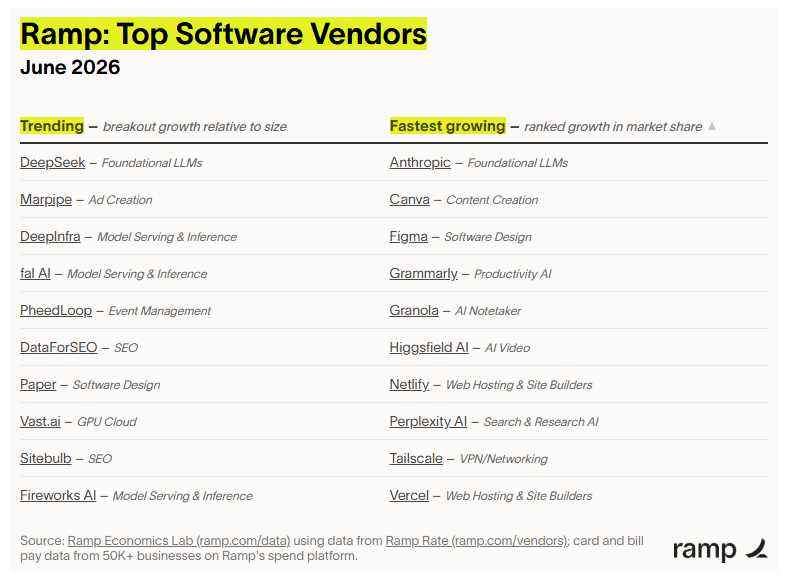
DeepSeek, the Chinese AI company that briefly captured attention in early 2025, is back. This time the traction looks more substantial. The company topped Ramp's list of fastest-trending software vendors in June 2026, based on transaction data from over 50,000 US companies.
Ramp's "trending" category tracks breakout growth relative to company size, not absolute spend. But the signal is clear: US businesses are paying DeepSeek directly and routing data through its platform. This isn't about self-hosted open-source usage. Companies are choosing a Chinese provider over Western alternatives.
“In probably the biggest sign that companies are looking for cheaper alternatives to OpenAI and Anthropic, some are willing to use cheaper, Chinese models, sending U.S. data back and forth from China-hosted servers.”
— Ara Kharazian, Lead Economist at Ramp
The Price Gap That's Driving the Shift
DeepSeek launched its V4 model at the end of April 2026. The model doesn't match top Western competitors in raw performance, but the pricing difference is dramatic. DeepSeek V4 Pro costs 11.5x to 34.5x less than GPT-5.5 for input and output tokens respectively.
That gap matters more now than it did a year ago. Model prices have climbed across all providers, and the era of heavily subsidized flat rates appears to be ending. Companies that previously absorbed AI costs without much scrutiny are now doing the math.
The performance gap is real but smaller than the price gap. For many workloads, especially high-volume tasks that don't require frontier-level reasoning, cheaper tokens win. In late May, DeepSeek made its promotional pricing permanent, accelerating the migration.

From 0.1% to Number One
DeepSeek's trajectory on the Ramp AI Index tells a volatile story. In January 2025, the company hit 0.3% adoption among US companies during a brief hype cycle. That quickly fell to 0.1%. The June 2026 surge represents a different kind of adoption, driven by cost awareness rather than novelty.
The broader trend supports this interpretation. A December 2025 report showed Chinese models like DeepSeek and Alibaba's Qwen passed US rivals in Hugging Face downloads for the first time, accounting for over 44% of all downloads of popular new models. Price-performance is winning.
The Security Question
Kharazian isn't convinced the trend will last. He warns about security and competitive risks of using Chinese models directly. When US companies route data through DeepSeek's platform, that data travels to and from China-hosted servers.
For non-sensitive, high-volume AI workloads, some enterprises are deciding the savings justify the risk. But the security calculation changes quickly when proprietary data or customer information enters the picture.
On Hacker News, technical users are debating whether DeepSeek's 671-billion-parameter Mixture-of-Experts architecture justifies the risks. Reddit's r/singularity community is benchmarking DeepSeek V4 Pro against top-tier US models, with developers noting high parity in coding tasks.
Signs of a Token Economy
DeepSeek's rise fits a larger pattern Kharazian calls the emerging "token economy." Companies are increasingly picking models based on price-to-performance ratios rather than brand loyalty or ecosystem lock-in.
Inference platforms like Fireworks AI, fal AI, and DeepInfra are growing too. These services let companies run open-source models without paying OpenAI or Anthropic directly. The infrastructure layer is commoditizing.
This shift comes as many companies struggle to measure AI's return on investment. When ROI is unclear, cost becomes the primary lever executives can control.
What the Data Doesn't Show
Ramp's data contradicts one popular narrative: the "SaaSpocalypse," the idea that AI will kill established software products. Design tools like Figma and Paper remain in demand despite the success of AI-native products like Anthropic's Claude, which recently launched its own design spinoff.
Western AI labs still lead by a wide margin in absolute spend. Anthropic topped Ramp's fastest-growing category in June, distinct from the trending category DeepSeek won. The market isn't zero-sum, at least not yet.
Logicity's Take
Frequently Asked Questions
Why are US companies choosing DeepSeek over OpenAI and Anthropic?
Price is the primary driver. DeepSeek V4 Pro costs 11.5x to 34.5x less than competing Western models. For high-volume, non-sensitive workloads, the cost savings outweigh performance differences.
What are the security risks of using DeepSeek?
When companies pay DeepSeek directly, their data travels through China-hosted servers. This raises concerns about data residency, government access, and competitive intelligence risks.
How does DeepSeek V4 compare to GPT-5.5 in performance?
DeepSeek V4 doesn't match top Western models in total performance, but the gap is smaller than the price difference. Developers report high parity in coding tasks specifically.
Is DeepSeek's growth sustainable?
Ramp's economist Ara Kharazian doubts the trend will last, citing security concerns. However, the broader shift toward price-conscious AI procurement appears durable.
What is Ramp's trending vendor category?
Ramp's trending category tracks breakout growth relative to company size, based on transaction data from over 50,000 US companies representing $100 billion in annual enterprise spend.
How another tech giant is integrating AI to improve user experience
Need Help Implementing This?
Source: The Decoder / Matthias Bastian
Manaal Khan
Tech & Innovation Writer
Produced with AI assistance and reviewed by the Logicity editorial team. Learn more in our Editorial Policy.