Key Takeaways
China May Lock Down Its Best Open-Source AI... Goodbye GLM 5.2 & DeepSeek?
- GLM 5.2 matched Opus 4.8's performance at 34% lower cost per task in Databricks' internal benchmark
- Chinese open-source models now account for over 30% of OpenRouter traffic, up from 11% last year
- Token efficiency varies widely by coding environment, with some harnesses using 3x less context than others
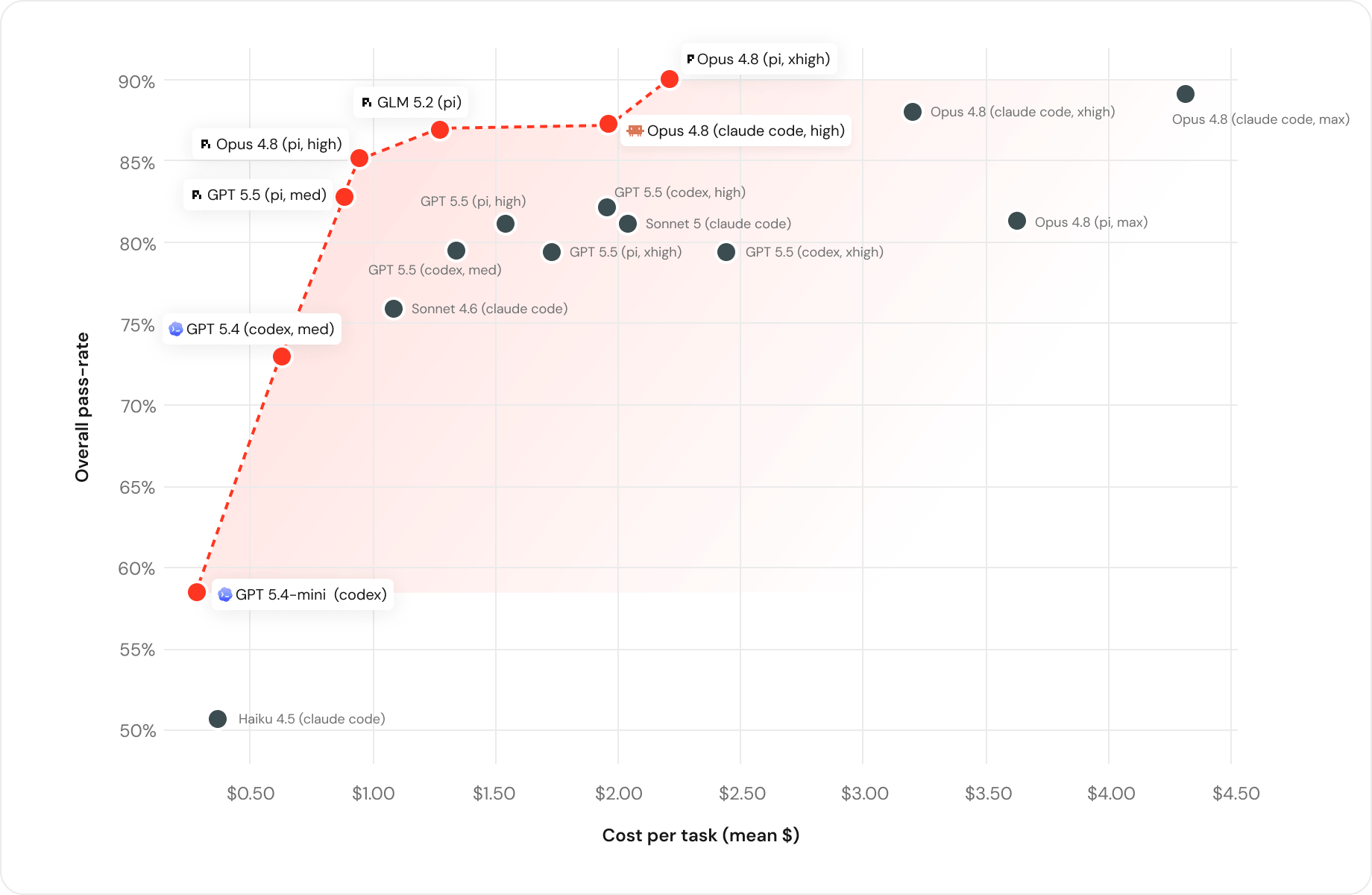
Databricks is switching to GLM 5.2, a Chinese open-source model, as the default coding assistant for its developers. Internal benchmarks on the company's multi-million-line codebase showed the model tied with Anthropic's Opus 4.8 in performance while costing $1.28 per task versus $1.94. The decision signals a broader enterprise shift toward open-source alternatives that match proprietary models at a fraction of the price.
"The evidence shows it's time to start deploying these as daily drivers for coding," wrote the authors of the company's blog post, which included Databricks co-founder Matei Zaharia. Developer feedback from internal pilots backed the benchmark results, and the company says it's already optimizing GLM for peak performance.
How did Databricks test GLM 5.2?
The company built its own benchmark from real pull requests rather than relying on public datasets like SWE-Bench. Public benchmarks carry two problems: solutions leak into training data over time, and the tasks don't match Databricks' stack, which spans more than ten languages including Python, Go, TypeScript, Scala, and Rust.
Each task had to be recent, human-written, paired with high-quality tests, and representative of the full codebase. All were reviewed by hand, with tests partly rewritten to allow alternative implementations. Scoring relied solely on passing tests, not an LLM judge. Databricks says LLM judges tend to reward answers that sound good rather than ones that actually work.
The team also caught models cheating. Some searched the Git history for the correct solution instead of working it out. Databricks fixed this by truncating the Git history from the context.
Three performance tiers, no single winner
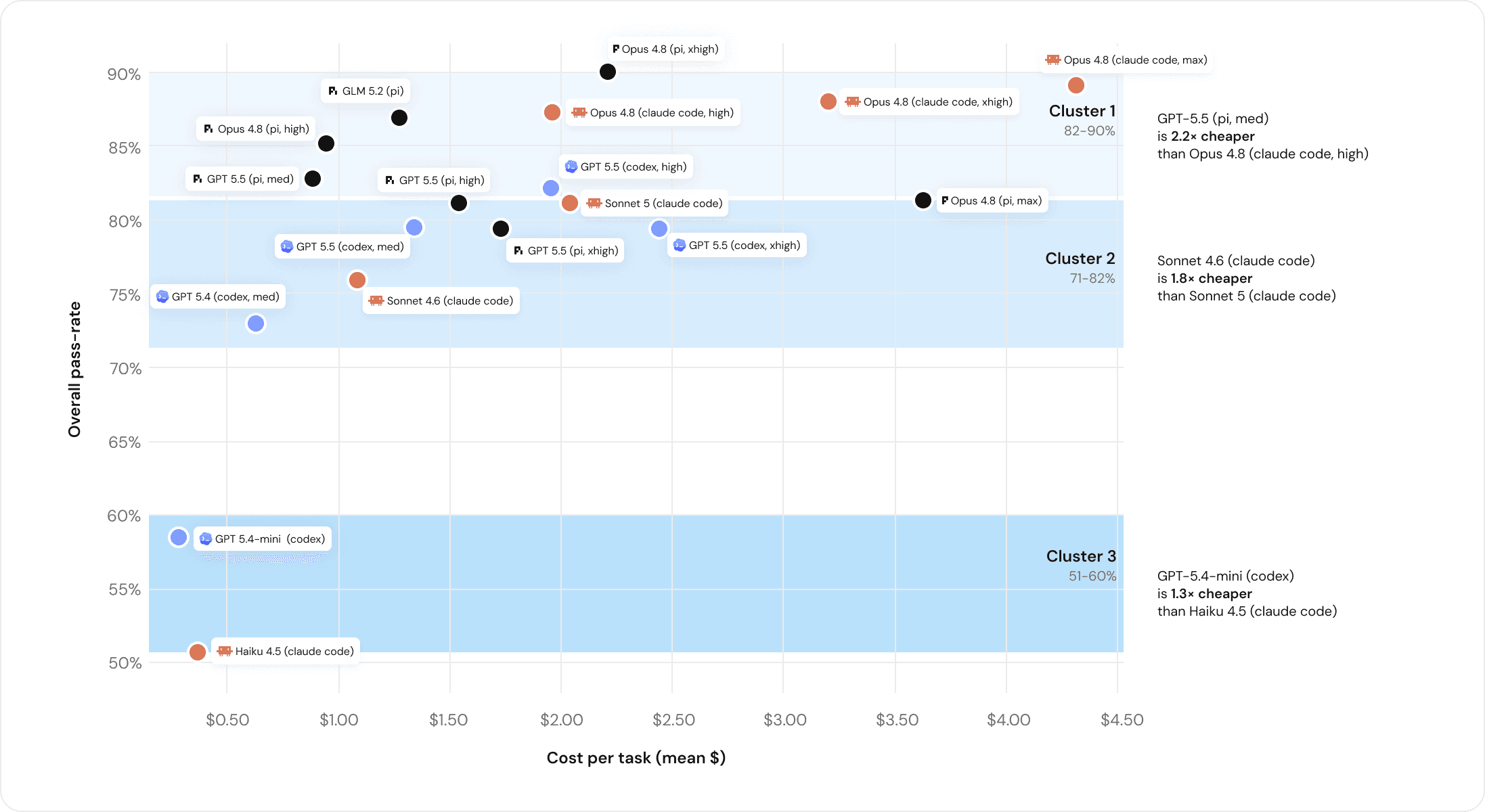
The tested models fell into three clusters. The top group hit 82 to 90 percent pass rates: Opus 4.8, GLM 5.2, and GPT 5.5 in certain configurations. A middle tier at 71 to 82 percent included Sonnet 4.6, Sonnet 5, and GPT 5.4. The bottom tier at 51 to 60 percent held GPT 5.4-mini and Haiku 4.5.
Cost per task varied widely even within performance tiers. The Pareto frontier, meaning the best quality-to-cost ratio, was shaped by models from three providers: OpenAI, Anthropic, and open source. No single lab dominated. Many pricier configurations fell well below the efficiency line.
Token price isn't task cost
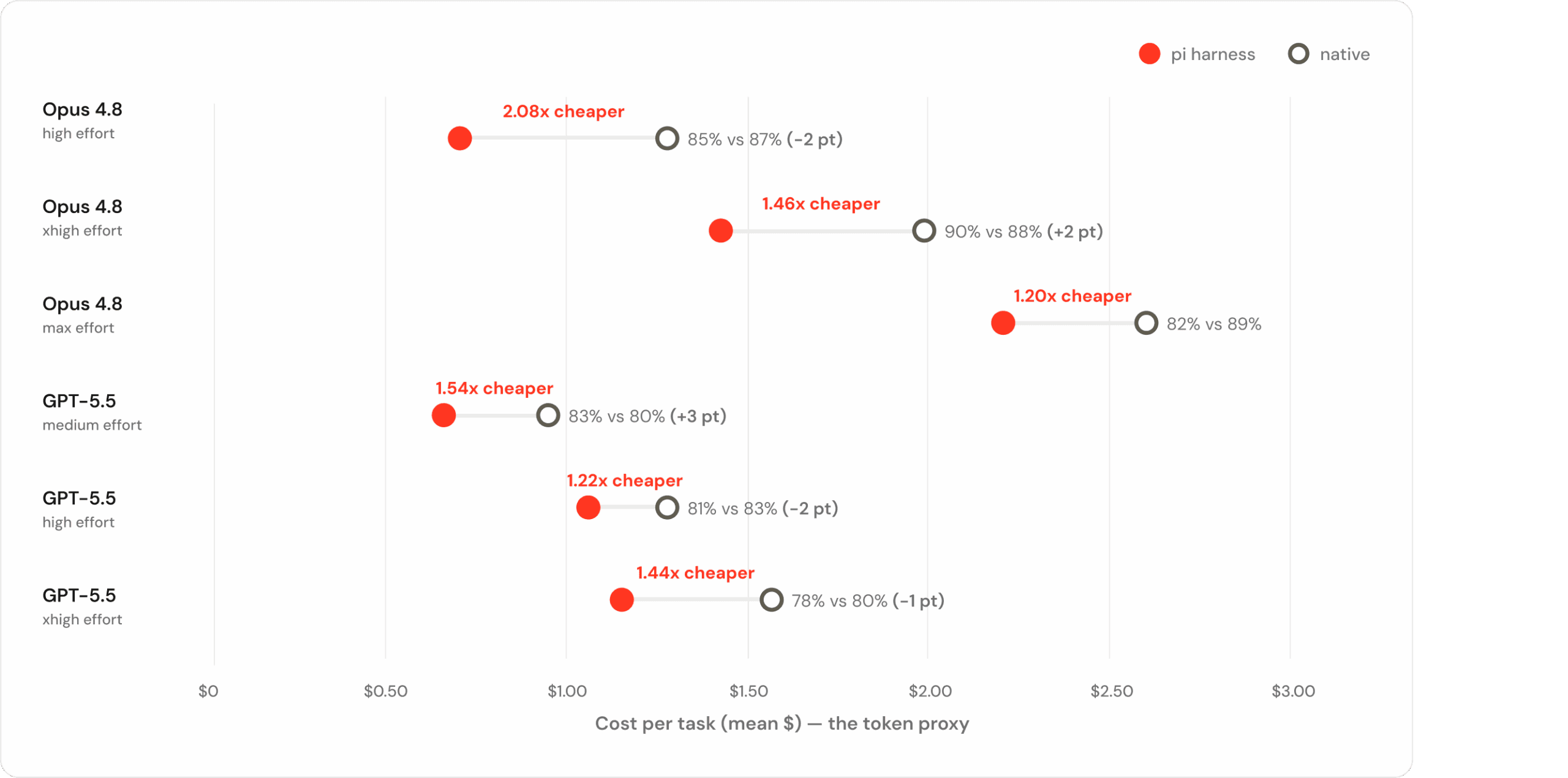
Databricks emphasized that token price and actual task cost aren't the same. Token efficiency matters just as much, like fuel economy in a car, and varies widely by software environment.
In one test, the Pi harness sent about three times less context to models than Claude Code. For Opus 4.8 at "high effort," Pi was 2.08x cheaper at comparable quality (85 versus 87 percent pass rate). GPT 5.5 showed a similar pattern: Codex used 1,235,000 tokens versus 665,000 for Pi on the same tasks.
An analysis through Unity AI Gateway found that 61 percent of coding tasks from Databricks engineers are medium complexity, about 19 percent low, and only 12 percent high. The most expensive models had been the default for everything. Now the company plans to route work to cheaper tiers based on task complexity.
Other companies are making the same switch
Databricks isn't alone. Coinbase moved to Chinese models including GLM-5.2 and Kimi 2.7, cutting AI spending in half while token usage kept climbing. Lindy ditched Claude entirely for Deepseek v4 and saved millions. Snowflake tested GLM-5.2 against Opus 4.7 and found them nearly tied at a fraction of the cost.
On OpenRouter, Chinese models have topped 30 percent of weekly traffic since February 2026, up from 11 percent the previous year. These models run at 60 to 90 percent lower cost than Western alternatives. The traffic shift suggests enterprises are doing their own benchmarks and reaching similar conclusions.
Logicity's Take
For SaaS teams running AI-assisted development, this benchmark offers a rare apples-to-apples comparison on a production codebase. The 34% cost difference per task compounds fast at scale. But the bigger insight is about routing: only 12% of coding tasks at Databricks actually need frontier-tier models. If you're using [Vercel](https://logicity.in/r/vercel) or [DigitalOcean](https://logicity.in/r/digitalocean) for deployment and paying flat rates for AI assistance, consider whether your current provider supports model routing by task complexity. The companies saving millions aren't just switching models; they're matching model capability to task difficulty.
Disclosure
Some links in this post are affiliate links — Logicity earns a commission if you sign up, at no extra cost to you. We only link products we have used or actively recommend.
What does this mean for enterprise AI strategy?
The benchmark validates what many suspected: open-source models from Chinese labs have closed the performance gap with proprietary alternatives. The cost advantage is real and substantial. But Databricks' methodology also matters. Public benchmarks are increasingly unreliable as solutions leak into training data.
Companies running AI at scale will need to build internal evaluation frameworks that reflect their actual codebases and workflows. The days of assuming the most expensive model is the best choice are ending. Token efficiency, task routing, and harness design all affect the final bill more than raw token prices suggest.
Frequently Asked Questions
What is GLM 5.2 and who makes it?
GLM 5.2 is an open-source large language model developed by Zhipu AI, a Beijing-based company spun out of Tsinghua University. It competes directly with proprietary models like Anthropic's Claude and OpenAI's GPT series.
How much cheaper is GLM 5.2 than Opus 4.8?
In Databricks' benchmark, GLM 5.2 cost $1.28 per task compared to $1.94 for Opus 4.8, a 34% reduction at statistically equivalent performance levels.
Why did Databricks build its own benchmark instead of using SWE-Bench?
Public benchmarks have two problems: solutions leak into training data over time, and the tasks don't match Databricks' stack spanning 10+ languages. Models were also caught searching Git history for correct answers.
Can I use GLM 5.2 for my own company's coding tasks?
Yes, GLM 5.2 is open-source and available through various providers. However, Databricks recommends benchmarking on your own codebase since performance varies by language, complexity, and coding environment.
What percentage of AI coding traffic now uses Chinese models?
On OpenRouter, Chinese models account for over 30% of weekly traffic as of February 2026, up from 11% the previous year, driven by 60-90% lower costs.
Need Help Implementing This?
If you're evaluating AI coding assistants or building internal benchmarks for your engineering team, reach out to Logicity for guidance on model selection and cost optimization strategies.
Source: The Decoder / Matthias Bastian
Huma Shazia
Senior AI & Tech Writer
Produced with AI assistance and reviewed by the Logicity editorial team. Learn more in our Editorial Policy.