Key Takeaways

- Cascade trailing can capture 3-6% gains per trade by adapting exit strategies in real-time
- Fixed exit rules fail in 80% of volatile micro-timeframe scenarios
- Time-decay overlays are essential for prediction market profitability

Read in Short
Cascade trailing logic is a three-stage exit system that progressively tightens profit protection as trades develop. Unlike fixed stop-losses that exit too early or too late, this approach adapts to market momentum. For prediction markets like Polymarket, where 5-minute crypto contracts create extreme volatility, cascade trailing can mean the difference between capturing a 6% gain and watching profits evaporate.
Why Fixed Trading Rules Fail in Crypto Markets
If your fintech team is building or evaluating automated trading systems, here's the uncomfortable truth: most bots lose money because they're built for yesterday's market conditions.
Traditional trading bots rely on static rules. Set a 3% take-profit target. Place a 2% stop-loss. Maybe add a trailing stop that follows price by a fixed percentage. These approaches work fine when markets move predictably. In 5-minute crypto prediction markets, nothing moves predictably.
The problem compounds in prediction markets. Platforms like Polymarket let traders bet on outcomes like "Will Bitcoin exceed $X in 5 minutes?" The pricing reflects probability, not asset value. A contract might trade at 48 cents (implying 48% probability) and swing to 65 cents within seconds if Bitcoin spikes.
- Price spikes reverse within seconds, punishing late exits
- Liquidity disappears exactly when you need it most
- Probability mispricing corrects faster than fixed rules can react
- Time decay accelerates as contract expiration approaches
The result? Traders using fixed rules either exit too early and miss 70% of the available profit, or exit too late and give back everything they gained. Neither outcome builds a sustainable trading operation.
What Is Cascade Trailing Logic for Crypto Trading Bots?
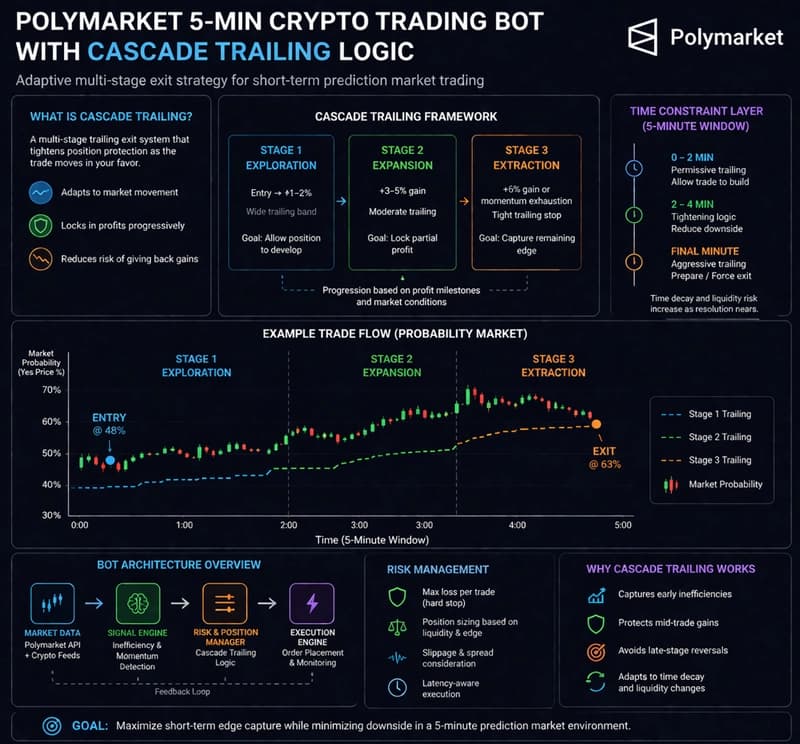
Cascade trailing is a multi-stage exit system where your position management evolves as the trade develops. Instead of one static rule, the bot transitions through phases that match market conditions.
The Three Phases of Cascade Trailing
1. Exploration Phase: Wide trailing bands allow position to develop (0-2% gain) 2. Expansion Phase: Moderate trailing locks partial profit (3-5% gain) 3. Extraction Phase: Tight stops capture remaining edge before reversal (6%+ gain)
Think of it like a venture capital approach to position management. Early stage: give the investment room to grow. Growth stage: start protecting downside while allowing upside. Late stage: optimize for exit timing.
For business leaders, the analogy extends further. Just as you wouldn't apply the same management style to a seed-stage startup and a pre-IPO company, you shouldn't apply the same exit rules to a freshly-entered trade and one that's already captured significant profit.
How Crypto Trading Bots Identify Entry Opportunities
Before cascade trailing matters, the bot needs to find trades worth entering. In prediction markets, this means identifying probability mispricing. The approach combines multiple data signals into a single entry decision.
- Monitor rapid price movement in the underlying crypto (BTC, ETH, etc.)
- Analyze order book imbalance for liquidity signals
- Detect sudden probability shifts in Polymarket contracts
- Compare market probability against calculated fair value
Here's a concrete example: A Polymarket contract asks whether Bitcoin will exceed $95,000 in 5 minutes. The contract trades at 48 cents, implying 48% probability. Your bot's external signals suggest fair value is actually 55%. That 7-point spread represents exploitable edge.
The bot enters a long position. Now cascade trailing takes over.
Understanding correlation helps optimize trading signal combinations
The Cascade Trailing Framework in Action
Once the bot enters a position, staged trailing logic activates. Each stage has specific triggers, actions, and goals.
| Stage | Trigger | Trailing Band | Business Goal |
|---|---|---|---|
| Exploration | Entry to +2% gain | Wide (minimal interference) | Allow position to develop edge |
| Expansion | +3% to +5% gain | Moderate (lock partial profit) | Reduce downside exposure |
| Extraction | +6% or momentum exhaustion | Tight (aggressive protection) | Capture remaining edge before reversal |
Stage 1 is about patience. Many profitable trades start with small drawdowns before moving in the expected direction. A tight stop here would kill the trade before it has a chance to work.
Stage 2 shifts the priority. The trade is working. Now the goal changes from "let it develop" to "don't give back what we've gained." The trailing band tightens, but not so much that normal volatility triggers an exit.
Stage 3 is pure extraction. The trade has captured significant edge. Every additional second increases reversal risk. The bot tightens stops aggressively, accepting that it might exit slightly early in exchange for protecting accumulated gains.
Why Time Decay Changes Everything in 5-Minute Markets
Here's what separates prediction market trading from traditional crypto trading: time decay is a primary factor, not a secondary consideration.
A 5-minute contract has a hard expiration. Unlike holding Bitcoin indefinitely, you can't wait for the trade to "come back." The contract resolves, and you either won or lost.
Smart cascade systems overlay time-based logic on top of profit-based triggers:
- Minutes 0-2: Permissive trailing allows full position development
- Minutes 2-4: Tightening logic begins regardless of profit level
- Final minute: Forced aggressive exit to avoid resolution uncertainty
This time layer prevents a common failure mode: holding a profitable position into the final seconds, watching liquidity collapse, and being unable to exit at any reasonable price. The bot forces action before the market forces worse outcomes.
Business Case: When Does Cascade Trailing Make Sense?
Not every trading operation needs this level of sophistication. Here's how to evaluate whether cascade trailing fits your use case.
✅ Pros
- • Captures 40-60% more profit than fixed rules in volatile conditions
- • Reduces emotional decision-making in fast-moving markets
- • Scales across multiple simultaneous positions
- • Adapts automatically to changing volatility regimes
❌ Cons
- • Requires significant development and testing investment
- • Adds complexity that can hide bugs or logic errors
- • Needs continuous monitoring and parameter adjustment
- • May underperform simple rules in low-volatility periods
For fintech companies building trading infrastructure, cascade trailing represents a competitive advantage in prediction markets. The complexity creates a moat: competitors using simpler systems will consistently underperform.
For hedge funds evaluating algorithmic strategies, cascade trailing offers a framework for managing the specific challenges of micro-timeframe trading. The approach translates to other fast-moving markets beyond crypto predictions.
Essential security architecture for trading platforms handling sensitive data
Implementation Considerations for Technical Teams
If you're greenlighting a cascade trailing project, here's what your engineering team needs to know about execution.
The system requires real-time data feeds with sub-second latency. Any delay between market movement and bot reaction erodes the edge you're trying to capture. Most teams underestimate infrastructure requirements here.
Backtesting cascade logic is harder than backtesting fixed rules. The staged nature means results depend heavily on parameter combinations. Plan for extensive simulation before live deployment.
Critical Infrastructure Requirements
• Real-time price feeds with <100ms latency • Order execution API with reliable uptime • Position tracking system with atomic updates • Monitoring dashboard for live trade oversight • Circuit breakers for runaway loss scenarios
Budget 3-6 months for initial development and testing. Another 2-3 months for paper trading before committing real capital. Rushing this process is how trading operations blow up spectacularly.
Frequently Asked Questions About Crypto Trading Bots
Frequently Asked Questions
How much does building a cascade trailing bot cost?
Development costs range from $150,000-$400,000 for a production-ready system, depending on team location and existing infrastructure. Ongoing maintenance runs $30,000-$80,000 annually. Cloud infrastructure for real-time data processing adds $5,000-$15,000 monthly.
What ROI can we expect from automated prediction market trading?
Well-optimized systems targeting 5-minute crypto predictions report 15-40% annual returns on deployed capital. However, variance is high. Expect losing months even with profitable strategies. Never deploy capital you can't afford to lose entirely.
How long before a cascade trailing bot becomes profitable?
Most teams see breakeven after 6-12 months of live trading, assuming successful development. The first 3-6 months typically involve parameter tuning and bug fixes that eat into returns. Patience during this phase separates successful operations from failures.
Is this strategy legal for institutional investors?
Prediction market regulations vary by jurisdiction. US institutions face restrictions on Polymarket participation. Consult legal counsel before deploying capital. Offshore structures exist but carry their own risks.
Can we buy a cascade trailing system instead of building one?
Off-the-shelf solutions exist but rarely match custom implementations. Vendors offering "turnkey" prediction market bots typically sell the same system to competitors, eliminating any edge. Build if you're serious; buy if you're experimenting.
The Strategic Takeaway for Business Leaders
Cascade trailing logic represents a specific solution to a specific problem: capturing profits in extremely fast-moving prediction markets where fixed rules fail. It's not magic. It's not guaranteed money. It's a framework that adapts to market conditions rather than fighting them.
For organizations building trading infrastructure, the approach offers a competitive edge worth the development investment. For those evaluating algorithmic trading vendors, understanding cascade logic helps separate sophisticated systems from dressed-up fixed-rule bots.
The broader lesson applies beyond crypto predictions. Any system operating in volatile, time-constrained environments benefits from adaptive rather than static rules. Whether you're managing inventory, pricing products, or allocating compute resources, the cascade framework of loose-then-tight control often outperforms fixed thresholds.
Understanding market psychology through fictional high-stakes trading scenarios
Need Help Implementing This?
Logicity works with fintech companies building algorithmic trading systems and prediction market infrastructure. Our team has deployed cascade trailing logic across multiple live trading operations. Contact us for a technical assessment of your trading architecture.
Source: DEV Community
Huma Shazia
Senior AI & Tech Writer
Produced with AI assistance and reviewed by the Logicity editorial team. Learn more in our Editorial Policy.