Key Takeaways
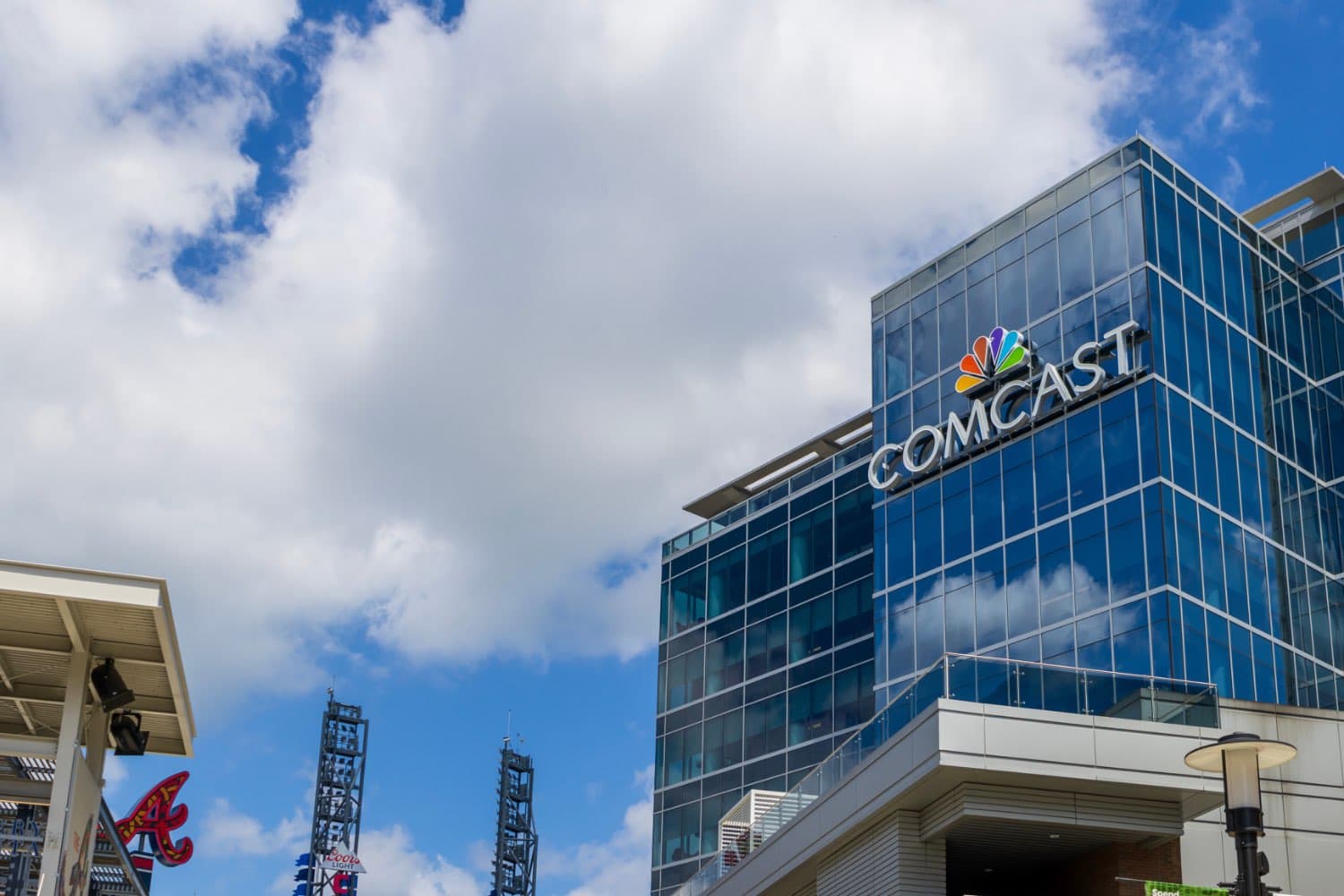
- Comcast announced a tax-free spinoff of NBCUniversal and Sky into a separate public company
- The split reverses a decade-long vertical integration strategy as cable subscribers decline
- Each new company will pursue distinct strategies: broadband infrastructure vs. streaming and content
Comcast will spin off NBCUniversal and Sky into a separate, publicly traded company through a tax-free transaction. The announcement sent Comcast shares higher in premarket trading and marks the end of the company's decade-long experiment in vertical integration between cable distribution and content production.
The split creates two distinct businesses. One will focus on high-speed internet and broadband infrastructure. The other, containing NBCUniversal's film studios, TV networks, theme parks, and Peacock streaming service alongside Sky's European operations, will compete as a standalone media company.
Why Comcast is unwinding its $39 billion bet
Comcast acquired full ownership of NBCUniversal between 2011 and 2013 for approximately $39 billion. The thesis was simple: own the pipes and the content flowing through them. That logic has eroded. Comcast has lost over 6 million cable TV subscribers since 2019. Consumers cut the cord. Streaming economics proved harder than expected.
Brian Roberts, Comcast's chairman and CEO, framed the decision around operational clarity. "We believe a separation would provide each company with increased strategic flexibility, allowing each company's management to focus its expertise and allocate capital on the opportunities each company faces independently," Roberts said in the announcement.
Translation: the two businesses need different things. Broadband requires network investment and regulatory navigation. Media requires content spending, subscriber acquisition, and figuring out how to make streaming profitable. Peacock lost $2.7 billion in 2023 alone.
What the new media company looks like
The spun-off entity inherits significant assets. NBCUniversal generated roughly $41 billion of Comcast's $121 billion in 2023 revenue. Sky brings 61 million customers across the UK, Italy, and Germany. Peacock has 23 million subscribers and is still climbing, though profitability remains years away.
The new company will face immediate strategic questions. Does it pursue mergers with other media players? Warner Bros. Discovery and Paramount Global have circled each other for years. A standalone NBCUniversal-Sky entity could become a buyer, a seller, or a merger partner.
Theme parks offer a brighter picture. Universal's parks in Orlando, Hollywood, and internationally have consistently grown. They provide cash flow less dependent on advertising markets or streaming churn.
What stays with Comcast
Comcast retains its core: broadband internet, Xfinity mobile, and business services. This is where the company's margins are strongest and growth most defensible. Fiber and fixed wireless competitors are gaining ground, but Comcast's cable plant reaches tens of millions of American homes with speeds competitors struggle to match in many markets.
The company also keeps its stake in Hulu, which it has been selling to Disney over time. That transaction should wrap up by 2025, providing additional capital.
The broader media industry context
Comcast's move follows a pattern. Media conglomerates assembled in the 2010s are coming apart. AT&T spun off WarnerMedia. Viacom and CBS merged, then became Paramount Global, which is now exploring a sale. The bundling thesis, that owning content and distribution together creates unbeatable synergies, has not delivered the returns investors expected.
Streaming changed the math. When consumers paid for cable bundles, owning networks meant guaranteed carriage fees. Now, every media company competes for the same streaming dollars, and consumers subscribe to two or three services, not ten. Scale matters, but vertical integration with a declining distribution business does not.
Logicity's Take
For AI builders watching media, the spinoff signals where tech investment will concentrate. The standalone Comcast will likely double down on broadband infrastructure and smart home technology, areas where AI and automation improve margins. The new media company faces a different challenge: using AI for content recommendations, ad targeting, and production efficiency to close Peacock's profitability gap. Product teams selling to media enterprises should track which entity inherits the tech teams and what their priorities become post-split.
Timeline and execution
Comcast has not disclosed a precise closing date. Tax-free spinoffs of this scale typically take 12 to 18 months to complete. Regulatory review, debt allocation, and operational separation all require time. Shareholders of Comcast will receive shares in the new company proportional to their holdings.
The market reaction suggests investors see value in separation. A pure-play broadband company trades at different multiples than a media conglomerate. Splitting the two lets each find its natural valuation.
Frequently Asked Questions
What is Comcast spinning off?
Comcast is spinning off NBCUniversal (including Peacock, Universal Pictures, NBC networks, and theme parks) along with Sky's European operations into a new, independent public company.
Is the Comcast NBCUniversal spinoff tax-free?
Yes, Comcast structured the transaction as a tax-free spinoff for shareholders, meaning investors will receive shares in the new company without triggering immediate capital gains taxes.
Why is Comcast splitting its media and tech businesses?
Comcast cited the need for strategic flexibility. The broadband business and media business face different challenges and require different capital allocation strategies. Separating them allows focused management of each.
When will the Comcast NBCUniversal spinoff close?
Comcast has not announced a specific date. Transactions of this complexity typically require 12 to 18 months for regulatory approval, debt restructuring, and operational separation.
What happens to Peacock after the spinoff?
Peacock will become part of the new standalone media company alongside NBC networks, Universal Pictures, and Sky. It will no longer be backed by Comcast's broadband cash flow.
Need Help Implementing This?
Logicity helps product teams and founders navigate shifts in enterprise markets. If your AI tools serve media or telecom, reach out for analysis on how restructuring affects your buyer landscape.
Source: Forbes Middle East / Forbes Middle East
Huma Shazia
Senior AI & Tech Writer
Produced with AI assistance and reviewed by the Logicity editorial team. Learn more in our Editorial Policy.