Key Takeaways
- Claude Mythos independently solved the Erdős unit-distance conjecture, a problem unsolved since 1946
- Anthropic used a distributed system where isolated Claude Code instances developed and shared solution paths
- The parallel breakthroughs from OpenAI and Anthropic suggest significant untapped AI math capabilities
Two AI labs. One 80-year-old math problem. Different solutions within the same week.
Anthropic employees say Claude Mythos has solved the Erdős unit-distance conjecture, the same open problem in combinatorial geometry that OpenAI disproved just days earlier. The conjecture had stumped mathematicians since Paul Erdős formulated it in 1946.
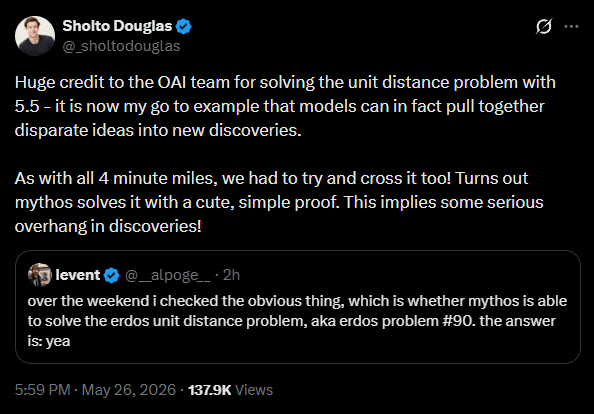
Anthropic engineer Sholto Douglas posted on X that Mythos found what he called a "cute, simple proof." He framed the achievement as evidence of "serious overhang" in AI-driven math discoveries. The implication: these models may have been capable of such breakthroughs already, just waiting for the right setup.
How Anthropic's Test System Worked
The team built a distributed test system after AI solved a different Erdős problem (#1196). Isolated Claude Code instances with Mythos access each received the problem and developed their own solution paths. One instance then summarized the approaches and distributed them to other instances working independently.
Mythos frequently took a different route than OpenAI's model. This matters. Two independent AI systems arriving at valid proofs through different methods suggests the solutions are robust, not artifacts of a specific training approach.
“The solution is a cute, simple proof, a sign of serious overhang in AI-driven math discoveries.”
— Sholto Douglas, Engineer at Anthropic
Mathematician Reactions: 'A Bit Worse' But Still Valid
Mathematician Daniel Litt reviewed the result and called it "a bit worse" than OpenAI's solution. But he confirmed Mythos also found OpenAI's approach when given the opportunity. The model could produce multiple valid paths to the same conclusion.
Anthropic published a proof version prepared by Opus 4.7, their current flagship model. This step toward transparency lets the broader mathematics community verify the work independently.
The Competitive Landscape of AI Math
Google DeepMind recently announced that an AI-assisted system solved nine Erdős problems. However, their approach relies on Lean, a formal proof language. Some view this as less impressive from a pure language model perspective since Lean provides more structural scaffolding.
Critics point out that Claude Code is also an agentic harness, not a pure language model. The orchestration layer that coordinates multiple instances and manages solution distribution does meaningful work beyond raw model inference.
What 'Discovery Overhang' Means
Douglas's phrase "serious overhang" has sparked debate in AI research circles. The concept suggests frontier models have possessed breakthrough capabilities that remained dormant until someone built the right orchestration system to unlock them.
If true, this has significant implications. Mathematical problems that have resisted human efforts for decades might fall quickly once researchers identify the right prompting strategies and coordination architectures. The bottleneck may not be model capability but rather the engineering around how models are deployed.
Online discussion has been intense. Many participants on Hacker News and Reddit are debating whether human mathematicians will shift from authoring proofs to primarily verifying AI-generated ones. The role could become more curator than creator.
What This Means for AI Research
The parallel breakthroughs from OpenAI and Anthropic demonstrate that advanced mathematical reasoning is not a moat any single lab can defend. Multiple organizations can independently achieve similar results, sometimes through entirely different approaches.
This also raises questions about reproducibility and verification. When AI systems produce novel mathematical proofs, the burden of checking their work falls on human experts. As the pace of AI-generated discoveries accelerates, the verification bottleneck could become a serious constraint.

Logicity's Take
Frequently Asked Questions
What is the Erdős unit-distance conjecture?
It's a problem in combinatorial geometry formulated by mathematician Paul Erdős in 1946. The conjecture concerns the maximum number of unit distances (pairs of points exactly one unit apart) possible among n points in a plane. It remained unsolved for 80 years until AI systems cracked it in 2026.
How did Claude Mythos solve the problem differently than OpenAI?
Anthropic used isolated Claude Code instances that developed independent solution paths, then shared summaries across instances. Mythos frequently took different routes than OpenAI's model, though it could also reproduce OpenAI's approach when given the opportunity.
What does 'discovery overhang' mean in AI research?
Discovery overhang suggests that AI models have possessed breakthrough capabilities that remained unused until someone built the right orchestration or prompting system. The idea is that capability exists before deployment catches up.
Is Claude Mythos better at math than OpenAI's model?
Not necessarily. Mathematician Daniel Litt called Mythos's proof 'a bit worse' than OpenAI's, though both are valid. The fact that two different AI systems independently solved the same 80-year-old problem suggests comparable capabilities.
What role do human mathematicians play in verifying AI proofs?
Human experts remain essential for checking AI-generated mathematical work. As AI produces more novel proofs, verification becomes both more important and potentially a bottleneck in the research pipeline.
Need Help Implementing This?
Source: The Decoder / Matthias Bastian
Manaal Khan
Tech & Innovation Writer
Produced with AI assistance and reviewed by the Logicity editorial team. Learn more in our Editorial Policy.