Key Takeaways
Claude Code vs. Cowork: Which one actually stuck for my admin tasks? 🤯

- Business operations and content creation account for 49.8% of all Claude Cowork sessions
- Software development represents only 8.7% of Cowork usage, as developers gravitate toward Claude Code
- The data suggests AI agents are filling gaps in knowledge work, not replacing core job functions
Anthropic's Claude Cowork has found its niche, and it's not where most AI hype would suggest. An analysis of 1.2 million anonymized sessions from late May 2026 shows that half of all usage targets the unglamorous administrative work that clutters knowledge workers' days: status reports, onboarding checklists, spreadsheet reconciliation, and slide decks.
The findings, drawn from more than 600,000 organizations, paint a picture of AI adoption that's less about replacing workers and more about handling the tasks nobody wants to own.
What are people actually using Claude Cowork for?
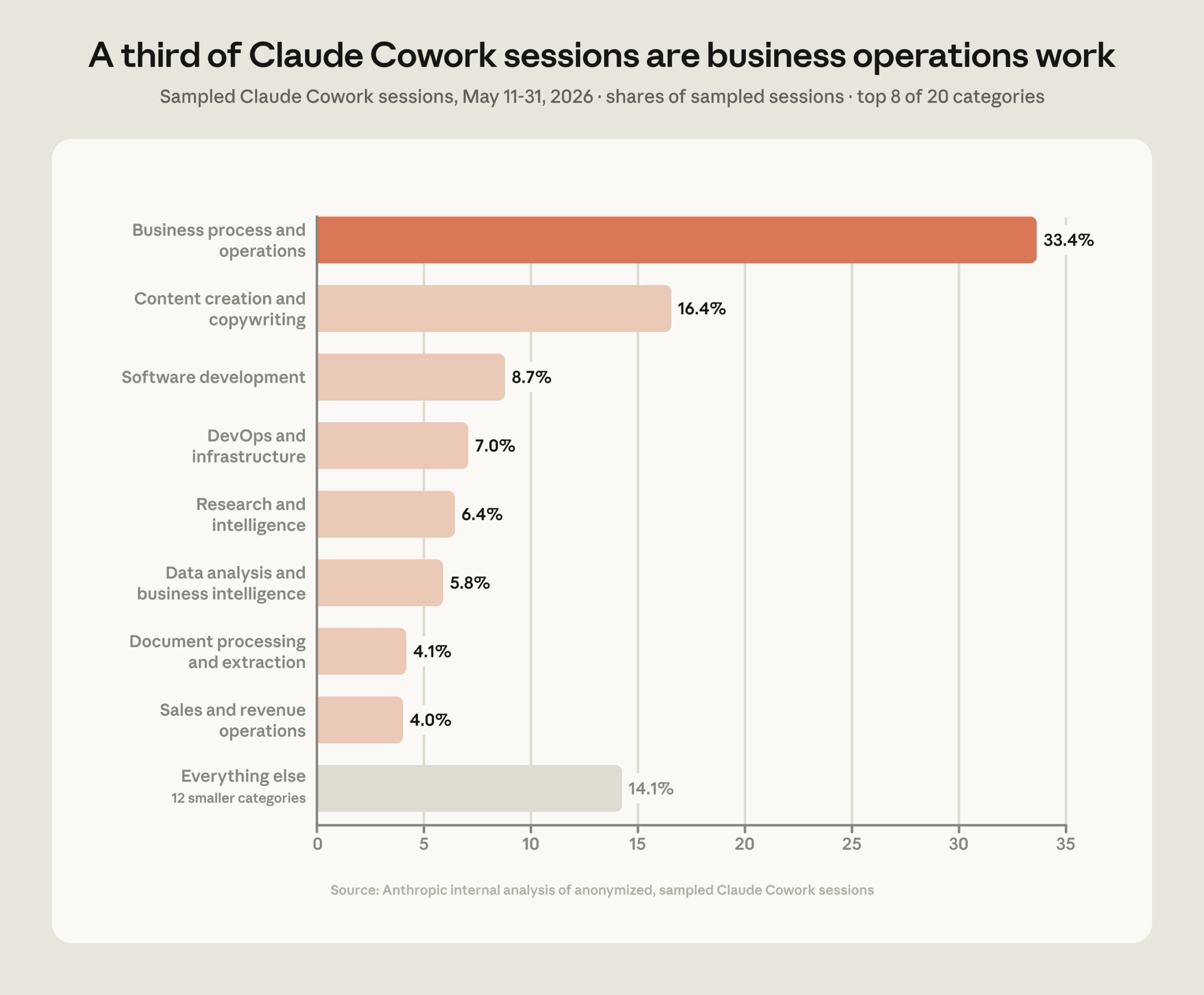
Two categories dominate. Business process and operations leads at 33.4%, covering tasks like pulling scattered status updates into unified reports, building checklists, and reconciling data across spreadsheets. Content creation and copywriting follows at 16.4%, encompassing drafts, presentations, social posts, and proposals.
Anthropic describes these activities as "connective in nature." They're the glue of office work. A spreadsheet consolidates scattered data. A slide deck translates a technical decision for stakeholders who lack context. An onboarding checklist codifies institutional knowledge that would otherwise live in someone's head.
The remaining categories trail far behind: software development at 8.7%, DevOps and infrastructure at 7%, research at 6.4%, data analysis at 5.8%, document processing at 4.1%, and sales operations at 4%. Personal assistance sits at 3.8%, education at 2.4%, and meeting analysis at 1.8%.
Why is software development so low?
The 8.7% figure for development confirms what Anthropic suspected: interface matters. Developers don't reach for a chat window when they need to build, debug, or ship code. They use Claude Code, the company's terminal-based programming tool that launched in 2025.
In Cowork, those same developers handle the communication overhead surrounding their work. Writing documentation. Drafting emails to stakeholders. Summarizing technical decisions for non-technical audiences. The tool serves a different purpose for the same users.
This split tracks with what happened after Claude Code launched. Anthropic noticed that non-technical users started showing up in the terminal to organize folders, remove duplicate files, and write spreadsheet formulas. Meanwhile, others found the command line intimidating. Cowork was designed to bring agent capabilities to a familiar chat interface for exactly these users.
The blank screen problem
Anthropic frames Cowork's value around one observation: the blank screen is often the first hurdle. Turning scattered thoughts and information into a coherent first draft consumes disproportionate time and mental energy.
The company offers three examples. A lawyer has documents formatted and filed so they can focus on legal analysis. A hiring manager uses Cowork to schedule interviews and summarize feedback, freeing time for evaluating candidates. A team lead has slides built to explain a difficult decision, buying them time to actually make it.
Each example targets peripheral work. The core job remains human. The agent handles the scaffolding.
What the data doesn't show
Anthropic acknowledges gaps in its taxonomy. Business Ops classifies activities, not professions, so there are no separate buckets for marketing, finance, or HR. Those functions are likely folded into the Business Operations category, which helps explain why it accounts for a third of all sessions.
Other limitations: the sample captures only a fixed maximum number of sessions per hour, underrepresenting peak usage times. The figures are percentages, not absolute volumes, so we don't know if usage is growing or shrinking. And roughly 5% of sessions involve personal use like hobbies or casual chat, meaning the dataset isn't purely professional.
Anthropic says it will keep updating the analysis as usage patterns evolve.
Where Cowork fits in Anthropic's product lineup
Cowork has expanded from the desktop app to web and mobile. The company recently gave the agent the ability to directly operate Mac and Windows desktops, extending its reach beyond chat into direct system interaction.
The positioning is clear: Claude Code for developers, Cowork for everyone else. The usage data suggests the split is working. Developers aren't abandoning their terminal tool for a chat interface, and non-technical users aren't struggling with command-line syntax to get agent capabilities.
Logicity's Take
This data should shift how product teams think about AI integration. The biggest opportunity isn't replacing expensive expert work. It's eliminating the administrative tax that every knowledge worker pays. For AI builders targeting enterprise, the implication is practical: design for the mundane. The lawyer doesn't need AI to argue a case. They need it to format filings. The engineer doesn't need AI to architect a system. They need it to explain their decision to stakeholders who won't read code. The gap between Claude Code and Cowork usage also signals a durable divide. Interface isn't just UX polish. It determines which jobs get done. Competitors like Microsoft Copilot, Google's Duet AI, and vertical-specific tools from [Notion](https://logicity.in/r/notion) and [ClickUp](https://logicity.in/r/clickup) are chasing the same administrative layer. Anthropic's advantage is showing the receipts.
Disclosure
Some links in this post are affiliate links — Logicity earns a commission if you sign up, at no extra cost to you. We only link products we have used or actively recommend.
Frequently Asked Questions
What percentage of Claude Cowork usage is for business operations?
Business process and operations accounts for 33.4% of all Claude Cowork sessions, making it the largest category by a significant margin.
Why do developers use Claude Code instead of Claude Cowork?
Developers prefer the terminal-based Claude Code for building, debugging, and shipping software. They use Cowork primarily for communication tasks like writing documentation or explaining decisions to non-technical stakeholders.
How many sessions were analyzed in Anthropic's Claude Cowork study?
Anthropic analyzed 1.2 million anonymized sessions from May 11 to 31, 2026, spanning more than 600,000 organizations.
Can Claude Cowork operate desktop computers directly?
Yes. Anthropic recently gave Cowork the ability to directly operate Mac and Windows desktops, extending its capabilities beyond the chat interface.
Related perspective on AI's impact on the workforce
Need Help Implementing This?
Building AI agents for your organization or evaluating tools like Claude Cowork for your team? Reach out to Logicity's consulting network for implementation guidance and vendor comparisons tailored to your use case.
Source: The Decoder / Jonathan Kemper
Huma Shazia
Senior AI & Tech Writer
Produced with AI assistance and reviewed by the Logicity editorial team. Learn more in our Editorial Policy.