Key Takeaways
Is Pi the Best Coding Agent? Pi vs OpenCode vs Claude Code

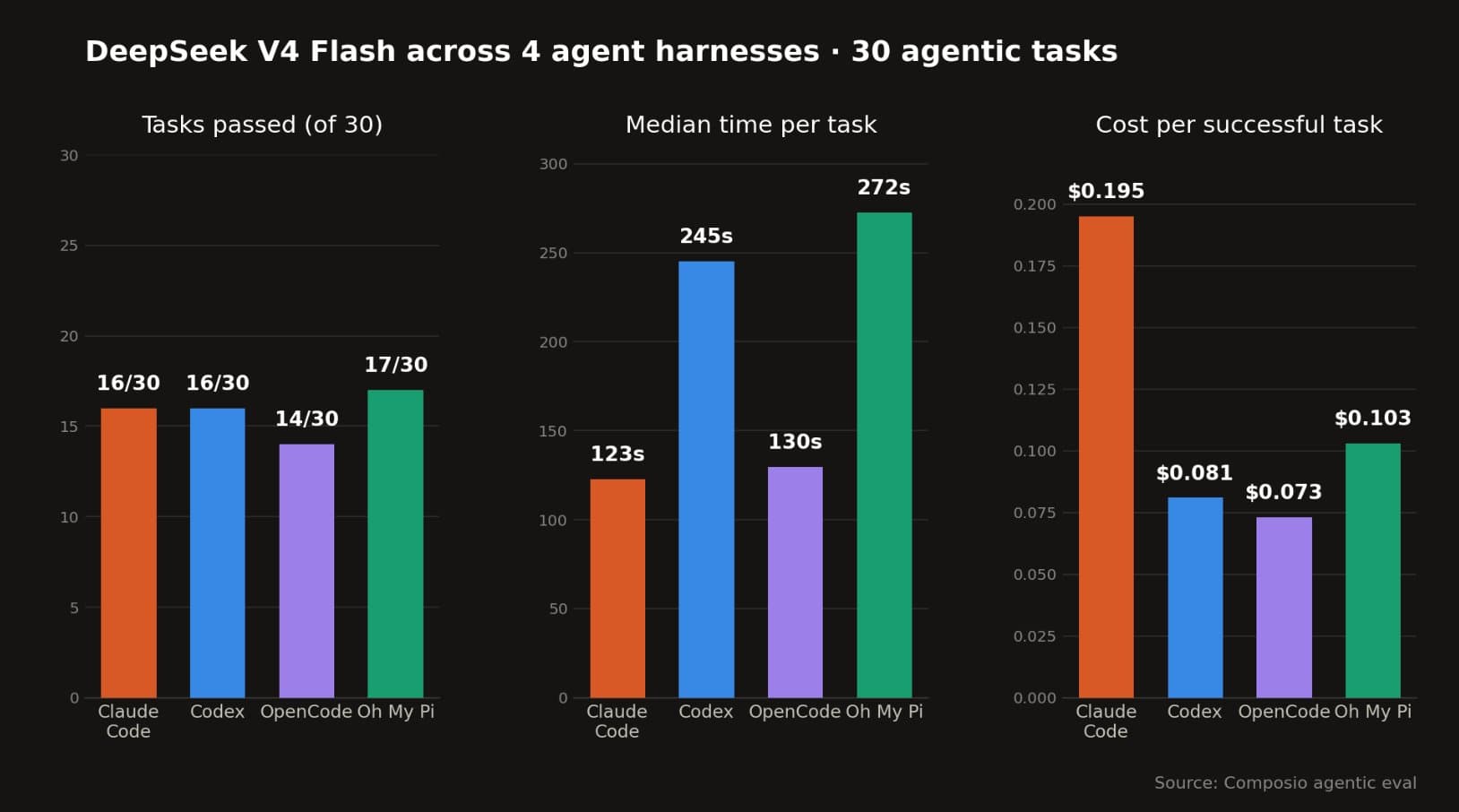
- Claude Code completes tasks in 122 seconds but costs $0.195 per successful task
- OpenCode is cheapest at $0.073 per task but slower at 202 seconds
- Oh My Pi achieved the highest success rate (17/30) but was slowest at 272 seconds
Claude Code is the fastest of four major agent frameworks tested against DeepSeek V4 Flash, completing tasks in 122 seconds on average. It also costs nearly three times more than the cheapest alternative. AI tooling company Composio ran 30 real-world tasks across Claude Code, Codex, OpenCode, and Oh My Pi, using integrations with Gmail, GitHub, Slack, and Notion. The results show that the wrapper around a model matters as much as the model itself.
| Framework | Success Rate | Avg. Time/Task | Cost/Successful Task |
|---|---|---|---|
| Claude Code | ~15-16/30 | 122 seconds | $0.195 |
| Oh My Pi | 17/30 | 272 seconds | Not disclosed |
| OpenCode | 14/30 | ~202 seconds | $0.073 |
| Codex | ~15-16/30 | Not disclosed | Not disclosed |
What did the benchmark actually test?
Composio held the model constant, running DeepSeek V4 Flash through all four frameworks. The 30 tasks involved real-world tool usage: sending emails, interacting with GitHub repositories, posting to Slack, and managing Notion pages. This setup isolates framework behavior from model capability.
Seven tasks passed or failed based solely on which framework ran them. That's a 23% variance from the framework alone. The model never changed. The prompts never changed. Only the orchestration layer differed.
Why does Claude Code cost so much more?
Claude Code clocked $0.195 per successful task despite using the fewest tool calls and generating the least output tokens. OpenCode hit $0.073. That's a 2.7x price gap for comparable success rates.
The cost difference likely traces to how each framework structures its context window, manages retries, and batches API calls. Claude Code's speed advantage (122 seconds versus OpenCode's estimated 202 seconds) suggests it parallelizes aggressively. But parallelization inflates token usage if the framework isn't pruning redundant context between calls.
For teams running hundreds of agent tasks daily, that 2.7x multiplier compounds. A workflow that costs $73 per thousand successful tasks on OpenCode would cost $195 on Claude Code. Over a month, that's real budget pressure.
Oh My Pi won on success rate but lost on time
Oh My Pi completed 17 of 30 tasks, the highest success rate in the test. It also took 272 seconds per task, more than double Claude Code's 122 seconds. For interactive use cases (a developer waiting for code generation, a support agent needing a quick answer), that latency kills the workflow.
For batch processing where correctness matters more than speed, Oh My Pi's higher success rate might justify the wait. Composio didn't publish Oh My Pi's cost-per-task, so the full tradeoff picture remains incomplete.
What should teams optimize for?
The answer depends on the job. A startup automating internal workflows with Zapier or Make cares about cost per task. An enterprise shipping customer-facing agents cares about latency. A compliance team cares about success rate.
Disclosure
Some links in this post are affiliate links — Logicity earns a commission if you sign up, at no extra cost to you. We only link products we have used or actively recommend.
No framework dominated all three metrics. That's the finding that matters. Claude Code is not "the best" agent framework. It's the fastest. OpenCode is not "bad." It's cheap. Oh My Pi is not "slow." It's thorough. The choice is a tradeoff, not a ranking.
Logicity's Take
This benchmark confirms what many teams suspected: the orchestration layer is a cost center, not a commodity. Teams evaluating agent frameworks should run their own task mix before committing. Composio's test used a specific set of integrations; your Slack-heavy or GitHub-heavy workflow may skew results differently. Also missing: error recovery behavior, which matters when agents fail mid-task.
Compares model-level costs and performance, complementing this framework-level analysis
What the test didn't cover
Composio published success/fail, time, and cost. They didn't publish error types, retry behavior, or partial-success rates. A task that fails on the final step after nine correct ones is not the same as a task that fails immediately. Framework error handling matters for production reliability, and this benchmark doesn't measure it.
The test also held the model constant at DeepSeek V4 Flash. Different frameworks may perform differently with Claude models, GPT-4, or Gemini. Framework-model pairing effects are real; this benchmark doesn't capture them.
Frequently Asked Questions
Which agent framework is cheapest per task?
OpenCode, at $0.073 per successful task in Composio's benchmark.
Which agent framework is fastest?
Claude Code, at 122 seconds per task on average.
Which framework has the highest success rate?
Oh My Pi completed 17 of 30 tasks, the highest in the test.
Need Help Implementing This?
Evaluating agent frameworks for your stack? Reach out to Logicity's consulting team for a custom benchmark tailored to your integrations and cost constraints.
Source: The Decoder / Matthias Bastian
Huma Shazia
Senior AI & Tech Writer
Produced with AI assistance and reviewed by the Logicity editorial team. Learn more in our Editorial Policy.