Key Takeaways
Anthropic Engineers Just Fixed Claude Code and Nobody's Talking About it!
- Anthropic deleted over 80% of Claude Code's system prompt for Claude Opus 5 and Claude Fable 5 with no loss in coding evaluation scores
- Newer Claude models handle ambiguity better, so rigid rules actually constrain performance rather than improve it
- Tool design matters more than examples: interface clarity beats demonstration volume for Claude 5 generation models
Anthropic removed over 80% of Claude Code's system prompt for its newest Claude 5 generation models, including Claude Opus 5 and Claude Fable 5. The result: no measurable loss on the company's coding evaluations. The lesson for founders building AI agents is counterintuitive. Less instruction, not more, gets better results from this generation of models.
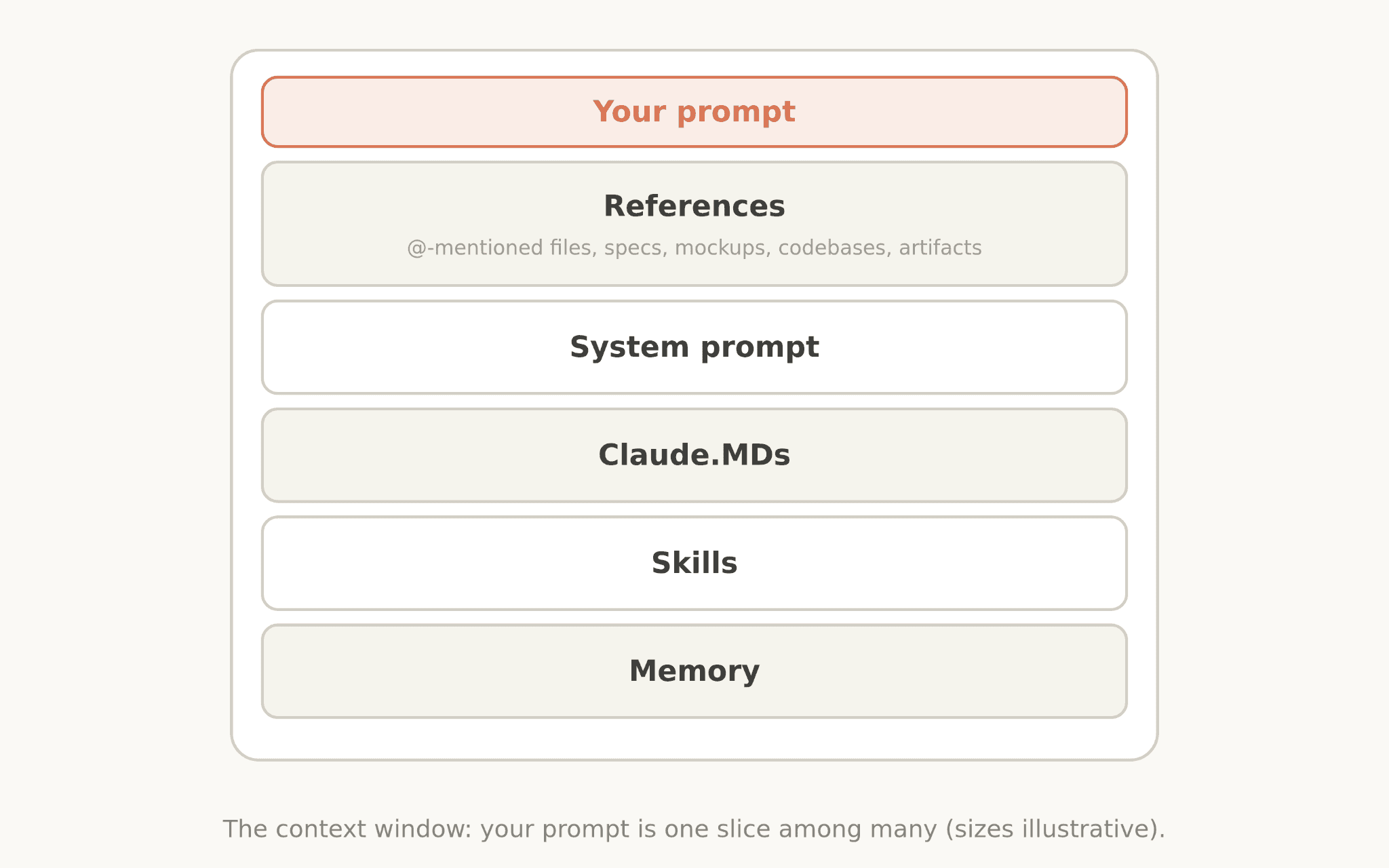
The company published its findings on July 24, 2026, detailing what it calls "context engineering", the practice of assembling system prompts, memory, skills files, and CLAUDE.md configurations that shape how Claude responds across many requests. Unlike a single prompt tailored to one task, context engineering builds the general scaffolding an agent uses for everything. Getting it right matters more as AI agents take on longer-running, more autonomous work.
Why did Anthropic strip out so many rules?
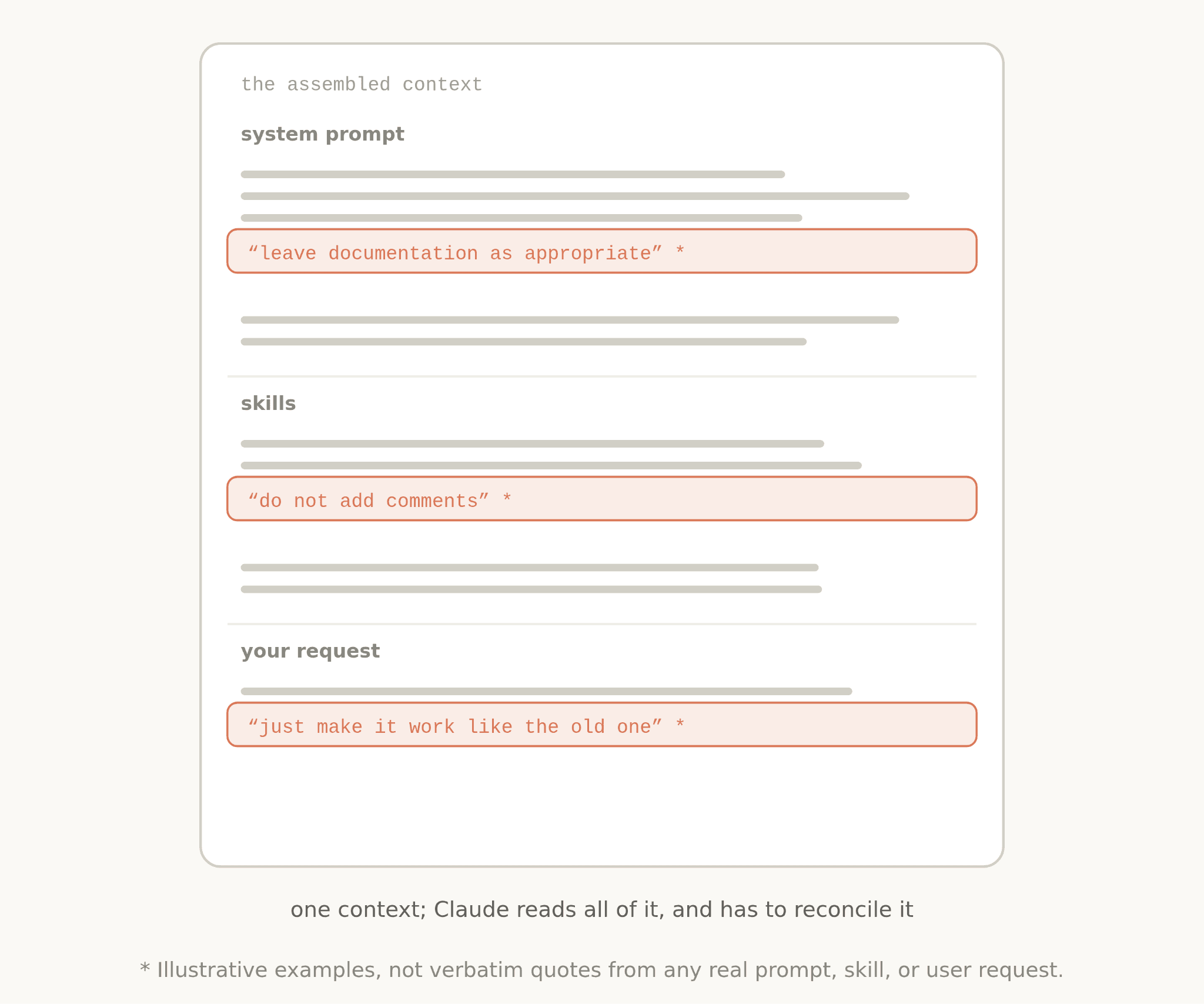
Anthropic's internal transcripts revealed a consistent problem: conflicting instructions. A system prompt might say "leave documentation as appropriate" while a skill file says "DO NOT add comments" and a user request implies something else entirely. Claude could usually infer the right answer, but the cognitive overhead of reconciling contradictory guidance slowed it down and introduced unnecessary friction.
Many of these rules existed to prevent worst-case scenarios. Early Claude Code versions received explicit instructions like: "Never write multi-paragraph docstrings or multi-line comment blocks, one short line max." The intent was avoiding verbose, incorrect comments. But this rule broke down when users actually needed detailed documentation for complex code sections.
Claude 5 models handle these edge cases without explicit guardrails. The new system prompt simply says: "Write code that reads like the surrounding code: match its comment density, naming, and idiom." That single sentence replaces multiple rigid rules because the model can interpret context well enough to make good decisions on its own.
The shift from rules to judgment
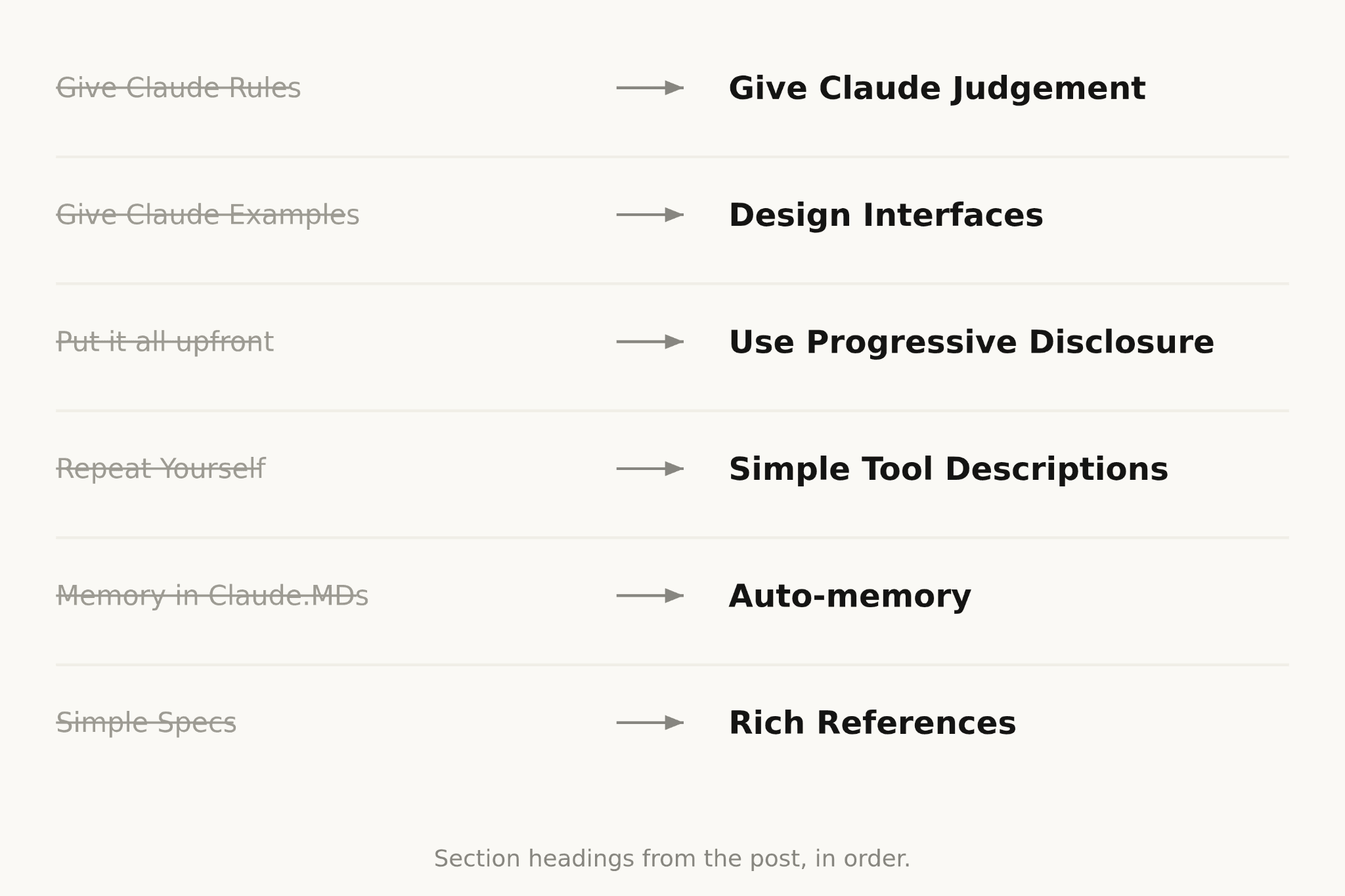
This is the core change. Older models needed explicit rules because they lacked the judgment to handle ambiguous situations. You told them exactly what to do because trusting their inference was risky. Claude 5 generation models flip that dynamic. Explicit rules now constrain performance rather than improve it.
Anthropic describes this as "unhobbling" Claude. The company found it was overconstraining Claude Code through both system prompts and supplementary files. Rules that once prevented failure modes now blocked the model from using its improved reasoning capabilities.
For founders building agents, this matters immediately. If you're still using prompts designed for Claude 3 or early Claude 4, you're likely leaving performance on the table. The prompting strategies that worked a year ago may actively hurt results with current models.
Design interfaces, not examples
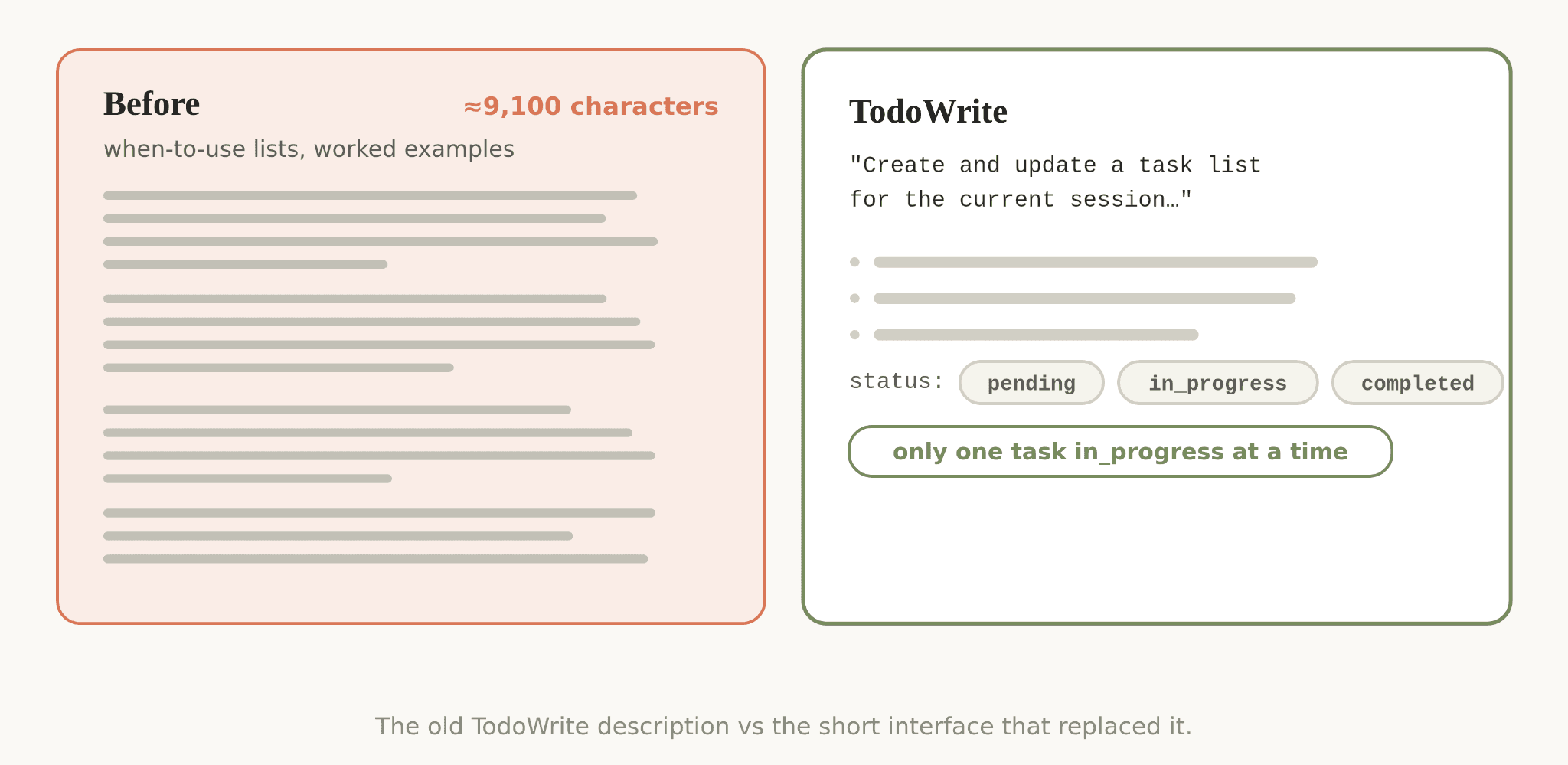
The second major finding concerns tool usage. The old best practice was clear: give Claude examples of how to use your tools. Show it the expected input and output patterns. This worked because earlier models needed concrete demonstrations to understand what you wanted.
With Claude 5, examples actually constrain the model to a narrower exploration space. Instead of showing Claude how to use a tool, Anthropic now recommends focusing on the tool's interface design itself. What parameters does the tool expose? How can those parameters be more expressive?
The company gives a concrete example: a Todo tool. Rather than providing examples of creating, updating, and completing todos, you improve the tool by making its status parameter an expressive enumeration. The model figures out the usage patterns from the interface design alone.
This shifts work from prompt engineering to API design. If you're building agent tooling, invest in clear, well-structured interfaces. Skip the lengthy example blocks. The model will learn faster from a good schema than from a dozen demonstrations.
Memory, artifacts, and skills change everything
Claude Code now has memory, artifacts, and skills as first-class features. Previously, developers used CLAUDE.md files as a catch-all for memory, information, and guidance. Now there are dedicated systems for each of these concerns.
This specialization matters because it reduces the burden on any single context source. Memory handles persistent state. Artifacts store reusable outputs. Skills define capabilities. CLAUDE.md can focus on project-specific guidance without trying to be everything at once.
Anthropic built a diagnostic tool to help developers adapt. Running `/doctor` in Claude Code analyzes your skills and CLAUDE.md files, suggesting where to trim or restructure. The company calls this "rightsizing" your context, cutting the cruft that newer models no longer need.
What this means for your agent architecture
If you're building AI agents using Claude, either through Claude Code or directly via the API, these findings have practical implications.
- Audit your system prompts for rules that duplicate the model's native judgment. Delete rules about formatting, commenting, or documentation style unless you have specific, non-negotiable requirements.
- Replace example-heavy tool documentation with well-designed schemas. Invest time in parameter naming and structure rather than demonstration blocks.
- Separate concerns across memory, artifacts, and skills rather than cramming everything into a single configuration file.
- Use `/doctor` to analyze existing Claude Code setups. The tool flags overconstraining patterns automatically.
Teams using workflow automation tools like Zapier, Make, or n8n to orchestrate Claude-based agents should pay particular attention to the tool design guidance. These platforms often encourage example-based prompting, which may now be counterproductive.
Disclosure
Some links in this post are affiliate links — Logicity earns a commission if you sign up, at no extra cost to you. We only link products we have used or actively recommend.
The prompt engineering skill shift
This release signals a broader change in what "prompt engineering" means. The discipline emerged because early large language models needed careful instruction to produce useful output. You learned to write detailed, explicit prompts because the model couldn't fill in gaps.
That skill set is becoming less relevant. With Claude 5 generation models, the emphasis shifts from instructing the model to designing the environment around it. Context engineering, tool design, memory architecture, and capability separation matter more than crafting the perfect prompt.
For hiring, this means looking for different skills. Someone who can design a clean API schema may now be more valuable than someone who can write elaborate system prompts. The best AI engineers will understand both, but the balance is shifting.
Context engineering creates new privacy considerations as AI agents access more user data
Logicity's Take
Anthropic's findings validate what many developers suspected: the prompting techniques that worked for earlier models create overhead with newer ones. But the company's framing of "unhobbling" is telling. It implies that the model's capabilities were always there, just constrained by outdated instructions. For startup founders, the immediate action is to audit existing agent architectures for rules that made sense six months ago but now add friction. The longer-term implication is that competitive advantage in AI applications is shifting from prompt craft to systems design. Building better tools, cleaner interfaces, and more thoughtful memory systems will matter more than writing clever prompts.
Frequently Asked Questions
Does this apply to all Claude models or just Claude 5?
Anthropic specifically tested these changes on Claude Opus 5 and Claude Fable 5. Earlier models like Claude 3 and Claude 4 may still benefit from more explicit prompting. The company recommends keeping detailed system prompts for older models while stripping them for the newest generation.
How do I check if my Claude Code setup is overconstraining the model?
Run the `/doctor` command in Claude Code. It analyzes your skills and CLAUDE.md files and suggests where to trim or restructure for newer models.
Should I remove all examples from my tool documentation?
Not necessarily. Anthropic's guidance is that examples constrain exploration with newer models. For complex tools with non-obvious usage patterns, a single minimal example may still help. The shift is from example-heavy documentation to interface-focused design.
Need Help Implementing This?
If you're building AI agents and want to audit your context engineering setup, reach out to Logicity's consulting team. We help startups optimize their AI architectures for the latest model capabilities.
Source: Hacker News: Best
Huma Shazia
Senior AI & Tech Writer
Produced with AI assistance and reviewed by the Logicity editorial team. Learn more in our Editorial Policy.