Key Takeaways

- AI agents are shifting from generating answers to executing work and making bounded decisions in payments and banking.
- Companies must redesign infrastructure, governance, and decision rights before agents can operate reliably.
- Autonomy is earned: low-risk tasks get delegated first, while high-impact decisions keep human controls.
Agentic AI is no longer a proof-of-concept in fintech. Executives from Visa, FIS, Synchrony, WEX, Billtrust, i2c, Thales, Velera, and Bottomline are now describing what happens when AI agents move from demos into live payment systems, fraud detection pipelines, and compliance workflows. The shift marks a transition from AI that assists employees to AI that executes work within defined boundaries.
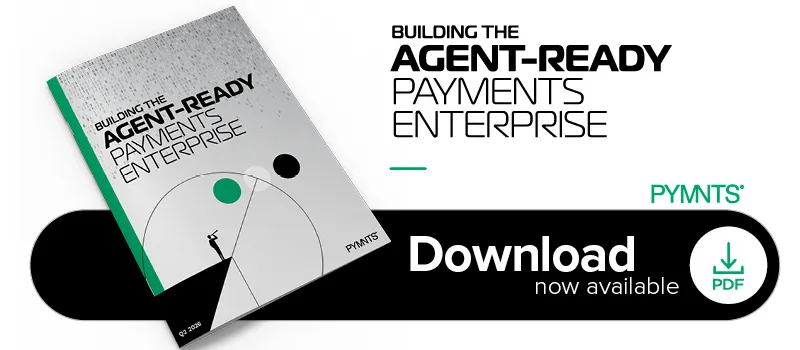
A new PYMNTS eBook, published July 21, compiles their insights. The consensus is clear: building an agentic enterprise is not about deploying the most agents or chasing autonomy for its own sake. It requires redesigning the systems, processes, and decision rights around AI. That's harder than plugging in a model.
What infrastructure do AI agents actually need?
Before agents can act reliably, they need trusted data, connected platforms, real-time access, and machine-readable rules. That list sounds obvious, but most enterprises don't have it. Data sits in silos. Rules live in PDFs and tribal knowledge. Real-time means batch jobs that run overnight.
The executives interviewed describe this infrastructure work as the non-negotiable first step. An agent tasked with reconciliation cannot function if it pulls from three databases with conflicting timestamps. An agent handling fraud escalations cannot act if the rules it needs exist only in a compliance officer's head.
Integration platforms like Zapier, Make, and n8n are becoming relevant even at enterprise scale because they can bridge legacy systems without multi-year rewrites. The goal is not perfection. It's giving agents enough structured access to start handling real work.
Disclosure
Some links in this post are affiliate links — Logicity earns a commission if you sign up, at no extra cost to you. We only link products we have used or actively recommend.
Who decides what an agent can decide?
Governance is the second pillar. Companies must define what agents can decide, which actions require approval, when systems must escalate, and who remains accountable when something goes wrong. This is not a technical problem. It's an organizational one.
The PYMNTS contributors describe a principle that appears repeatedly: autonomy must be earned. Low-risk, structured tasks get delegated first. Routing a support ticket, flagging a duplicate invoice, categorizing a transaction. Higher-impact decisions involving money, regulation, fraud, credit, or customer trust require stronger controls and human intervention.
This means agents in payments and banking are not replacing human judgment wholesale. They are absorbing the repetitive investigation, reconciliation, and processing work so humans can focus on exception management, policy design, oversight, and customer relationships.
Examines the technical tradeoffs when routing AI tasks across multiple models.
How does work redistribute between humans and agents?
The executives describe less a story of wholesale replacement than one of work being redistributed. An analyst who spent four hours daily on reconciliation exceptions now reviews only the edge cases an agent couldn't resolve. A compliance officer who manually checked sanctions lists now supervises an agent that does it continuously.
This redistribution creates new roles. Someone must define the policies agents follow. Someone must audit their decisions. Someone must handle the customer when the agent gets it wrong. The agentic enterprise does not eliminate these responsibilities. It makes them more visible.
What's the timeline for agentic enterprise adoption?
The contributors avoid making bold predictions. The agentic enterprise is not a distant vision of machines running companies on their own. It's an operating model taking shape now, one workflow, permission, and decision at a time. That framing matters.
Companies chasing a single transformative deployment will likely fail. The path forward is incremental: pick a workflow, define the agent's boundaries, monitor outcomes, expand scope. Repeat.
Covers a partnership expanding enterprise AI adoption in emerging markets.
Where does customer trust fit in?
The eBook notes that customer service, fraud, and credit decisions are domains where agents must earn trust gradually. A customer who loses money to a fraudulent transaction does not care whether a human or an agent made the call. They care that it was wrong.
This means agents in customer-facing roles need tighter guardrails, clearer escalation paths, and human backup. The companies furthest along are treating agent governance like they treat credit policy: documented, audited, and regularly reviewed.
Another example of governments and enterprises deploying AI agents to citizens and customers.
| Integration Platform | Best For | Pricing Tier |
|---|---|---|
| Zapier | Broad app library, no-code workflows | Free tier; paid from $19.99/mo |
| Make | Visual automation, complex logic | Free tier; paid from $9/mo |
| n8n | Self-hosted, developer-friendly | Free self-hosted; cloud from $20/mo |
Logicity's Take
The PYMNTS eBook lands at a moment when every enterprise vendor is pitching agentic capabilities. The difference between companies that ship working agents and those stuck in pilots will come down to infrastructure readiness and governance discipline, not model sophistication. For fintech teams, the practical question is whether your data layer and decision rules are machine-readable today. If not, that's job one. Tools like Zapier, Make, and n8n can accelerate integration work, but the harder task is defining what agents should and shouldn't decide. Start there.
Frequently Asked Questions
What is an agentic enterprise?
An organization where AI agents execute work, coordinate systems, and make bounded decisions rather than just assisting human employees.
Which companies are deploying AI agents in payments?
Visa, FIS, Synchrony, WEX, Billtrust, i2c, Thales, Velera, and Bottomline are among the firms discussing live agent deployments.
What infrastructure do AI agents require?
Trusted data, connected platforms, real-time access, and machine-readable rules are prerequisites for reliable agent operation.
How is work changing with AI agents?
Agents absorb repetitive tasks like reconciliation and routing, while humans shift toward exception management, policy design, and oversight.
When should humans still make decisions instead of agents?
High-impact decisions involving money, regulation, fraud, credit, or customer trust continue to require human controls and intervention.
Need Help Implementing This?
If you're evaluating agentic AI for payments, compliance, or finance workflows, Logicity can help you map decision rights and integration requirements. Reach out to our team for a no-obligation conversation.
Source: PYMNTS | / PYMNTS
Manaal Khan
Tech & Innovation Writer
Produced with AI assistance and reviewed by the Logicity editorial team. Learn more in our Editorial Policy.