Key Takeaways
Korean gov't set to launch renewed AI-based ‘Study in Korea’ website
- South Korea plans to launch a free, domestically-built AI chatbot and AI agent by the end of 2026
- Nearly 23 million South Koreans currently use ChatGPT, prompting government push for AI sovereignty
- The country's AI Basic Act took effect this week, requiring content labeling and heightened safety rules for 10 sensitive sectors
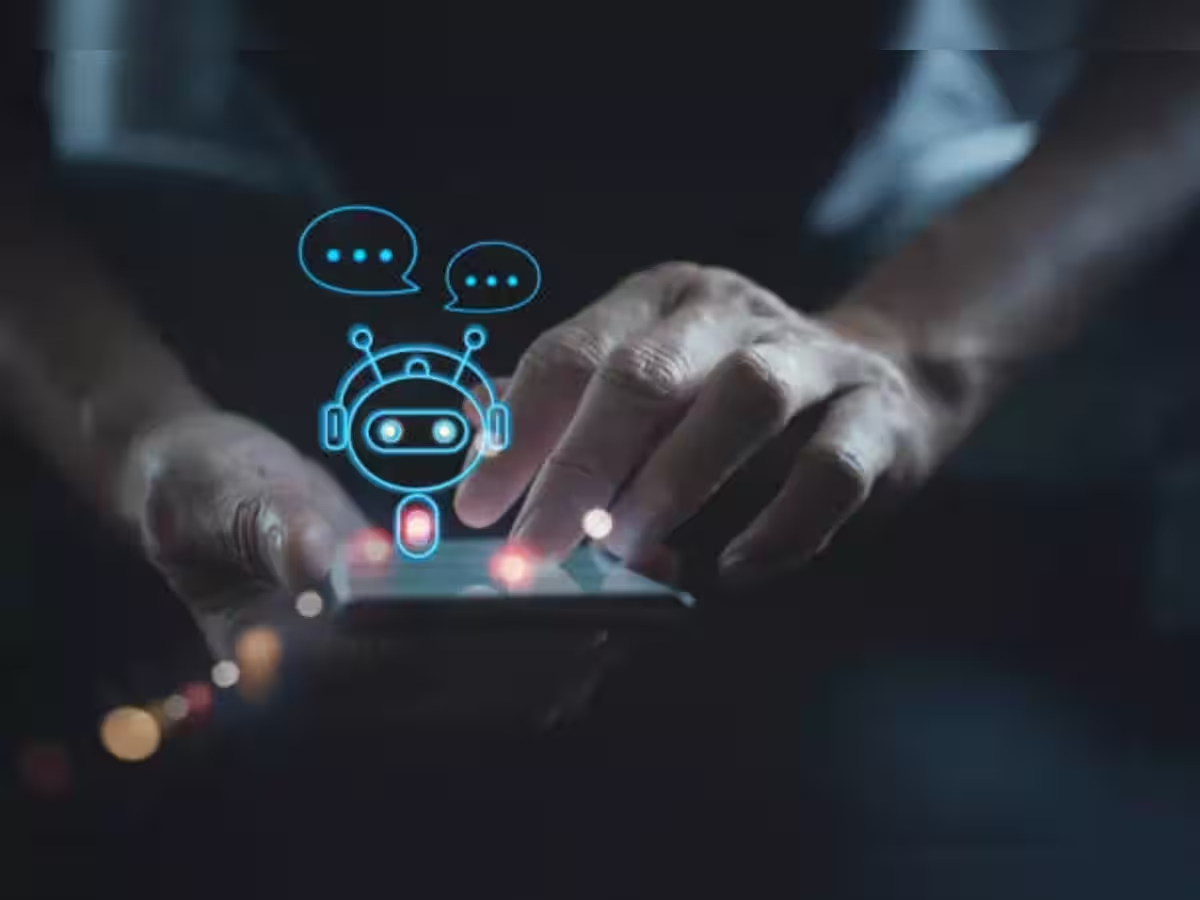
South Korea announced plans to launch a free AI chatbot powered entirely by domestic technology before the end of 2026. The government aims to pull users away from ChatGPT and other foreign platforms, citing concerns over data sovereignty and the need to grow a self-sustaining local AI industry.
The announcement comes as roughly half of South Korea's 51 million citizens already use generative AI applications. According to market research firm Wiseapp-Retail, nearly 23 million of them rely on OpenAI's ChatGPT. That dominance has made Seoul uneasy.
What is South Korea building?
A spokesperson for South Korea's science ministry confirmed that the government initiative will deliver two products by year-end: a general-purpose AI chatbot and an AI agent capable of handling more complex, multi-step tasks.
Science Minister Bae Kyung-hoon framed the stakes bluntly. "To persuade users to move away from foreign AI services they already pay for, we need to provide services that are even better," he told reporters. "We want Korea to move quickly into the era of AI agents and compete in that field."
The government's first priority under its "AI for All" scheme is integrating public AI agent services that offer functions unavailable on foreign platforms. Free access is core to the strategy. Many existing AI tools charge monthly subscriptions; Seoul believes eliminating that barrier will accelerate adoption and let the domestic market accumulate data to feed its own models.
Why is AI sovereignty driving this push?
Countries worldwide have grown wary of routing sensitive citizen data through foreign-owned AI systems. South Korea is not alone in seeking what policymakers call "AI sovereignty": the capacity to develop and control AI models aligned with national security, privacy laws, and business interests.
Kim Yong-beom, senior presidential secretary for policy, explained the economics in a Facebook post. "Providing free domestic AI services encourages users to adopt Korean platforms, allowing demand and data to accumulate and helping the domestic AI market grow on its own." A public AI agent could also help citizens identify and apply to relevant government services, streamlining bureaucracy.
Another example of regional AI sovereignty initiatives shaping enterprise strategy
What comes after the initial launch?
From 2027, Seoul plans to expand the system into personalized AI agents. These would assist users with asset management, learning support, and retirement planning. The ambition is broad: transform government-citizen interaction through proactive, AI-driven service recommendations.
South Korea's AI Basic Act now in effect
The chatbot announcement coincides with South Korea's AI Basic Act taking effect this week. The legislation establishes the country's first national legal framework for the AI industry.
Key provisions include mandatory labeling of generative AI content, a management framework for AI tools that could affect physical safety or fundamental rights, and expanded government support for the sector. The law designates 10 sensitive fields subject to heightened transparency and safety requirements: nuclear power, criminal investigations, loan screening, education, medical care, and five others.
Relevant for teams evaluating AI architecture tradeoffs under new regulatory constraints
How does this compare to existing AI chatbots?
South Korea's government chatbot will compete against established players like ChatGPT, Google's Gemini, and Anthropic's Claude. The competitive edge Seoul is betting on: free access, native Korean language optimization, and integration with government services that foreign platforms cannot replicate.
| Feature | South Korea Gov AI (Planned) | ChatGPT (OpenAI) | Perplexity |
|---|---|---|---|
| Price | Free | $20/month (Plus) | Free tier; $20/month (Pro) |
| Government service integration | Yes | No | No |
| Native Korean optimization | Expected | Partial | Partial |
| AI agent capabilities | Planned for launch | Available (GPT-4o) | Limited |
| Data residency | Domestic | US-based | US-based |
For teams already using tools like Perplexity for research or ChatGPT for productivity, the South Korean alternative may hold limited appeal outside the country. But for Korean enterprises handling regulated data, a domestically-hosted option addresses compliance headaches that foreign providers struggle to solve.
Disclosure
Some links in this post are affiliate links — Logicity earns a commission if you sign up, at no extra cost to you. We only link products we have used or actively recommend.
The catch: can a government chatbot actually be better?
Minister Bae's admission that the government must offer "services that are even better" than paid foreign alternatives sets a high bar. OpenAI, Anthropic, and Google have multi-billion-dollar R&D budgets and years of iteration behind their models. South Korea's domestic AI ecosystem, while growing, has not yet produced a frontier-class foundation model.
The bet appears to be less about raw model capability and more about unique value: deep integration with Korean public services, regulatory compliance baked in, and zero cost. Whether that's enough to shift 23 million ChatGPT users remains an open question.
Logicity's Take
South Korea is making a calculated wager: government-exclusive features and free access can compensate for whatever gap exists in raw model performance. For enterprise CTOs in Korea, this creates optionality. Sensitive workflows could route through the domestic agent while global tools handle general tasks. The bigger signal is geopolitical. If Seoul's playbook succeeds, expect similar government-backed AI services in Japan, the EU, and India within 24 months. Multi-model orchestration is becoming a compliance strategy, not just a technical choice.
Context on how Asian tech giants are positioning amid shifting policy landscapes
Frequently Asked Questions
When will South Korea's free AI chatbot launch?
The South Korean government plans to roll out the AI chatbot and AI agent by the end of 2026.
Will the South Korean government AI chatbot be available outside Korea?
The government has not announced plans for international availability. The focus is on domestic users and integration with Korean public services.
What is AI sovereignty?
AI sovereignty refers to a country's ability to develop and control its own AI models, ensuring alignment with national security, privacy regulations, and business interests rather than relying on foreign platforms.
What does South Korea's AI Basic Act require?
The AI Basic Act mandates labeling of generative AI content, establishes safety frameworks for AI affecting physical safety or rights, and applies heightened rules to 10 sensitive sectors including healthcare, education, and criminal investigations.
Need Help Implementing This?
If your organization is evaluating multi-model AI strategies or compliance-first AI deployment, reach out to the Logicity team for guidance on architecture and vendor selection.
Source: Tech-Economic Times / ET
Huma Shazia
Senior AI & Tech Writer
Produced with AI assistance and reviewed by the Logicity editorial team. Learn more in our Editorial Policy.