Key Takeaways
1Password for Claude: For Everyday AI Users

- 1Password built an authentication framework that lets AI agents like Claude access credentials without exposing them directly
- The integration addresses the critical gap between AI assistants and authenticated services
- Engineering teams can now build AI agent workflows that interact with secure systems while maintaining credential hygiene
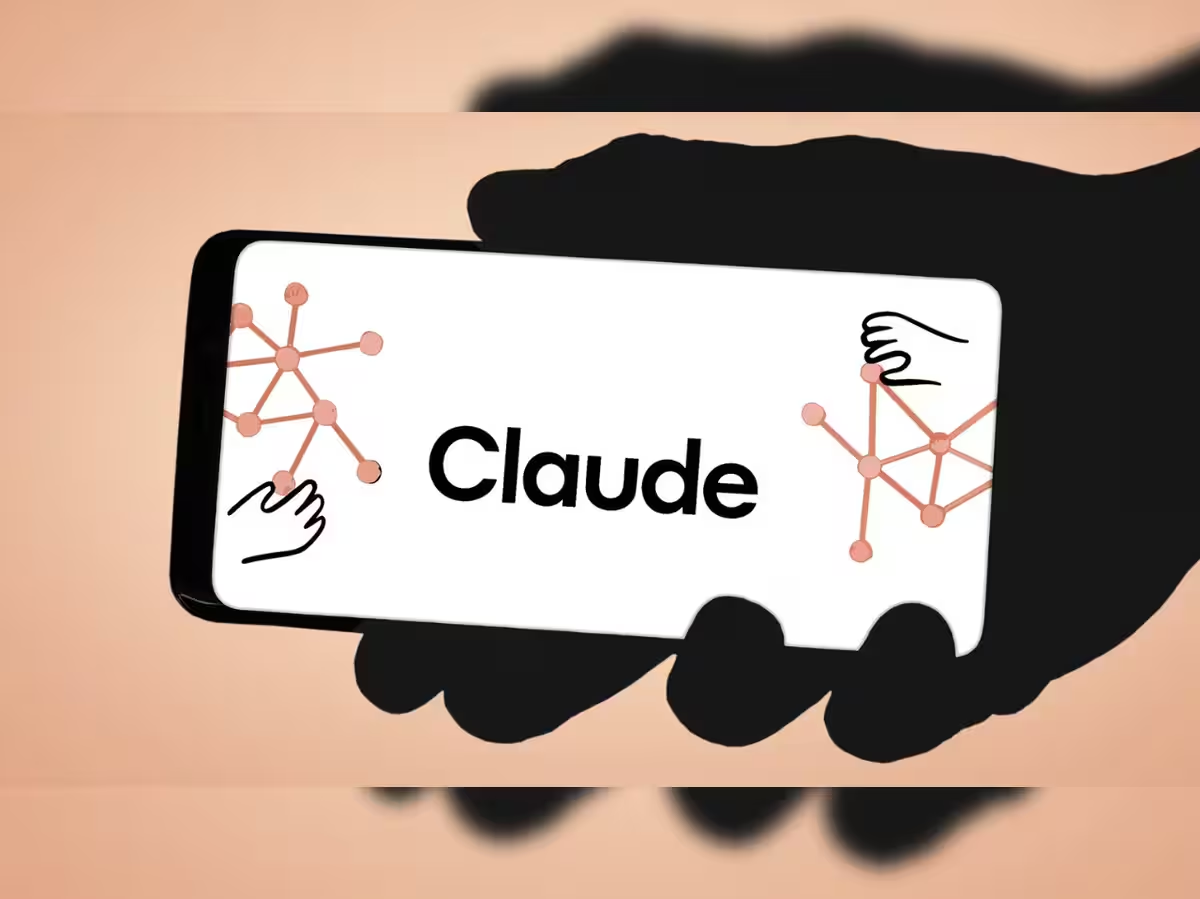
1Password has released a browser integration framework that allows Anthropic's Claude to access stored credentials when performing tasks on behalf of users. The integration solves one of the thorniest problems in the AI agent space: how do you let an AI act on your behalf across authenticated services without handing over your passwords?
The answer, according to 1Password, is to never expose the credentials at all. Instead, their new Agentic AI framework acts as a secure intermediary, injecting authentication at the moment Claude needs it while keeping the actual secrets locked in 1Password's vault.
How the authentication handoff works
When Claude needs to log into a service or use an API key, the 1Password browser extension intercepts the request. The user sees a prompt asking whether to authorize the action. If approved, 1Password fills the credential directly into the browser session. Claude never sees the password itself.
This matters because most AI agent implementations today require users to paste credentials into prompts or store them in configuration files the agent can read. Both approaches create security holes. Credentials in prompts can end up in logs. Config files can be exfiltrated. 1Password's approach keeps the credential in the vault until the exact moment of use, then immediately discards it from memory.
The framework also handles API keys and other secrets developers need when building automated workflows. Teams using tools like Zapier, Make, or n8n for automation often face the same credential exposure problem. 1Password's integration could extend to these platforms as the framework matures.
Disclosure
Some links in this post are affiliate links — Logicity earns a commission if you sign up, at no extra cost to you. We only link products we have used or actively recommend.
Why Anthropic gets the first integration
Claude's architecture makes it a natural fit for this kind of browser-based credential handoff. Anthropic has positioned Claude as an AI that can use computer interfaces the way humans do, clicking buttons, filling forms, and navigating between applications. That capability requires authentication, and authentication requires trust.
1Password has over 150,000 business customers and more than 21 million individual users. For enterprise deployments, the integration creates a clear audit trail. Security teams can see exactly which credentials Claude accessed, when, and for what purpose. That visibility is table stakes for regulated industries.
The password management market is projected to reach $9.51 billion by 2029, growing at 17.4% annually. AI agent authentication could become a significant driver of that growth as more companies deploy autonomous AI workflows.
What this means for DevOps workflows
Engineering teams already manage secrets through tools like HashiCorp Vault, AWS Secrets Manager, or 1Password's own Secrets Automation. The new framework bridges the gap between these enterprise secret stores and AI agents that need programmatic access.
Consider a deployment scenario where Claude needs to SSH into a production server, pull logs, and summarize errors. Today, that requires either giving Claude the SSH key directly or building custom middleware. With 1Password's framework, the key stays in the vault. Claude requests access, the user approves, and the connection is established without the credential ever leaving 1Password's control.
The same pattern applies to cloud console access, database connections, and third-party API calls. Each authentication event becomes auditable and revocable.
The broader agentic AI problem
Authentication is just one piece of the agent infrastructure puzzle. AI agents also need permission boundaries, execution sandboxes, and rollback capabilities. 1Password's integration addresses the credential layer but leaves other problems unsolved.
OpenAI, Google, and Microsoft are all building competing frameworks for AI agent deployment. Google recently shipped 13 Gemini Agent Platform demos through its Agent Development Kit, signaling how seriously the major labs take this market. The company that solves agent infrastructure first will likely capture significant enterprise share.
Google's competing approach to AI agent infrastructure
Real-world agent deployments have exposed gaps in current tooling. When SaaStr ran 21 AI agents for a week, authentication failures were among the most common issues. Agents would lose session state, fail to re-authenticate, or hit rate limits because they could not manage credential rotation.
Field report on AI agent reliability challenges
Logicity's Take
1Password is making a smart bet that AI agent infrastructure will become as important as CI/CD pipelines. The integration is limited today, working only with Claude through the browser extension, but the architecture could extend to any agent that interacts with authenticated web services. Competitors like Bitwarden, Dashlane, and LastPass will need to respond. For engineering leaders evaluating this now: the framework is most useful for teams already using 1Password Enterprise, which runs around $7.99 per user per month. If you are on Bitwarden or another manager, switching costs may not justify the agent benefits until the ecosystem matures.
What comes next
1Password has not announced pricing changes tied to the Agentic AI features. For now, the capability appears bundled into existing business and enterprise tiers. The company's $6.8 billion valuation, established during a $620 million Series C in 2022, gives it runway to invest in agent infrastructure without immediate monetization pressure.
The real test will be adoption. If Claude users start expecting credential integration as a default capability, other AI providers will need to build similar partnerships. That could turn password managers into a critical layer of the AI stack, not just a security tool.
Frequently Asked Questions
Does Claude ever see my passwords with 1Password integration?
No. The 1Password browser extension fills credentials directly into the browser session. Claude requests access but never receives the actual password or API key.
Which 1Password plans support the Claude integration?
The Agentic AI framework is available on 1Password Business and Enterprise tiers. Individual and family plans do not currently support AI agent authentication.
Can I use this with AI agents other than Claude?
Currently, the integration is designed for Anthropic's Claude. 1Password has not announced support for OpenAI, Google Gemini, or other AI assistants, though the framework could theoretically extend to them.
How do I audit which credentials an AI agent accessed?
1Password Enterprise includes activity logs that show credential access events. Each agent authentication request is recorded with timestamp, user approval, and the service accessed.
Need Help Implementing This?
If you are building AI agent workflows and need help with authentication architecture, credential management, or security reviews, reach out to our consulting team at Logicity. We work with engineering teams deploying production AI systems.
Source: The New Stack / Amanda Caswell
Huma Shazia
Senior AI & Tech Writer
Produced with AI assistance and reviewed by the Logicity editorial team. Learn more in our Editorial Policy.