Key Takeaways
xAI Open Sourced Grok Build... Days After This Happened!

- xAI has open-sourced Grok Build, a terminal-based AI coding agent written in Rust
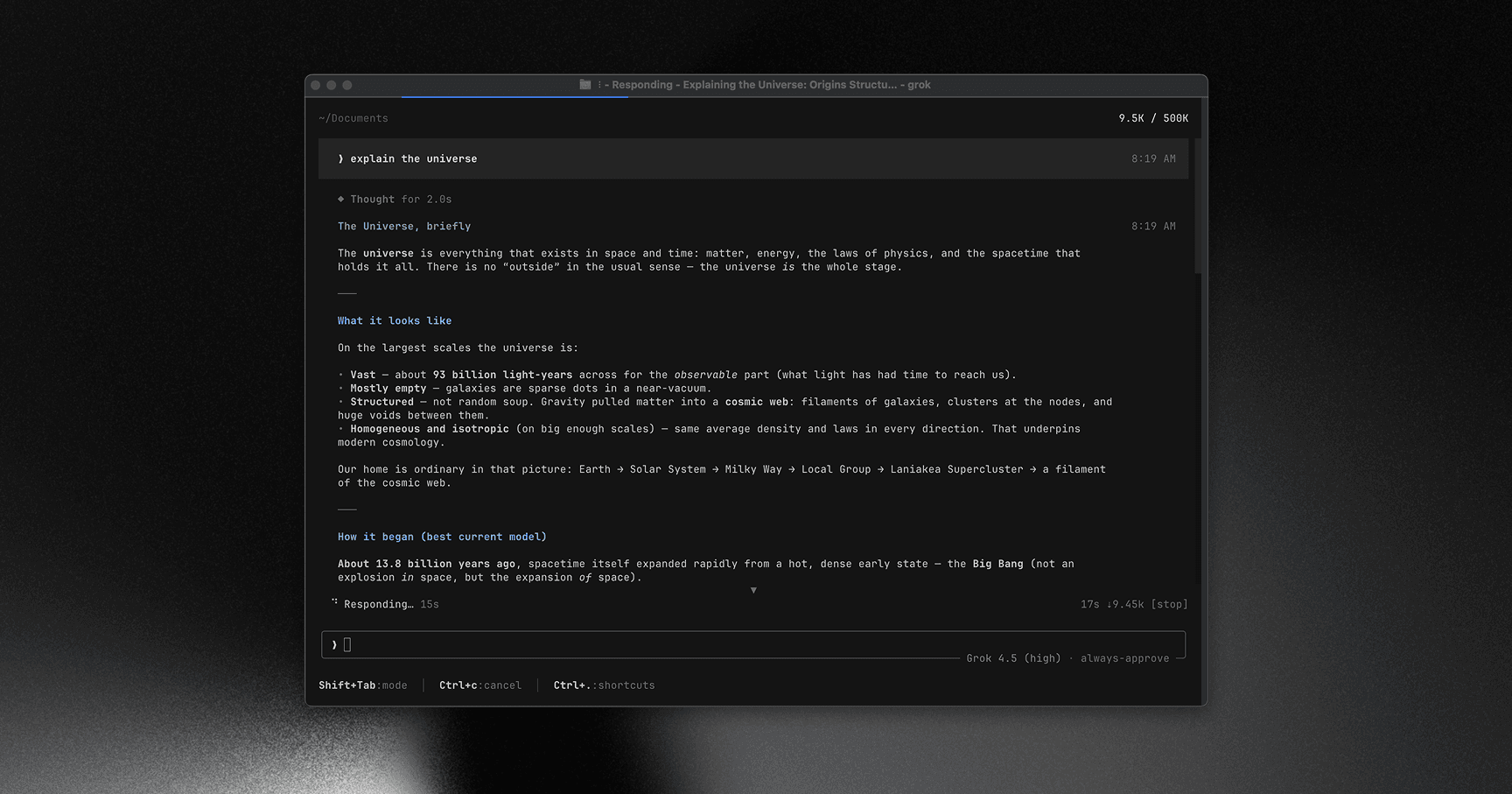
- The tool supports interactive TUI mode, headless CI scripting, and editor integration via Agent Client Protocol
- External contributions are not accepted, limiting community involvement despite open-source licensing
xAI has released Grok Build, its terminal-based AI coding agent, as open source under the Apache 2.0 license. The Rust application can edit files, execute shell commands, search the web, and manage long-running tasks. It works in three modes: an interactive full-screen terminal interface, headless operation for CI pipelines, and editor embedding through the Agent Client Protocol.
What Grok Build actually does
Grok Build is not a chatbot with a coding hobby. It is a dedicated coding agent that understands your entire codebase, not just the file you have open. The tool ships prebuilt binaries for macOS, Linux, and Windows, installable via curl or PowerShell one-liners. Developers who want to build from source need Rust and DotSlash, with proto codegen handled automatically.
The repository structure reveals a modular design. Separate crates handle the TUI rendering, agent runtime, tool implementations for file editing and terminal commands, workspace management including VCS and checkpoints, and sandbox execution. The codebase syncs periodically from SpaceXAI's internal monorepo, with a SOURCE_REV file tracking the specific commit.
The Agent Client Protocol angle
ACP support is the technically interesting piece here. The protocol allows Grok Build to embed into editors rather than forcing developers to context-switch to a separate terminal. This positions it against VS Code's Copilot integration and Cursor's native approach. For startups building internal tooling, ACP compatibility means potential integration with custom development environments.
The headless mode matters for different reasons. CI/CD pipelines can invoke Grok Build programmatically, opening possibilities for automated code review, refactoring passes, or test generation as part of build workflows. Whether teams trust an AI agent with commit-level autonomy is a separate question.
Open source, but no pull requests
Here is the catch: xAI does not accept external contributions. The CONTRIBUTING.md file makes this explicit. You can read the code, fork it, build on it under Apache 2.0 terms, but you cannot submit changes back to the main repository.
This is "source available" more than truly open source in spirit, even if the license technically qualifies. For enterprises evaluating the tool, the implication is clear. You can self-host and audit the code, but you are dependent on xAI's roadmap. Bug fixes and features come when xAI ships them, not when the community contributes them.
Why Rust matters for this use case
The Rust implementation is not marketing fluff. Terminal applications that parse large codebases, maintain scrollback buffers, and execute shell commands benefit from Rust's memory safety guarantees and performance profile. A Python or JavaScript agent doing the same work would either consume more memory or require careful manual optimization.
For startup engineering teams already comfortable with Rust, the codebase is readable and hackable. The third_party directory includes vendored Mermaid diagram rendering and acknowledged ports from OpenAI's Codex and SST's opencode implementations, with proper Apache Section 4(b) change notices.
Competitive positioning
Grok Build enters a crowded market. GitHub Copilot dominates editor-integrated assistance. Cursor has built a following among developers who want AI-native editing. Claude Code from Anthropic offers terminal-based agentic coding with strong reasoning capabilities. Smaller tools like Aider have cultivated open-source communities that actually accept contributions.
xAI's differentiation is the Grok model family underneath and the SpaceX engineering pedigree implied by the "SpaceXAI" branding in the repository. Whether Grok's coding performance matches or exceeds Claude or GPT-4 on real-world tasks remains to be benchmarked by the community now that the code is inspectable.
Logicity's Take
For startup founders, Grok Build's open-source release is less about the tool itself and more about what it signals. xAI is trying to build developer trust and ecosystem adoption by showing its work. The no-contributions policy limits that trust-building. If your team needs an AI coding agent today, Cursor ($20/month pro tier) and GitHub Copilot ($10-19/month) have stronger editor integrations. Claude Code offers superior reasoning for complex refactoring. Grok Build's value is in self-hosting and auditability, not community momentum.
Another AI coding tool challenging established players on both performance and price
Frequently Asked Questions
Is Grok Build completely free to use?
The source code is Apache 2.0 licensed, but using the tool requires authentication through xAI, which may involve API costs depending on your usage tier.
Can I contribute code to Grok Build?
No. xAI explicitly states in CONTRIBUTING.md that external contributions are not accepted. You can fork and modify for your own use.
Does Grok Build work offline?
The tool requires authentication on first launch and connects to xAI's services for inference. Fully offline operation is not supported.
How does Grok Build compare to GitHub Copilot?
Grok Build is a terminal-first agent that operates on entire codebases and executes commands. Copilot is primarily an inline code completion tool integrated into editors.
What operating systems does Grok Build support?
Prebuilt binaries are available for macOS, Linux, and Windows. Building from source is supported on macOS and Linux, with Windows builds described as best-effort.
Need Help Implementing This?
Evaluating AI coding tools for your engineering team? Logicity helps startups assess and integrate developer productivity tools. Contact us for a technical review tailored to your stack and workflow.
Source: Hacker News: Best
Huma Shazia
Senior AI & Tech Writer
Produced with AI assistance and reviewed by the Logicity editorial team. Learn more in our Editorial Policy.