Key Takeaways
RERIGHT · JPMorgan CEO Jamie Dimon says Anthropic's Mythos AI risks ar
- Jamie Dimon compared unrestricted Mythos AI access to 'giving ballistic missiles to individuals'
- The U.S. government temporarily restricted Anthropic's top AI models over national security concerns before lifting the order after new safeguards were added
- Mythos has drawn interest from banks for its ability to identify cybersecurity vulnerabilities faster than traditional methods
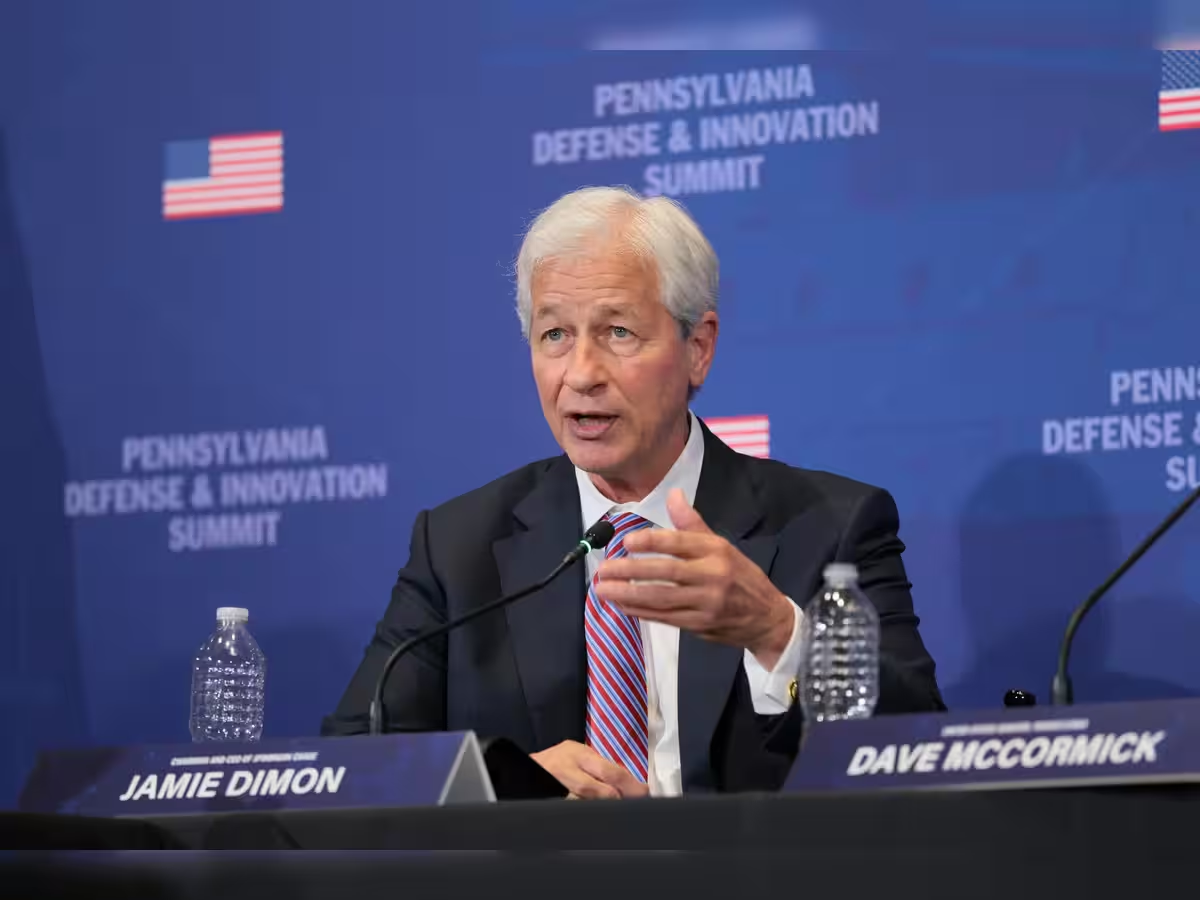
JPMorgan Chase CEO Jamie Dimon warned that Anthropic's Mythos AI model presents a "real issue" for national security, comparing uncontrolled access to the technology to "giving ballistic missiles to individuals." Speaking at Senator Dave McCormick's Pennsylvania Defense and Innovation Summit on Wednesday, Dimon said the U.S. government is "on top of" the risks posed by advanced AI systems.
The remarks come months after Washington intervened directly in Anthropic's operations. In June, the U.S. government ordered the company to restrict access to its top AI models, Fable 5 and Mythos 5, to foreign nationals. National security concerns drove the order. Anthropic was forced to cut off worldwide access until it implemented new safeguards that satisfied regulators.
Why banks want Mythos despite the risks
Anthropic released Mythos in April to a select group that included JPMorgan. The model's appeal to financial institutions is specific: it ranks among the most advanced AI systems for identifying cybersecurity vulnerabilities. Banks can use it to uncover and fix security weaknesses faster than traditional penetration testing allows.
That same capability creates the risk Dimon described. An AI system that can find software vulnerabilities for defenders can also find them for attackers. The dual-use problem sits at the center of Washington's growing concern about frontier AI models.
Washington tightens oversight on AI releases
The government's June intervention against Anthropic signals a shift in how regulators approach AI model releases. Washington has stepped up oversight amid fears that advanced AI could be exploited by military intelligence in China, Russia, or other adversarial nations. The concern isn't theoretical. AI systems capable of identifying zero-day vulnerabilities could give foreign intelligence services a significant advantage in cyber operations.
Anthropic eventually regained permission to distribute its models after implementing what the government deemed adequate safeguards. The company did not respond to requests for comment on Dimon's remarks.
Dimon's broader AI stance
Dimon has positioned himself as an AI realist rather than a skeptic. "AI is not hype. It's real," he wrote in his 2024 shareholder letter. JPMorgan has invested heavily in the technology, deploying it across trading, fraud detection, and customer service. The bank has described AI's potential impact as comparable to "the printing press, the steam engine, electricity, and computing."
His warning about Mythos doesn't contradict that enthusiasm. It reflects a view shared by many in finance and national security: the most capable AI systems require controlled access precisely because they work. A tool that genuinely accelerates vulnerability discovery is too powerful to distribute freely.
Logicity's Take
Dimon's comments reveal the uncomfortable reality facing enterprise AI adoption. The models most useful for defense are equally useful for offense. Banks and governments will likely push AI labs toward tiered access systems, where the most powerful capabilities remain restricted to vetted institutions. This creates a commercial opening for companies building AI security tools with narrower, auditable capabilities. Firms like CrowdStrike and Palo Alto Networks may benefit from enterprises seeking defensible alternatives to frontier models that attract regulatory scrutiny.
What this means for AI deployment
The episode illustrates a pattern likely to repeat. AI labs release powerful models. Governments assess national security implications. Access restrictions follow until safeguards are proven. For enterprises planning AI deployments, the lesson is that relying on frontier models carries regulatory risk. A model available today might not be available tomorrow.
Companies building on top of AI systems should consider diversifying their model dependencies. They should also expect that AI governance will increasingly resemble export controls on sensitive technology rather than typical software licensing.
Frequently Asked Questions
What is Anthropic's Mythos AI model?
Mythos is an advanced AI model from Anthropic that excels at identifying cybersecurity vulnerabilities. It was released in April to select organizations including JPMorgan Chase.
Why did the U.S. government restrict Anthropic's AI models?
The government ordered restrictions on Fable 5 and Mythos 5 in June over national security concerns that the models could be exploited by foreign intelligence services to identify software vulnerabilities.
Are Anthropic's AI models still restricted?
No. The government lifted restrictions after Anthropic implemented new safeguards that addressed national security concerns.
What did Jamie Dimon say about Mythos AI?
Dimon called the risks posed by Mythos a 'real issue' and said unrestricted access would be like 'giving ballistic missiles to individuals.'
Explores the competitive landscape of AI coding tools and open-source strategies
Covers AI model competition and pricing dynamics relevant to enterprise adoption
Need Help Implementing This?
If your organization is evaluating AI security tools or needs guidance on AI governance frameworks, contact Logicity's advisory team for vendor-neutral recommendations tailored to your risk profile.
Source: Tech-Economic Times / ET
Huma Shazia
Senior AI & Tech Writer
Produced with AI assistance and reviewed by the Logicity editorial team. Learn more in our Editorial Policy.