Key Takeaways
Chinese AI Startup Moonshot Unveils Kimi K3 Model

- Kimi K3 from Beijing-based Moonshot ranked first in Arena's front-end coding capability benchmark
- K3 costs half as much as OpenAI's GPT-5.6 Sol model according to Bank of America analysts
- Anthropic has accused Moonshot and other Chinese labs of using distillation to extract capabilities from Claude
Beijing-based startup Moonshot released Kimi K3 on Friday, and the model immediately claimed the top position on Arena's front-end coding capability benchmark, edging out Anthropic's Claude and OpenAI's ChatGPT. The timing was not accidental. K3 dropped hours before Chinese President Xi Jinping's opening address at the World Artificial Intelligence Conference in Shanghai.
"This may be the single biggest release of the year," said Anastasios Angelopoulos, co-founder and CEO of Arena, a platform for evaluating AI systems. He added that the release marks a moment when open-source Chinese models are surpassing closed US models. "More results are rolling in that are likely to continue to show it is at the top of the pack," Angelopoulos wrote on social media.
How much does Kimi K3 cost compared to GPT-5.6?
K3 carries the highest price tag yet for a Chinese AI model, but it still undercuts American competitors. According to Bank of America research analysts, K3 costs half as much as OpenAI's GPT-5.6 Sol model. The pricing gap matters for enterprises running inference at scale, where API costs compound quickly.
The release follows a pattern established by DeepSeek in early 2025, when that company's model triggered a market-shaking panic among investors. Not everyone buys the hype this time. Tech analyst Patrick Moorhead called the response to K3 an "overreaction shockingly similar" to DeepSeek's release. He acknowledged it could benefit parts of the broader AI industry but pose a revenue challenge to Anthropic and OpenAI.
Who is behind Moonshot AI?
Moonshot's co-founder and CEO Yang Zhilin earned his Ph.D. in 2019 at Carnegie Mellon University, where he made fundamental contributions to machine learning research. Former colleagues describe him as a devoted fan of Pink Floyd. The startup has raised over $1 billion in funding and partners with Huawei, though Moonshot has not disclosed what hardware powered K3's training.
The Carnegie Mellon connection is not just trivia. Yang's academic work fed directly into the architecture choices that make Moonshot's models competitive. Pride among his former colleagues in Pennsylvania reportedly transcends the US-China rivalry.
Distillation accusations and the two-way street
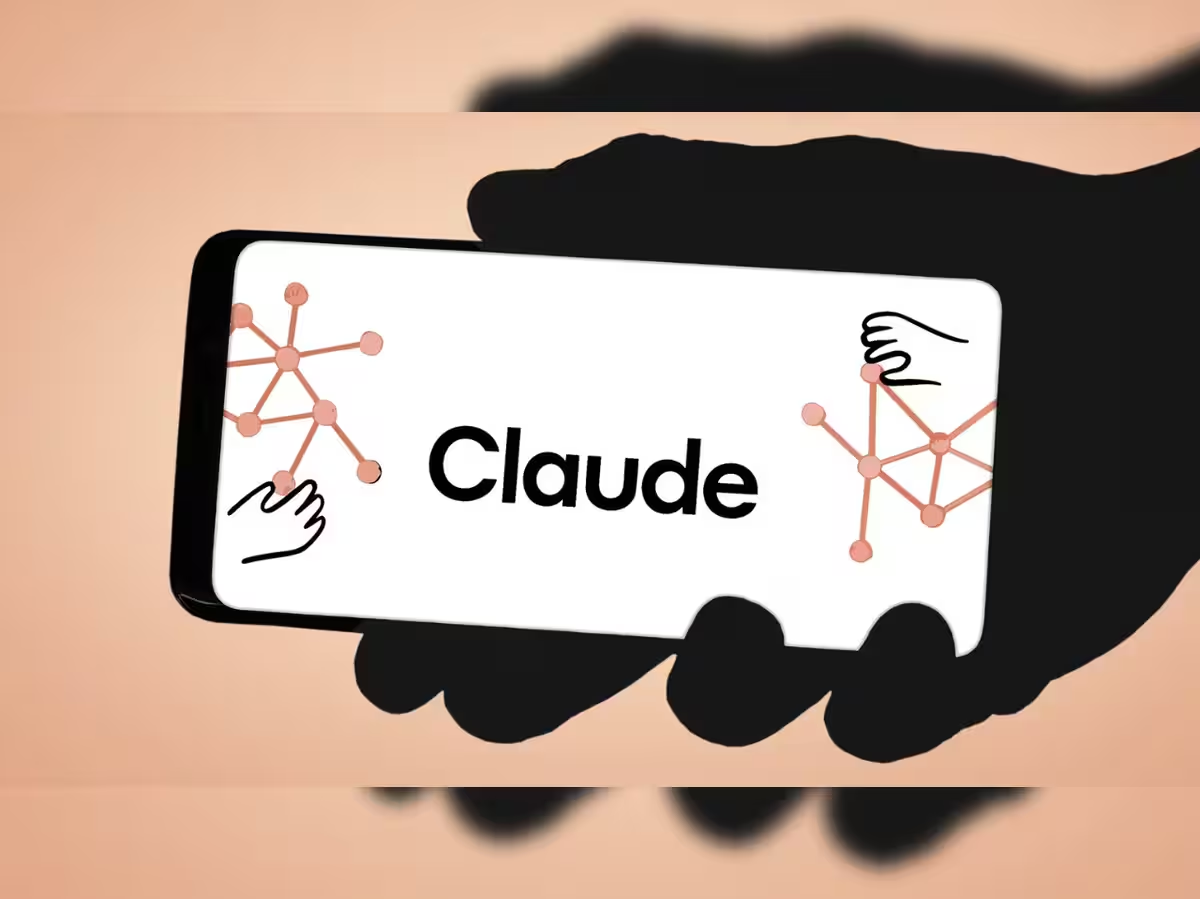
Anthropic accused Moonshot, DeepSeek, and MiniMax in February of engaging in campaigns to "illicitly extract Claude's capabilities to improve their own models." The technique in question, called distillation, involves training a less capable model on the outputs of a stronger one. Anthropic argues this lets competitors "acquire powerful capabilities from other labs in a fraction of the time, and at a fraction of the cost, that it would take to develop them independently." Beijing calls the accusations "groundless."
But the influence runs both ways. San Francisco-based Anysphere, maker of the popular coding tool Cursor, acknowledged that one of its top products was based on Moonshot's K2.5 model. Elon Musk's SpaceX is reportedly planning to acquire Cursor for $60 billion later this year. If that deal closes, Moonshot's technology will sit inside an American aerospace company.
China's hardware push despite US restrictions
American-led export controls have blocked China from accessing Nvidia's most advanced chips. At the same conference where K3 debuted, Huawei showcased a new AI computing system called the Atlas 950 SuperPoD. The demonstration signals that China is assembling domestic hardware capable of training frontier models despite the restrictions.
Xi addressed the geopolitical tension directly. "The development of artificial intelligence should not be a solo performance by any single country but rather a symphony of global cooperation," he said at the event.
What this means for open-source AI
K3 arrives weeks after Zhipu released its GLM-5.2 model, which software developers globally report performs nearly as well as top US models at a lower price. The succession of releases suggests Chinese open-source models are no longer trailing; they are setting the pace on specific benchmarks.
For companies evaluating AI vendors, the calculus is shifting. Open-source models from China offer cost advantages and avoid lock-in to any single provider. The tradeoff involves geopolitical risk, supply chain considerations, and questions about the provenance of the training data.
Logicity's Take
The benchmark win matters less than the pricing. Kimi K3 at half the cost of GPT-5.6 Sol forces OpenAI and Anthropic into an uncomfortable position: match the price and compress margins, or justify the premium with capabilities that benchmarks cannot capture. For CTOs evaluating inference costs at scale, the China-based models now demand serious consideration even if you end up choosing Claude or GPT for compliance reasons. The real story is not which model tops this week's leaderboard. It is that frontier AI is now a two-player game with different economic models.
Frequently Asked Questions
What benchmark did Kimi K3 win?
Kimi K3 ranked first on Arena's front-end coding capability benchmark, surpassing Claude and ChatGPT.
How much cheaper is Kimi K3 than OpenAI's model?
Bank of America analysts report K3 costs half as much as OpenAI's GPT-5.6 Sol model.
What is AI distillation and why is it controversial?
Distillation trains a smaller model on the outputs of a more capable one. Anthropic accuses Chinese labs of using this technique to extract Claude's capabilities without independent development.
Who founded Moonshot AI?
Yang Zhilin, who earned his Ph.D. at Carnegie Mellon University in 2019 and is known for contributions to machine learning research.
Is Cursor based on Moonshot technology?
Yes, Anysphere acknowledged that one of Cursor's top products was based on Moonshot's earlier K2.5 model.
Need Help Implementing This?
If you're evaluating AI models for enterprise use or need guidance on navigating the open-source vs. proprietary tradeoffs, reach out to the Logicity team at hello@logicity.in.
Source: Tech-Economic Times / ET
Manaal Khan
Tech & Innovation Writer
Produced with AI assistance and reviewed by the Logicity editorial team. Learn more in our Editorial Policy.