Key Takeaways
- China has nearly doubled its nuclear capacity since 2016, reaching 60 GW with standardized gigawatt-scale reactors
- US nuclear construction costs roughly $15 per watt compared to China's $2-3 per watt
- Small modular reactors attract US investment but remain years away from grid-scale deployment
Two Nuclear Strategies, Two Different Outcomes
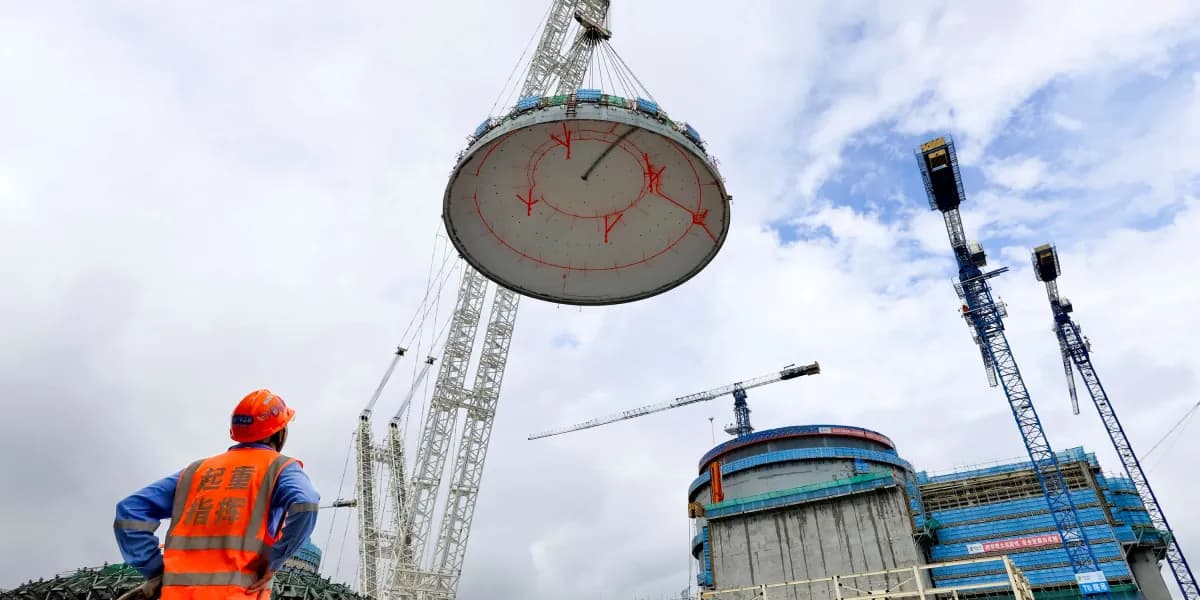
China is building nuclear reactors the way other countries build apartment blocks. Since 2016, the country has nearly doubled its nuclear fleet, reaching close to 60 gigawatts of total capacity. The facilities coming online are nearly all gigawatt-scale pressurized-water reactors, built to a standardized design that China has refined over two decades.
In that same period, the United States completed exactly two reactors: Unit 3 and Unit 4 at Plant Vogtle in Georgia. France, which generates about two-thirds of its electricity from nuclear power, connected its latest reactor to the grid in December 2024. It was the country's first new reactor in over 20 years.
The gap is not just about quantity. It is about speed and cost. China builds advanced Generation III reactors for roughly $2 to $3 per watt. The US pays approximately $15 per watt. China completes a reactor in 6 to 7 years. Plant Vogtle took over a decade.
Why Big Reactors Are Hard in the West
Building a gigawatt-scale nuclear plant is one of the most complex construction projects humans undertake. The upfront investment runs into the billions. Investors need to wait decades to break even. Designs are intricate, and they often change during the regulatory approval process. Each change adds cost and time.
The US and France remain global leaders on paper. The US operates the world's largest nuclear fleet. France ranks second. But neither country has built reactors at scale in years. Their existing fleets are aging, and the pipeline for replacements is thin.
China took a different path. The country standardized on designs like the Hualong One, a domestically developed pressurized-water reactor. By building the same reactor repeatedly, Chinese firms moved down the learning curve. Workers got faster. Supply chains got cheaper. The government backed the effort with consistent funding and streamlined approvals.
The US Bet on Small Modular Reactors
Many in the US believe smaller reactors can break the cycle. The logic is straightforward: a smaller reactor needs less upfront capital. It can be assembled in a factory rather than built on-site. Over time, factory production should drive costs down.
The Department of Energy has pushed this approach with a new pilot program. The department set a goal last year: three test reactors reaching criticality by July 4, 2026, the nation's 250th anniversary. Criticality is the point at which a reactor achieves a self-sustaining chain reaction that can release energy.
Last week, California-based Antares hit that milestone with its Mark-0 reactor. The company plans to build microreactors designed to produce between 100 kilowatts and 1 megawatt of electricity. For context, large reactors on the grid today produce at least 1,000 times that amount.
The Mark-0 uses a sodium-cooled core design and TRISO fuel. TRISO fuel consists of self-contained graphite-coated spheres containing more concentrated fuel than conventional reactors use. But the Mark-0 is far from commercial. It lacks power conversion and heat removal systems. It cannot actually produce electricity yet.
“The race isn't just about the technology itself; it's about the speed and scalability of the supply chain.”
— Michael Foster, Nuclear Infrastructure Specialist
The Scale Problem
Small modular reactors face a math problem. A 1-megawatt microreactor produces one-thousandth the power of a standard gigawatt reactor. To match China's output, the US would need to deploy thousands of small reactors. Each would need regulatory approval, grid connection, and ongoing maintenance.
| Metric | China (Large Reactors) | US (SMR Approach) |
|---|---|---|
| Cost per watt | $2–$3 | ~$15 (Vogtle benchmark) |
| Construction time | 6–7 years | 10+ years (large); SMRs TBD |
| Reactors under construction | 36–50 | SMR prototypes only |
| Grid capacity added since 2016 | ~30 GW | ~2.2 GW (Vogtle units) |
The small reactor approach may prove viable for niche applications: remote military bases, industrial facilities, or backup power for data centers. But replacing coal plants and meeting rising electricity demand from AI data centers requires grid-scale power. That means either many small reactors or fewer large ones.
The AI Energy Crunch
Electricity demand is climbing. Data centers for AI training and inference consume enormous amounts of power. Hyperscalers like Microsoft, Google, and Amazon are signing power purchase agreements years in advance. Some are exploring nuclear power directly.
Online forums have taken notice. Discussions on Reddit's r/Nuclear focus on what some call the "AI energy crisis." The argument: if the US cannot build power generation fast enough, it risks losing the infrastructure race to countries that can. China's standardized fleet model is the obvious comparison point.
On HackerNews, debate centers on whether China's construction pace introduces safety risks. Some users argue that the slow, heavily regulated US approach produces higher-quality plants. Others counter that regulatory complexity itself creates risk by delaying zero-carbon power.
What Happens Next
China's target is carbon neutrality by 2060. Nuclear power is a core pillar of that strategy. The country will likely continue building large reactors at its current pace, adding tens of gigawatts of capacity over the next decade.
The US path is less clear. The Department of Energy's pilot program will test whether small reactors can move from lab to deployment. Private companies are raising capital. But none have demonstrated that they can build reactors cheaply and quickly at scale.
France offers a cautionary tale. The country once led the world in nuclear construction. Then it stopped building. Restarting that capability has proven difficult and expensive. The US may face the same challenge if it waits too long to scale up.
Logicity's Take
Frequently Asked Questions
Frequently Asked Questions
How many nuclear reactors is China currently building?
Estimates range from 36 to 50 reactors under construction simultaneously, representing nearly half of all global new-build nuclear projects.
Why are US nuclear reactors so expensive compared to China?
US projects face higher labor costs, complex regulatory processes that often change designs mid-construction, and a lack of recent building experience. China benefits from standardized designs, a trained workforce, and consistent government backing.
What is a small modular reactor (SMR)?
SMRs are nuclear reactors with power output typically under 300 megawatts. They are designed to be factory-built and transported to sites, potentially reducing costs through standardization.
Can small reactors power AI data centers?
Potentially, but current prototypes produce far less power than data centers need. A single large data center can require hundreds of megawatts. Most SMR designs under development would need to be deployed in clusters to meet that demand.
When will US small modular reactors be commercially available?
No firm timeline exists. The first US SMR projects are in early testing phases. Commercial deployment at scale is likely still several years away, pending regulatory approvals and demonstrated cost reductions.
Another look at how AI is reshaping infrastructure demands
Need Help Implementing This?
Source: MIT Technology Review
Manaal Khan
Tech & Innovation Writer
Produced with AI assistance and reviewed by the Logicity editorial team. Learn more in our Editorial Policy.