Key Takeaways
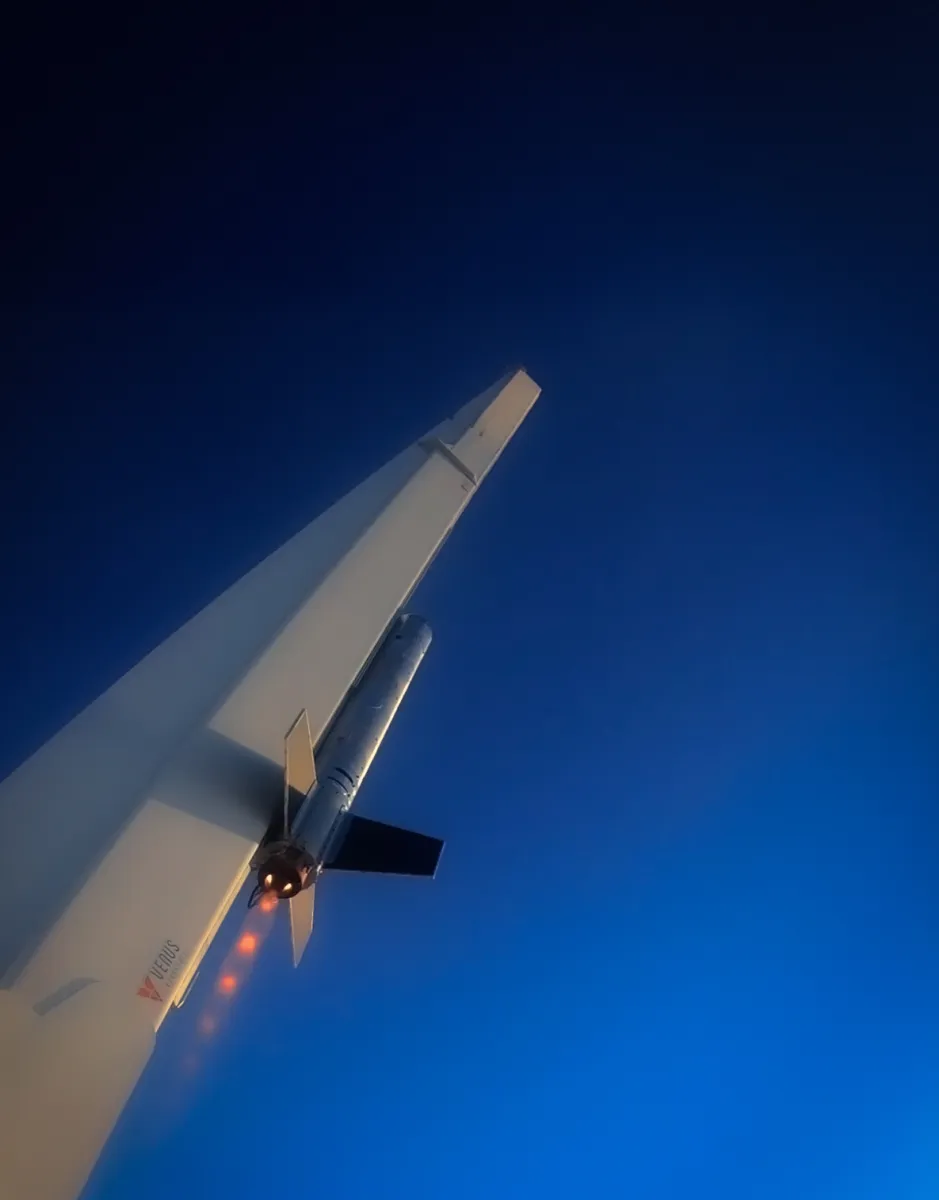
- Venus Aerospace raised $90M Series B led by Mercury Fund with Lockheed Martin Ventures participating
- The company pivoted from passenger hypersonic jets to defense applications after its May 2025 RDRE flight test
- Venus must extend engine burn time from 32 seconds to 6-15 minutes to meet military customer requirements
Venus Aerospace closed a $90 million Series B round to scale production of its Rotating Detonation Rocket Engine, a propulsion system that drew unexpected military interest after the company flew one last May. The Houston-based startup, founded by husband-and-wife team Sassie and Andrew Duggleby in 2020, originally set out to build hypersonic passenger jets. That plan is now on hold.
Mercury Fund led the round. Lockheed Martin Ventures, MESH, PEAK6, Draper Associates, Starboard Star Venture Capital, and Green Sands Equity also participated. The capital will fund testing and development work on vehicle designs with potential defense customers.
Why the pivot from passenger travel to weapons?
The answer is straightforward: customers showed up. After Venus successfully demonstrated the first RDRE-powered rocket flight in May 2025, defense contractors came calling with a question the Dugglebys did not anticipate.
“What happened when we flew last May is the world looked at us and said, 'oh my gosh, you have a working RDRE, would you sell us one?' And that wasn't what we were expecting.”
— Sassie Duggleby, CEO, Venus Aerospace
Venus now focuses on replacing the solid rocket motors in existing missiles with its own thruster, plus building high-speed space vehicles for military applications. The company believes its engine architecture combines efficiency, throttling capability, reusability, and manufacturability in ways existing propulsion systems cannot match.
What makes the RDRE different from conventional rockets?
Rotating Detonation Rocket Engines date back to mid-20th century theory. Instead of burning propellants in a traditional combustion chamber, an RDRE creates a continuous supersonic detonation wave that rotates through a circular channel. The physics promised less wasted propellant, but proved difficult to control in practice.
That changed with 3D printing and better computational simulations. The University of Central Florida ran the first working RDRE test in 2020. NASA demonstrated one on the ground in 2022. Japan's space agency JAXA fired one briefly in space in 2021. Venus's May 2025 test was the first RDRE to actually launch a rocket into flight.
The core engineering challenge has been heat management. "When we first started Venus, the entire story was there's a new type of rocket engine, we think it's going to put out more heat and more thrust and be more efficient, but we think we know how to keep it from melting," Sassie Duggleby explained. "That's been a lot of what our work has been over the last four years, how do we keep this engine from melting, and we've solved that."
The burn time problem Venus still needs to solve
Proving the engine works is one thing. Proving it works long enough is another. Across 600 tests, the longest Venus has fired its RDRE is 32 seconds. Defense and space applications will require sustained burns of 6 to 15 minutes. That gap explains where much of the $90 million will go.
The Texas Space Commission awarded Venus a grant earlier this year to build a larger test stand. Scaling up testing infrastructure is essential before the company can validate engines for operational use.
Where Lockheed Martin fits in
Lockheed Martin Ventures' participation signals strategic interest, not just financial. Lockheed builds many of the missiles and hypersonic vehicles that could eventually carry Venus engines. A venture investment often precedes deeper partnerships or acquisition conversations if the technology matures.
For Venus, having a prime defense contractor on the cap table provides credibility with government procurement officials and potential access to classified programs where hypersonic propulsion matters most.
Logicity's Take
Venus is betting that defense customers will pay for RDRE development today, creating the production scale and reliability track record needed to eventually return to civilian hypersonic transport. It is a pragmatic path, but the passenger jet vision is now years further out. The real test comes when Venus must demonstrate minutes of sustained burn rather than seconds. Defense customers tolerate long development cycles, but they demand results. If the company clears the 6-minute threshold, expect acquisition interest to accelerate. If not, $90 million goes faster than founders expect.
Frequently Asked Questions
What is a Rotating Detonation Rocket Engine?
An RDRE uses a continuous supersonic detonation wave rotating through a circular channel, rather than traditional combustion. This design can extract more thrust from the same amount of propellant, making it theoretically more efficient than conventional rocket engines.
Why did Venus Aerospace pivot from passenger jets to defense?
After demonstrating the first RDRE-powered flight in May 2025, defense contractors approached Venus with unexpected demand for the engine technology. The company shifted focus to hypersonic weapons and military space vehicles where near-term revenue is available.
How much has Venus Aerospace raised in total?
With this $90 million Series B and its previous $33 million Series A in 2022, Venus has raised over $120 million, plus grants including one from the Texas Space Commission.
When will Venus Aerospace engines be ready for operational use?
The company must first extend engine burn time from 32 seconds to 6-15 minutes. No timeline has been announced, but the Series B funds testing and development work toward meeting defense customer requirements.
Another founder-led startup raising capital to build infrastructure for an emerging technology category
Need Help Implementing This?
If you're tracking aerospace and defense technology investments or building competitive intelligence systems for deep tech, reach out to the Logicity team for research support and analysis.
Source: TechCrunch / Tim Fernholz
Manaal Khan
Tech & Innovation Writer
Produced with AI assistance and reviewed by the Logicity editorial team. Learn more in our Editorial Policy.