Key Takeaways
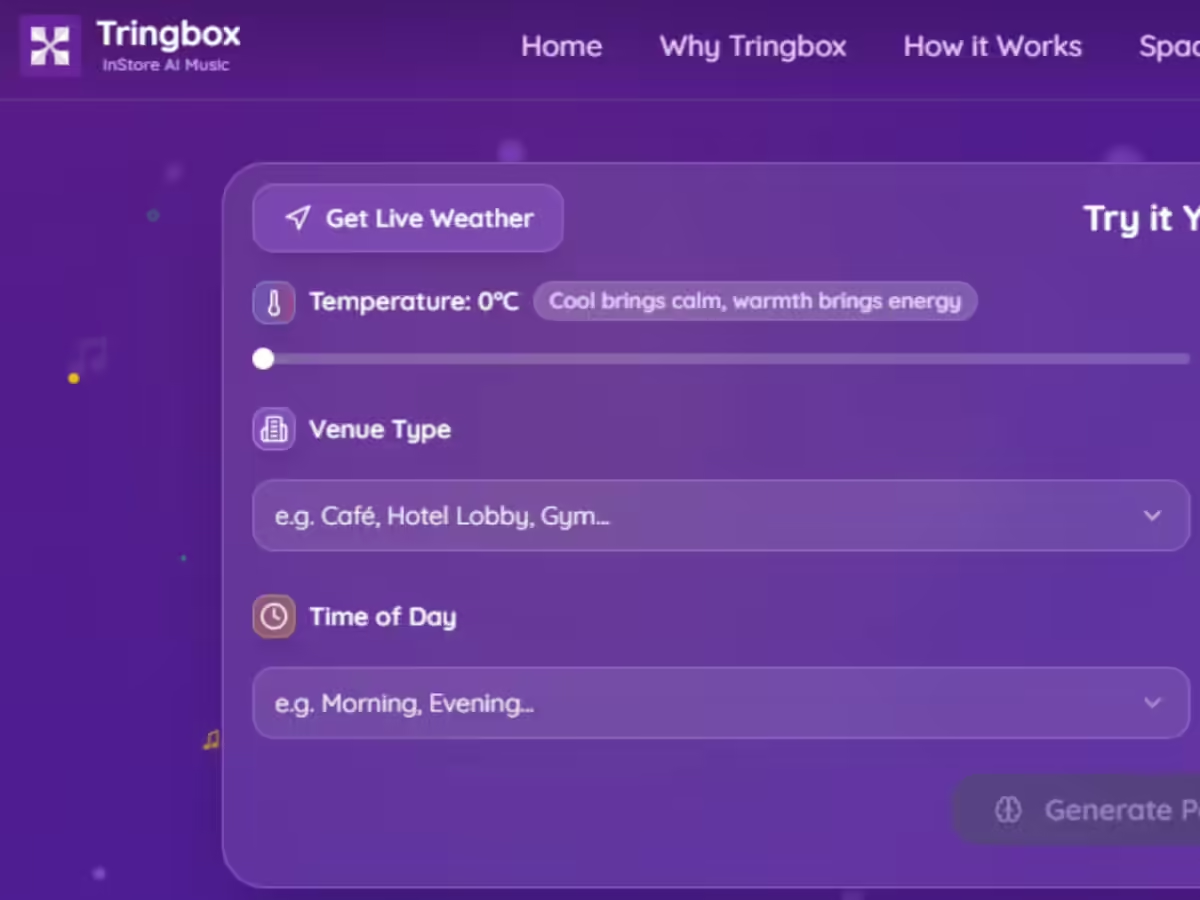
- Tringbox raised ₹5 crore in seed funding led by Nikhil Gandhi's GIPL with participation from Paytm's CBO
- The startup uses a 'Hybrid Neuro-Symbolic Music Engine' to adjust venue music based on weather, time, and customer mood
- Funds will go toward product development, music licensing, and expanding deployments beyond 30+ current venues
Tringbox, a Mumbai-based startup building AI-powered background music for commercial spaces, has raised ₹5 crore in seed funding. The round was led by Nikhil Gandhi through GIPL, with participation from MGB Family Office, Paytm Chief Business Officer Narendra Singh Yadav, and other angel investors.
The company emerged from a year of stealth mode with a product that goes beyond standard playlist curation. Its system adjusts what plays in cafés, hotels, gyms, and retail stores based on real-time signals: weather outside, time of day, crowd density, and what Tringbox calls customer mood detection.
How Tringbox's music engine works
At the core is what the company calls a "Hybrid Neuro-Symbolic Music Engine." The name sounds like marketing, but the concept is straightforward: combine machine learning (the neural part) with rule-based logic (the symbolic part) to make decisions about track selection.
A café on a rainy Monday morning gets different music than the same café on a sunny Saturday afternoon. The system pulls environmental data and adjusts tempo, genre, and energy level without requiring a human DJ or manager to intervene.
The company currently operates across 30+ premium venues in India. That number is small, but the seed funding suggests investors see a path to scale. Commercial background music is a fragmented market dominated by legacy licensing deals and generic playlists. An AI-first approach could consolidate it.
Where the ₹5 crore will go
Tringbox laid out a broad spending plan. The priorities include:
- Product and AI development to improve the music engine
- Technology infrastructure for scaling deployments
- Music licensing and catalogue expansion
- Compliance work, likely around PPL and IPRS regulations in India
- Hiring in product, engineering, and operations
- Business development and brand partnerships
The licensing piece is critical. Playing music in commercial venues requires proper licenses from collecting societies. Many Indian businesses either ignore this or pay blanket fees for generic catalogues. Tringbox handling licensing compliance as part of its service could be a selling point for venue owners who want to stay legal without the paperwork.
Why investors are betting on contextual audio
The investor mix is notable. Nikhil Gandhi leading through GIPL brings media and entertainment experience. Narendra Singh Yadav from Paytm brings distribution muscle and fintech connections that could help Tringbox bundle with payment or POS systems in retail.
The broader thesis: as physical retail fights for relevance against e-commerce, store atmosphere becomes a differentiator. Music is a low-cost lever. If Tringbox can prove that its AI-driven selections increase dwell time or purchase rates, the product sells itself.
Similar plays exist globally. Soundtrack Your Brand in Sweden raised significant venture capital for a similar premise. In the US, companies like Rockbot and Custom Channels serve chains. India's fragmented retail market, with its mix of organized chains and independent stores, presents different challenges but also less entrenched competition.
The execution risks ahead
Tringbox faces the classic hardware-software hybrid challenge. Its "intelligent speaker network" means physical devices in venues. That requires installation, maintenance, and support in a way that pure software does not. Scaling from 30 to 300 venues is one problem. Scaling to 3,000 is a different problem entirely.
Music licensing in India is also messy. The Phonographic Performance Limited (PPL) and Indian Performing Right Society (IPRS) have overlapping jurisdictions and inconsistent enforcement. Tringbox positioning itself as the compliant option works only if competitors face actual consequences for non-compliance.
There is also the question of whether venue owners care. A café owner focused on rent, wages, and food costs may not prioritize sophisticated background music. Tringbox will need to prove ROI in terms those owners understand: more customers, longer visits, higher tickets.
Logicity's Take
Tringbox is entering a market that barely exists in India's organized form. That is both the opportunity and the risk. The company's success depends less on AI sophistication and more on execution: can they sign venues quickly, keep hardware working reliably, and demonstrate measurable business impact? At ₹5 crore, this is a modest bet to prove the model before a larger raise. Watch for deployment numbers and retention rates over the next 12 months.
Frequently Asked Questions
What does Tringbox do?
Tringbox provides AI-powered background music for commercial venues like cafés, hotels, and gyms. Its system automatically adjusts music based on factors like weather, time of day, and customer mood.
How much funding did Tringbox raise?
Tringbox raised ₹5 crore in seed funding, led by Nikhil Gandhi through GIPL, with participation from MGB Family Office and Paytm CBO Narendra Singh Yadav.
How many venues does Tringbox currently serve?
Tringbox operates across 30+ premium venues in India as of its emergence from stealth mode.
Does Tringbox handle music licensing for venues?
Yes. Part of the company's value proposition includes music licensing, catalogue expansion, and compliance with Indian collecting societies like PPL and IPRS.
Who are Tringbox's competitors?
Globally, similar services include Soundtrack Your Brand (Sweden), Rockbot, and Custom Channels (US). In India, the organized commercial music market is less developed, with most venues using generic playlists or unlicensed music.
Another recent AI investment story focused on the Indian market
Need Help Implementing This?
If you're a venue owner exploring AI-powered music solutions or a startup building in the contextual audio space, reach out to our team at Logicity.in for introductions and technical guidance.
Source: Tech-Economic Times / ET
Manaal Khan
Tech & Innovation Writer
Produced with AI assistance and reviewed by the Logicity editorial team. Learn more in our Editorial Policy.




