Key Takeaways
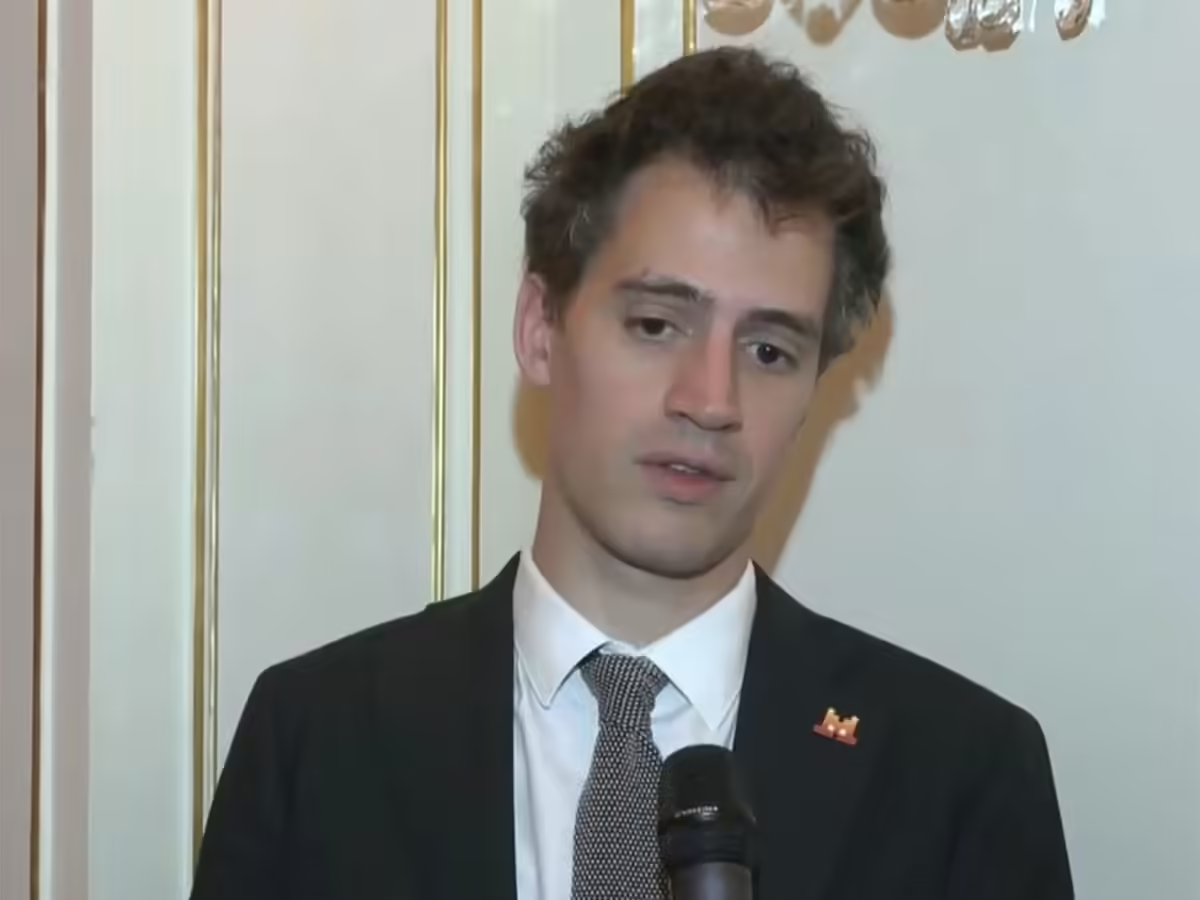
- Mistral AI CEO Arthur Mensch met PM Modi in Paris to discuss building sovereign AI capabilities in India
- The partnership would focus on AI infrastructure that escapes foreign control and supports India's 22 official languages
- Mensch emphasized training the population and partnering with Indian startups to accelerate AI adoption
Mistral AI CEO Arthur Mensch met Prime Minister Narendra Modi in Paris this week to discuss a potential partnership on sovereign AI, the French company's term for AI systems built on local infrastructure and free from foreign control. The meeting signals India's growing interest in alternatives to US and Chinese AI dominance.
"We discussed artificial intelligence," Mensch told ANI after the meeting. "We're a company building sovereign AI capabilities across the world. The discussion revolved around how to build a full-stack solution that is resilient and that is escaping foreign control, which is something that we can help with."
What does sovereign AI actually mean?
Sovereign AI refers to a country's ability to develop, train, and deploy AI models using its own data, infrastructure, and talent. For India, this means AI systems trained on local languages and cultural contexts rather than relying on models built primarily for English-speaking Western markets.
Mensch framed the stakes in strong terms: "AI is too important a technology not to be controlled by sovereign states and not to be controlled by sovereign companies." The statement positions Mistral, valued at $6.8 billion after recent funding rounds, as a European alternative to OpenAI, Google, and Chinese players like Baidu.
The company's open-weight model approach differs from the closed systems typical of major US AI labs. This openness appeals to governments wary of depending on black-box technology from foreign corporations.
Why is India interested in Mistral?
India has 22 official languages and over 19,500 dialects. Most large language models perform poorly outside English, creating a gap that domestic or partnership-driven solutions could fill. Mensch emphasized making AI "available to everyone, both to the citizens, to the civil servants."
The CEO also pitched a broader ecosystem play: training Indian startups on the technology, partnering with local companies, and "general training of the population so that they make better use of that technology to learn faster and to build business faster."
Mensch described Modi as having strong "understanding and leadership" on AI, noting alignment between the PM's vision and Mistral's three-year strategy. "There's actually very strong alignment with what he says and what we've been saying," he said.
What comes next?
The Ministry of External Affairs confirmed Modi "highlighted the opportunities in India's growing AI ecosystem" and that Mensch "expressed Mistral AI's strong interest in collaborating with India and partnering with Indian companies to drive innovation and expand AI capabilities."
No specific deal was announced. The meeting appears to be exploratory, part of Modi's broader Paris visit. But it follows a pattern: India has been courting AI partnerships while simultaneously pushing domestic initiatives like the India AI Mission.
The sovereign AI framing resonates with India's broader tech policy. The country has already pushed for data localization requirements and shown skepticism toward unrestricted foreign tech access. A partnership with a European company that emphasizes openness and local control fits that narrative better than deals with US tech giants.
The skeptic's view
Online discussion around the meeting has been mixed. Some observers on HackerNews and tech forums question whether "sovereign AI" is genuine digital independence or simply protectionism with a friendlier label. Others note that true AI sovereignty requires compute infrastructure, talent pipelines, and massive training datasets, not just partnership announcements.
Mistral's open-weight models do offer more transparency than closed alternatives, but building competitive AI still requires GPU clusters, power infrastructure, and engineering talent that India is still scaling. The real test will be whether any partnership produces models that meaningfully outperform existing options for Indian use cases.
Logicity's Take
The meeting matters less for what was announced (nothing concrete) and more for what it signals: India is shopping for AI partners who won't lock it into US or Chinese dependency. Mistral's open-weight approach and European base make it a politically palatable option. But sovereign AI requires more than diplomatic photo ops. India needs to convert partnership talks into actual training runs on Indian-language data, or 'sovereignty' remains a talking point rather than a technical reality.
Related coverage of AI infrastructure investments shaping the global compute landscape
Frequently Asked Questions
What is sovereign AI?
Sovereign AI refers to AI systems developed, trained, and deployed using a country's own data, infrastructure, and talent, reducing dependence on foreign technology providers.
Who is Arthur Mensch?
Arthur Mensch is the co-founder and CEO of Mistral AI, a French AI company valued at $6.8 billion that focuses on open-weight language models as an alternative to US tech giants.
Why does India want sovereign AI capabilities?
India has 22 official languages and wants AI systems trained on local data and cultural contexts. Sovereign AI would reduce reliance on foreign models that perform poorly outside English.
Did Mistral AI and India announce a deal?
No specific partnership or deal was announced. The Paris meeting was exploratory, with both sides expressing interest in future collaboration.
How does Mistral AI differ from OpenAI?
Mistral AI releases open-weight models, meaning their architecture and parameters are publicly available. OpenAI's GPT models are closed-source, with no external access to their underlying systems.
Need Help Implementing This?
If your organization is exploring AI partnerships or evaluating sovereign AI strategies, Logicity can connect you with experts navigating the evolving landscape of government AI initiatives. Contact our editorial team for introductions to relevant consultants and analysts.
Source: Tech-Economic Times / ET
Huma Shazia
Senior AI & Tech Writer
Produced with AI assistance and reviewed by the Logicity editorial team. Learn more in our Editorial Policy.




