The development of artificial intelligence is experiencing an unprecedented explosion, with computational power and data storage increasing exponentially. This growth is driven by advances in hardware and software, making AI more powerful and affordable. As a result, the possibilities for AI are endless, and it's unlikely to hit a wall anytime soon.
Key Takeaways
- The compute power used for AI training has grown by a staggering 1 trillion times since 2010.
- Advances in hardware and software are driving the AI revolution, making it more powerful and affordable.
- The cost of deploying AI models is decreasing rapidly, with some models seeing a 900-fold reduction in costs.
In This Article
- Introduction to the AI Revolution
- Advances in Hardware: The Key to Unlocking AI Potential
- The Software Revolution: Making AI More Accessible
- The Future of AI: Endless Possibilities
- Challenges and Opportunities in the AI Revolution
- Conclusion and Next Steps
Introduction to the AI Revolution
Artificial intelligence has come a long way since its inception, with significant advancements in recent years. The driving force behind this growth is the exponential increase in computational power and data storage. As Mustafa Suleyman notes, 'we evolved for a linear world,' but AI is changing the game with its explosive growth.
- The amount of training data for AI models has increased significantly, from 10^14 flops to over 10^26 flops.
- This growth is driven by advances in hardware and software, making AI more powerful and affordable.
Advances in Hardware: The Key to Unlocking AI Potential
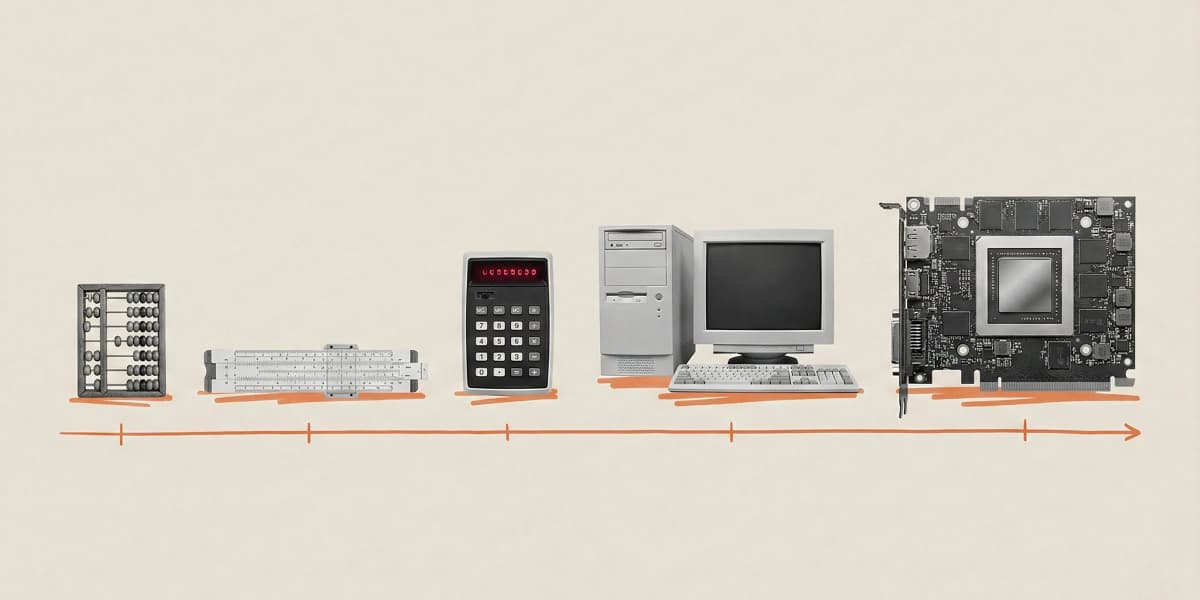
The development of more powerful and efficient hardware is crucial for the growth of AI. Recent advancements in chips, memory, and interconnects have enabled significant improvements in computational power.
- Nvidia's chips have delivered an over sevenfold increase in raw performance in just six years.
- The latest generation of high bandwidth memory, HBM3, triples the bandwidth of its predecessor, feeding data to processors faster.
The Software Revolution: Making AI More Accessible
The software used for AI development is also undergoing a significant transformation. Research has shown that the compute required to reach a fixed performance level halves approximately every eight months, making AI more affordable and accessible.
- The cost of serving some recent models has collapsed by a factor of up to 900 on an annualized basis.
- Leading labs are growing capacity at nearly 4x annually, with the compute used to train frontier models growing 5x every year.
The Future of AI: Endless Possibilities
With the current pace of growth, the possibilities for AI are endless. As Mustafa Suleyman says, 'the compute explosion is the technological story of our time, and it is still only just beginning.'
- The development of more powerful and efficient hardware will continue to drive AI growth.
- The decreasing cost of deploying AI models will make it more accessible to businesses and individuals.
Challenges and Opportunities in the AI Revolution
While the growth of AI presents numerous opportunities, it also raises important questions about its impact on society. As AI becomes more powerful and pervasive, it's essential to address these challenges and ensure that its benefits are shared by all.
- The increasing reliance on AI raises concerns about job displacement and the need for workforce retraining.
- The development of AI also presents opportunities for improving healthcare, education, and other areas of life.
Conclusion and Next Steps
In conclusion, the AI revolution is unstoppable, driven by advances in hardware and software. As we look to the future, it's essential to address the challenges and opportunities presented by AI and ensure that its benefits are shared by all.
- The development of AI will continue to transform industries and improve lives.
- It's crucial to invest in education and retraining programs to prepare the workforce for an AI-driven economy.
“The compute explosion is the technological story of our time, and it is still only just beginning.”
— Mustafa Suleyman
Final Thoughts
As we move forward in this AI-driven world, it's essential to stay informed and adapt to the changing landscape. With its endless possibilities and opportunities, the future of AI is exciting and unpredictable. One thing is certain, though: the AI revolution is here to stay, and it will continue to shape our world in profound ways.
Sources & Credits
Originally reported by MIT Technology Review
Manaal Khan
Tech & Innovation Writer
Produced with AI assistance and reviewed by the Logicity editorial team. Learn more in our Editorial Policy.