
Key Takeaways

- Discord's invasive age-verification system, which requires video selfies and ID documents, sparked a user exodus in 2026
- Stoat offers a near-identical Discord interface with self-hosting options, while Element provides enterprise-grade encryption on the Matrix protocol
- A 2025 hack of Discord's third-party verification partner exposed up to 70,000 users' government IDs, underlining the risks of centralized data collection
Discord's age-verification policies have pushed a growing number of users toward open-source chat platforms they can host themselves. Two apps, Stoat and Element, now offer the closest experience to Discord without the subscription pressure, ad experiments, or invasive identity checks that sparked the backlash.
The shift isn't just about privacy purists. Discord's February 2026 announcement of its "Teen Default Experience," designed to comply with the UK's Online Safety Act, required users flagged by an inference model to submit video selfies and government ID to third-party verification partners. Discord claimed selfies never left the user's device and that partners didn't retain ID copies. Users didn't buy it.
What made Discord's age verification so controversial?
The pushback was swift enough that Discord postponed the rollout to the second half of 2026, promising more verification options. But the damage had already been done. In October 2025, one of Discord's third-party service providers was hacked, potentially exposing up to 70,000 users' government IDs. That breach confirmed exactly what critics feared: centralized identity collection creates centralized risk.
User interest in "private, non-monetized" chat platforms has jumped 40% since 2024, according to research tracking. Discord still commands around 150 million monthly active users, but the network effect that keeps people locked in is weakening for groups willing to do a bit of technical work.
How does Stoat compare to Discord?
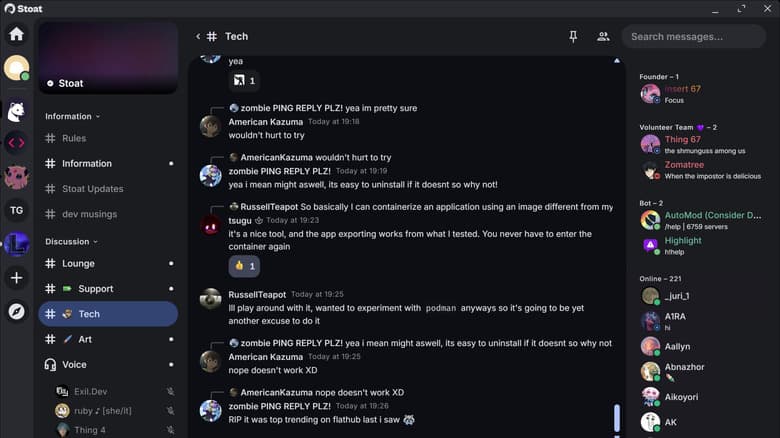
Stoat, formerly known as Revolt, is the most direct Discord clone available. The interface is nearly identical, right down to the layout of text channels, voice calls, and role-based moderation. According to its GitHub, Stoat began rolling out screen-sharing earlier this year, closing one of the last feature gaps for groups who use Discord to stream games.
Custom emoji, theming, and a roles system all work as expected. You can let Stoat host your server for you, or self-host with some setup. Either way, official apps exist for web, Linux, Windows, macOS, Android, iOS, and iPadOS.
Reddit's r/privacy community has called Stoat the first "drop-in" replacement that doesn't feel like a downgrade. That matters. Most open-source alternatives ask users to accept a worse experience in exchange for principles. Stoat doesn't.
What does Element offer that Stoat doesn't?
Element takes a different approach. Built on the open-source Matrix protocol, Element is end-to-end encrypted by default and targets both individuals and enterprise or government customers with paid tiers. Text, voice, video calls, screen sharing, file sharing, and mobile location sharing are all supported.
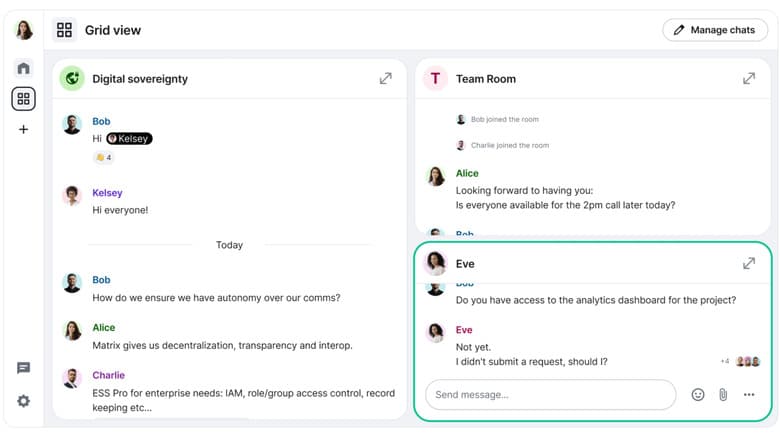
Matrix-based apps are interoperable. An Element user can message someone on another Matrix client. Over 10,000 community-run Matrix homeservers are currently active, creating a decentralized network without a single company controlling the infrastructure.
The trade-off: Element doesn't support custom emoji by default, and the interface feels more business-tool than gaming-hangout. You can theme it however you want, but the playful Discord vibe isn't built in.
Is migration from Discord realistic?
HackerNews discussions remain split on this. The technical capability exists. The social challenge is harder. Discord's network effect keeps casual groups from moving because everyone's already there. For tightly-knit communities, gaming guilds, or privacy-focused organizations, migration is straightforward. For a 50,000-member fan server, it's a different story.
The honest assessment: open-source Discord alternatives work best for groups that can coordinate a move and don't need to be discoverable to random new members. If your community already knows each other, Stoat or Element can replace Discord entirely. If you're trying to build a public community from scratch, you'll miss Discord's discovery features.
| Feature | Stoat | Element |
|---|---|---|
| Interface style | Discord clone | Business/enterprise |
| Encryption | Optional | End-to-end by default |
| Custom emoji | Yes | No (by default) |
| Protocol | Proprietary | Matrix (federated) |
| Self-hosting | Yes | Yes |
| Interoperability | No | Yes (with other Matrix clients) |
For more on the tension between security demands and technical reality
Which open-source alternative should you choose?
If your group wants Discord without Discord's policies, pick Stoat. The learning curve is zero. If your group prioritizes encryption and doesn't mind a less playful UI, Element gives you federation and interoperability. Both let you self-host or use their managed services.
The 70,000-user ID breach proved that trusting a platform with your government documents carries real risk. For groups tired of waiting to see what Discord's next compliance requirement will demand, running your own server is no longer a fringe choice.
Frequently Asked Questions
Can I migrate my Discord server to Stoat or Element?
There's no automated migration tool. You'll need to recreate channels and roles manually. The main challenge is getting all your members to move, not the technical setup.
Is self-hosting a chat server difficult?
Both Stoat and Element provide documentation for self-hosting. Basic Linux server administration skills are required. Alternatively, both offer managed hosting if you want the benefits without the maintenance.
Are Stoat and Element free?
Both are free and open-source. Element offers paid enterprise tiers with additional support. Stoat's managed hosting may have costs depending on scale.
Do these alternatives work on mobile?
Yes. Stoat has apps for Android, iOS, and iPadOS. Element has mobile apps with additional features like location sharing.
What happened to Revolt?
Revolt rebranded to Stoat in 2024, citing a desire for a more focused user experience. The underlying software continues to develop under the new name.
Logicity's Take
Discord's real problem isn't the age-verification policy itself. It's that Discord built a platform 150 million people depend on, then discovered it needed to collect sensitive identity data to comply with laws it couldn't ignore. Open-source alternatives exist because some users realized they'd rather own the infrastructure than rent it from a company with competing obligations. The question isn't whether Stoat or Element are better than Discord. It's whether your community values control enough to do the work.
Need Help Implementing This?
If your organization is evaluating self-hosted communication platforms or needs guidance on secure community infrastructure, reach out to Logicity's consulting partners for a technical assessment.
Source: Engadget
Huma Shazia
Senior AI & Tech Writer
Produced with AI assistance and reviewed by the Logicity editorial team. Learn more in our Editorial Policy.




