Key Takeaways
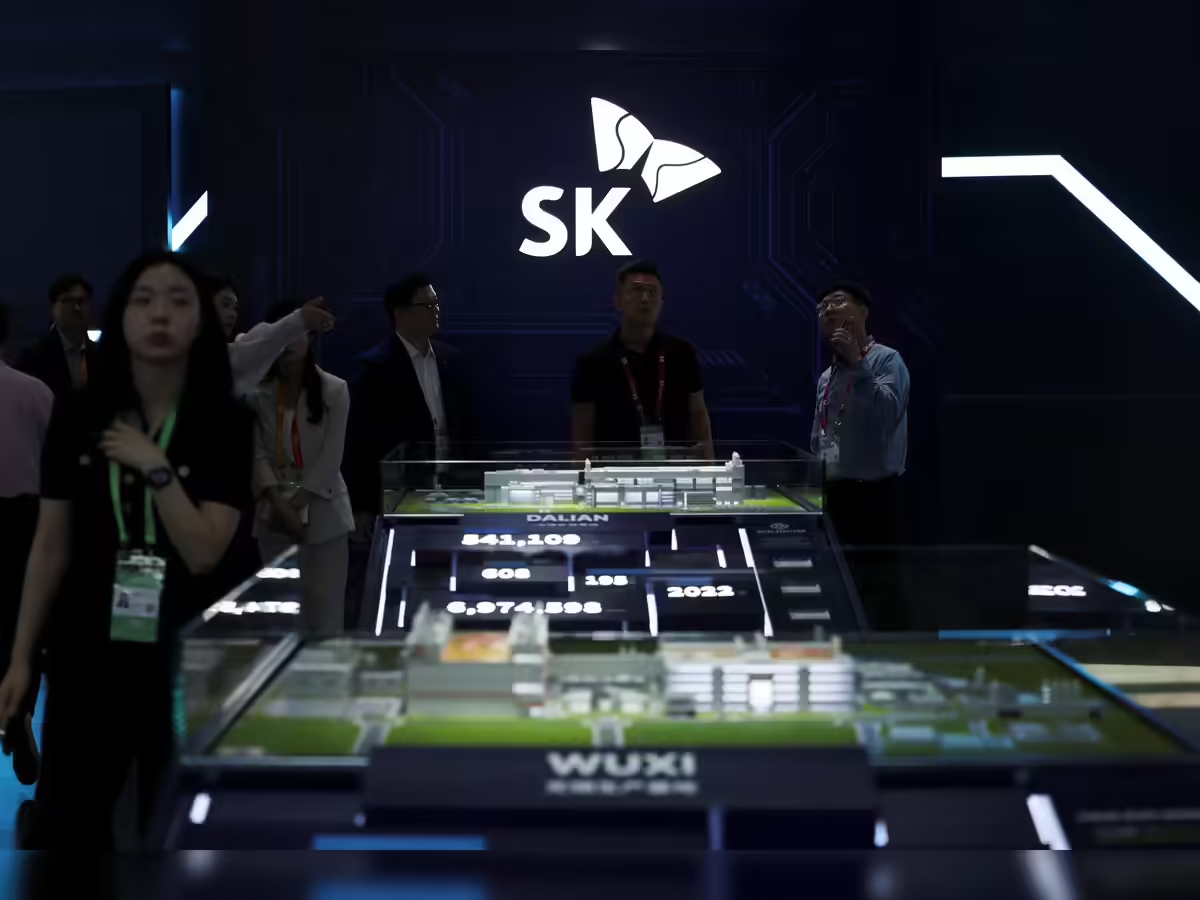
- SK Hynix plans to raise up to $29.4 billion through a Nasdaq ADR listing, which would be the largest U.S. listing by a Korean company and potentially the largest ADR offering ever.
- Proceeds will fund new chip factories in South Korea and purchase ASML's extreme ultraviolet lithography equipment to expand HBM production capacity.
- The company's shares have quadrupled in 2025, driven by its dominant position as Nvidia's key supplier of high-bandwidth memory chips for AI systems.
SK Hynix announced plans on Wednesday to raise up to $29.4 billion through a Nasdaq listing, which would be the largest U.S. stock market debut by a Korean company and potentially the biggest American Depositary Receipt offering in history. The move comes as the Nvidia supplier seeks to tap into strong investor appetite for AI stocks while funding aggressive capacity expansion.
If completed at the top end of its target, the offering would surpass Alibaba's $25 billion ADR debut in 2014. The world's second-largest memory chipmaker plans to issue 17.79 million new shares, worth 45.45 trillion won, with ten ADRs representing one common share. Pricing will be finalized after bookbuilding, based on an initial range tied to Tuesday's closing price of 2.555 million won ($1,651.69).
Why SK Hynix wants a U.S. listing now
The timing is no accident. SK Hynix has been one of the clearest corporate winners of the AI boom. Its shares have quadrupled so far this year, outperforming rivals Samsung Electronics and U.S.-based Micron. This week, SK Hynix overtook Samsung to become South Korea's most valuable company, now valued at approximately $1.2 trillion.
The company manufactures high-bandwidth memory (HBM) chips, a critical component in AI systems built by Nvidia, Google, and other hyperscalers. As demand for large language models and AI training infrastructure has exploded, so has demand for HBM.
“The most attractive benefit for investors is that SK Hynix will trade on Nasdaq alongside rival Micron, giving the company an opportunity to be re-rated in the U.S. market. That could also be reflected in its Korea-listed shares as investors increasingly link the two valuations.”
— Ryu Young-ho, Senior Analyst, NH Investment & Securities
CLSA Senior Analyst Sanjeev Rana noted that expectations for a U.S. listing have already helped drive SK Hynix's stock rally. "If they can get at least a valuation multiple similar to Micron, for example, then the local shares also need to reflect that," Rana said. "I wouldn't be surprised if this rally continues."
Where the $29 billion will go
SK Hynix said proceeds from the ADR listing will fund chip factory construction in South Korea and purchase chipmaking equipment. The company specifically mentioned extreme ultraviolet (EUV) lithography scanners from Dutch equipment maker ASML. ASML shares rose 1.1% on Wednesday following the announcement.
The capital injection aligns with SK Hynix's need to scale production to meet AI demand. High-bandwidth memory requires more advanced manufacturing than standard DRAM, and capacity constraints have been a persistent bottleneck as Nvidia and other chipmakers race to build AI accelerators.
Limited dilution despite headline size
Despite the eye-popping headline figure, some investors view the offering as measured relative to SK Hynix's scale. Gary Tan, a portfolio manager at Allspring Global Investments in Singapore, offered a tempered assessment.
“The ADR listing should not materially change our view on SK Hynix or the memory sector. The headline capital raise appears large but implies only limited dilution and remains modest relative to its mid-term capex plans.”
— Gary Tan, Portfolio Manager, Allspring Global Investments
BofA Securities, Citigroup Global Markets, Goldman Sachs, and JP Morgan Securities are managing the offering.
A broader wave of AI-linked equity issuance
SK Hynix's listing arrives during a surge of AI-related capital raising. Elon Musk's SpaceX recently completed an $85.7 billion initial public offering, a record. Anthropic and OpenAI are both expected to pursue IPOs later this year.
The appetite for AI equities persists even as volatility increases across U.S. tech and semiconductor markets. For SK Hynix, a Nasdaq listing offers direct access to the investor base most bullish on AI infrastructure plays. Trading alongside Micron on the same exchange also creates a natural valuation benchmark.
What this means for the memory market
SK Hynix's move puts pressure on Samsung Electronics, which has trailed its smaller rival in HBM technology and market share. Samsung remains the world's largest memory chipmaker overall, but SK Hynix has captured the highest-margin segment of the market. HBM chips command significantly higher prices than standard DRAM, and SK Hynix controls roughly half the global HBM market.
If SK Hynix secures a valuation multiple closer to Micron's on Nasdaq, it could widen the gap between the two Korean rivals in market cap terms. It may also prompt Samsung to accelerate its own AI chip investments.
Frequently Asked Questions
What is SK Hynix's planned ADR listing on Nasdaq?
SK Hynix plans to raise up to $29.4 billion by listing American Depositary Receipts on Nasdaq, which would be the largest U.S. listing by a Korean company and potentially the biggest ADR offering ever.
Why is SK Hynix raising $29 billion?
The company will use proceeds to build chip factories in South Korea and purchase advanced chipmaking equipment, including ASML's extreme ultraviolet lithography scanners, to expand HBM production capacity.
What is SK Hynix's relationship with Nvidia?
SK Hynix is Nvidia's key supplier of high-bandwidth memory (HBM) chips, which are critical components in AI accelerators like the H100 and H200 GPUs used in data centers.
How has SK Hynix stock performed in 2025?
SK Hynix shares have quadrupled so far this year, outperforming Samsung Electronics and Micron. The company recently overtook Samsung to become South Korea's most valuable company at approximately $1.2 trillion.
When will SK Hynix's Nasdaq listing happen?
Pricing will be finalized after bookbuilding. The company has not announced a specific listing date, but the filing indicates the offering is proceeding.
Logicity's Take
SK Hynix is betting that U.S. investors will pay a premium for direct AI infrastructure exposure. The company dominates a market segment, HBM, that didn't exist at scale five years ago. If this listing prices at the top end, it validates a thesis that AI chip suppliers deserve tech multiples, not commodity semiconductor valuations. Watch whether Samsung responds with its own capital market moves or doubles down on catching up in HBM technology.
Need Help Implementing This?
Stay ahead of AI infrastructure and semiconductor market developments with Logicity.in. Subscribe to our newsletter for timely analysis on the companies powering the AI revolution.
Source: Tech-Economic Times / ET
Huma Shazia
Senior AI & Tech Writer
Produced with AI assistance and reviewed by the Logicity editorial team. Learn more in our Editorial Policy.