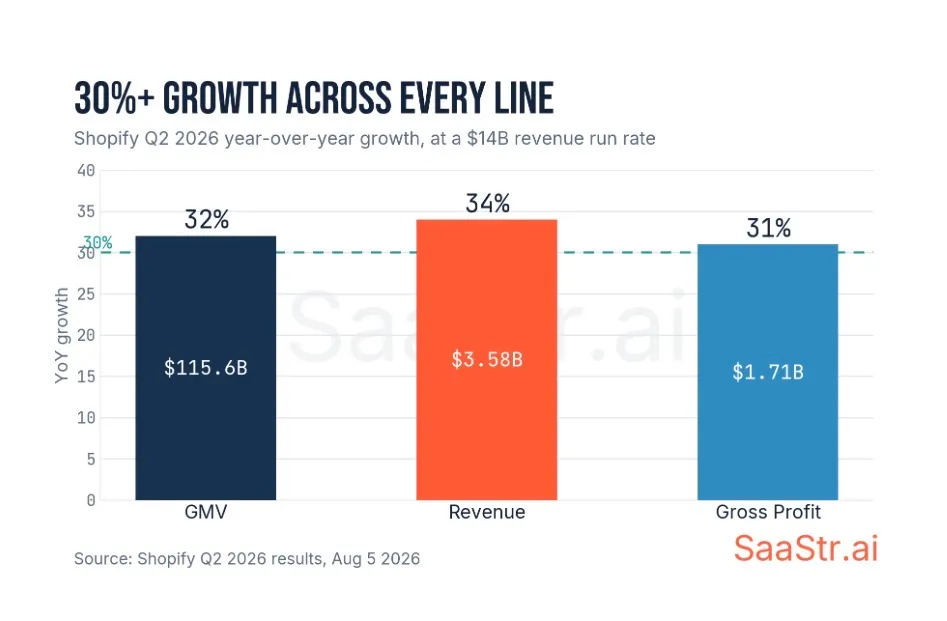
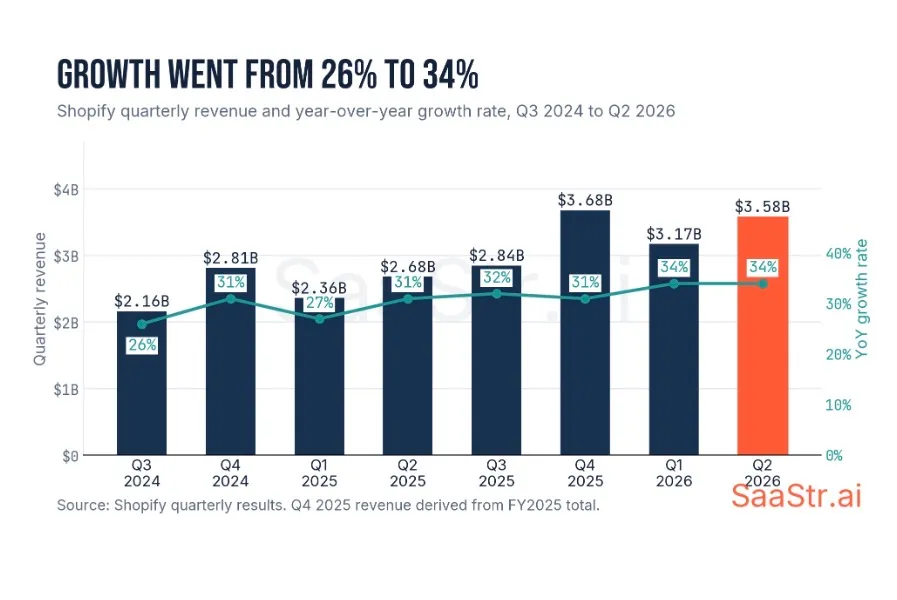
Shopify reported Q2 2026 earnings this week with numbers that made the stock jump 18% in a single session: $3.58 billion in quarterly revenue (up 34% year-over-year), $115.6 billion in gross merchandise volume (up 32%), and $654 million in free cash flow at an 18% margin. At a $14 billion annual run rate, Shopify is now one of the rare public companies growing above 30% while expanding cash flow margins. The story underneath those numbers matters more than the numbers themselves.
Disclosure
Some links in this post are affiliate links — Logicity earns a commission if you sign up, at no extra cost to you. We only link products we have used or actively recommend.
For SaaS founders watching public market comps, Shopify's quarter reveals three structural shifts happening across B2B software right now. None of them are about AI in the way most coverage suggests.
AI traffic tripled, but the moat is data, not models
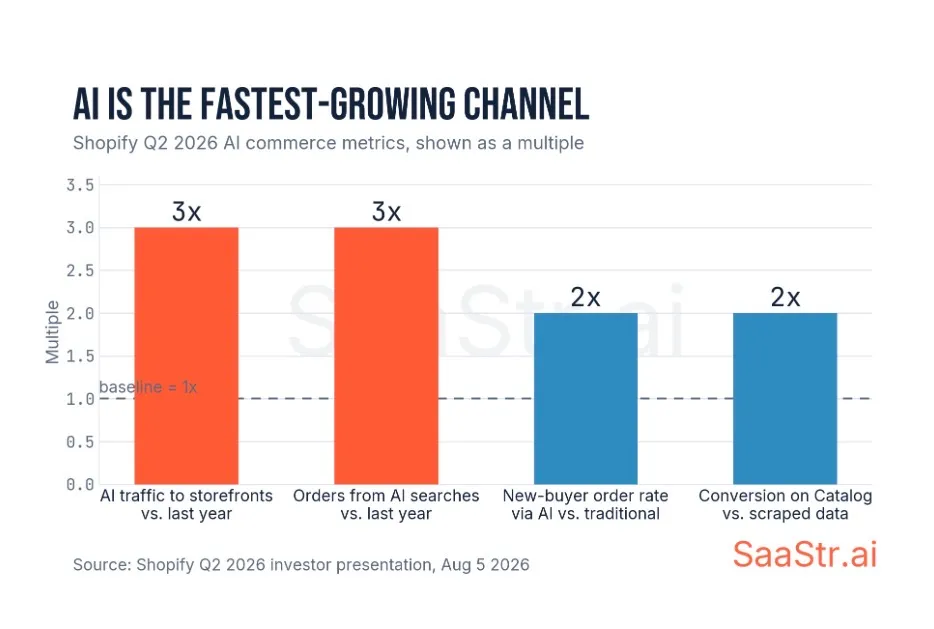
Traffic to Shopify merchant storefronts from AI channels tripled year-over-year. Orders from AI searches tripled. The new-buyer order rate from AI channels ran at twice the rate of traditional channels like Google, social, and direct traffic.
That last metric is the one that matters. AI isn't just redirecting existing demand. It's generating net-new buyers at double the conversion rate. Shopify's explanation: Shopify Catalog now holds more than 1 billion products in structured data formats that AI agents can actually parse. Searches powered by Catalog convert at 2x the rate of searches built on scraped data.
The implication is uncomfortable for companies betting on AI wrappers. The agent that can see real inventory, real pricing, and real variants recommends better than the agent guessing from a rendered web page. Shopify spent a decade accumulating clean product data for boring operational reasons. That turned out to be the moat.
The companies that benefit most from agentic buying won't be the ones with the best AI. They'll be the ones that own the structured data the AI has to query. If your product sits on proprietary, well-formatted data that agents need, you have leverage. If it's a UI wrapper over data someone else owns, you have a problem.
The subscription business is the minority
People keep calling Shopify a SaaS company. The revenue split says otherwise.
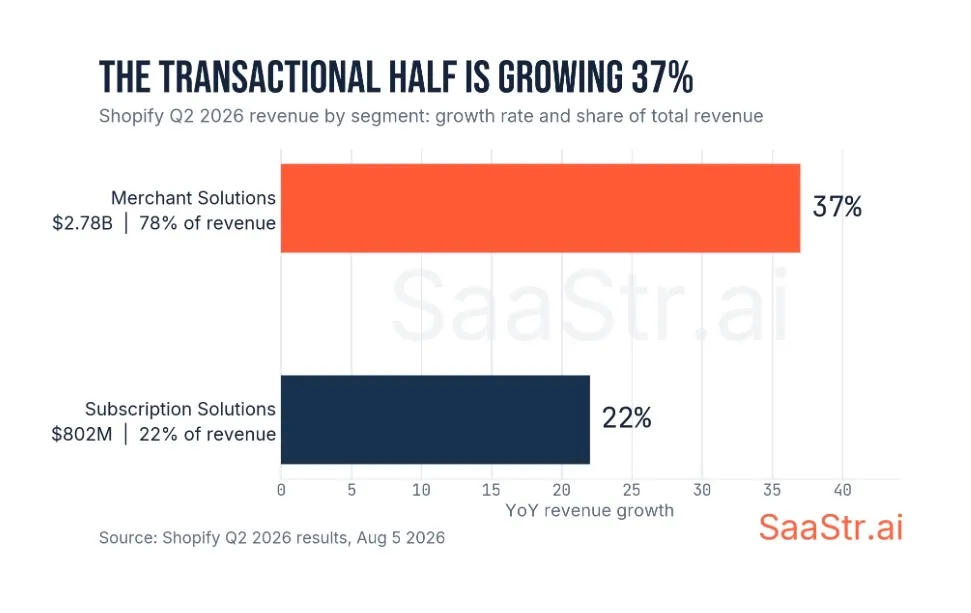
Merchant Solutions (payments, capital, shipping, cross-border, variable platform fees) hit $2.78 billion in Q2, up 37%. That's 78% of total revenue. Subscription Solutions came in at $802 million, up 22%. That's 22% of revenue. The recurring software subscription, the part that looks like classic B2B SaaS, is the slower-growing minority of the business.
Monthly recurring revenue sits at $221 million, compounding at 18% annually over five years. Solid in isolation. But it's less than a quarter of what Shopify collects in a single quarter from transaction-based revenue.
Even the subscription bucket is shifting toward usage. Apps, themes, domains, and variable platform fees have gone from 11% of Subscription Solutions in Q1 2023 to 21% today. The recurring revenue is becoming more consumption-weighted by design.
This is the pattern showing up everywhere
Shopify's growth split isn't unique. It's the same pattern appearing across public B2B software right now. Seat-based subscription revenue grows in the teens to low twenties. Consumption, transaction, and outcome-based revenue grows at 35%+.
Shopify's 34% growth rate isn't a story about better software pricing. It's a story about being paid when the customer wins, in proportion to how much they win. The transactional model creates natural expansion without sales motions. A merchant who doubles their sales doubles what they pay Shopify, automatically.
“The companies that benefit most from agentic buying won't be the ones with the best AI. They'll be the ones that own the structured data the AI has to query.”
— SaaStr analysis of Shopify Q2 2026
For SaaS founders, the question becomes whether your product can credibly tie pricing to customer outcomes. If you're selling productivity tools, that's hard to measure. If you're selling infrastructure that sits in the transaction path, like payments, fulfillment, or commerce, you have a clear number to attach to.
Another Q2 2026 earnings breakdown showing how AI investment translates (or doesn't) to margins
Payments reached 68% attach. That's the real lock-in.
Shopify processed $78 billion in gross payments volume in Q2. That's 68% of all GMV on the platform flowing through Shopify's own payment rails rather than third-party processors. Cumulative GPV since inception crossed $1 trillion this quarter.
Payments started as a checkbox feature. It became the majority of the revenue engine.
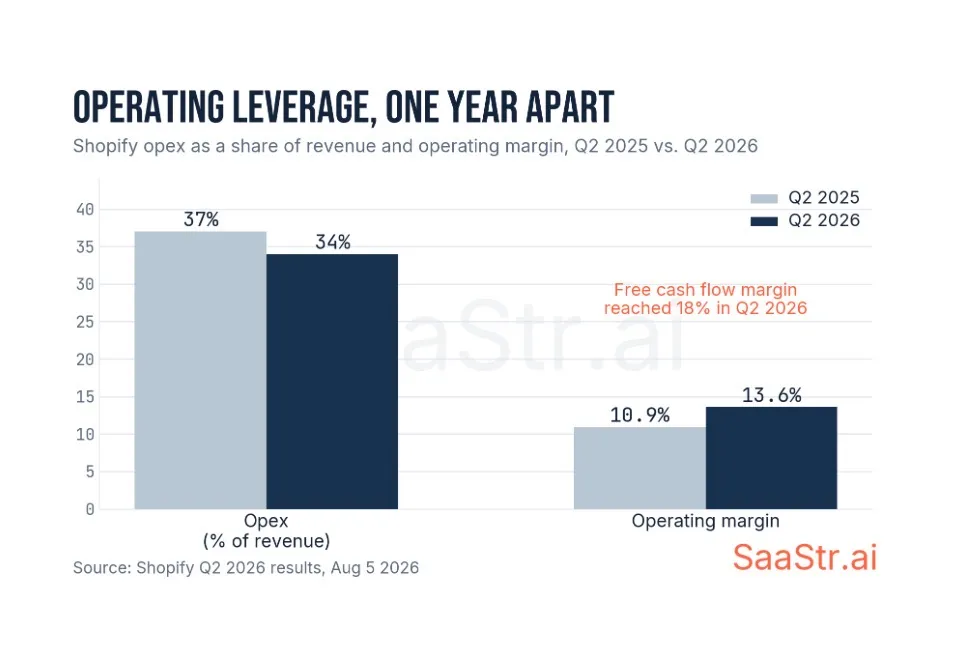
The cost is visible in margins. Gross profit grew 31% against 34% revenue growth because payments carries lower gross margin than software. Gross margin landed at 47.7%. Q3 guidance calls for revenue growth in the low 30s but gross profit growth only in the mid-to-high 20s. Transaction and loan losses are running at 3.9% of revenue, mostly from Shopify Capital.
Shopify made that trade deliberately. Lower gross margin percentage in exchange for far more gross profit dollars and a much deeper hook into merchant operations. A merchant using Shopify Payments, Shopify Capital, and Shopify Shipping has meaningful switching costs beyond just the storefront software.
The infrastructure position in agentic commerce
The earnings call framed Shopify as "agentic eCommerce infrastructure." That phrase matters. As AI agents increasingly handle product discovery and purchasing, someone has to provide the structured data, the checkout rails, and the fulfillment coordination those agents need. Shopify is positioning to be that layer.
The competitive question is whether platforms like Amazon, which control both demand and fulfillment, or AI-native commerce startups can build the same structured data advantage. Amazon has the data but no incentive to open it to external agents. Startups have the incentive but not the decade of accumulated catalog depth.
Shopify's position is that it already has 1 billion products in agent-readable format, plus the merchant relationships and payments infrastructure to close transactions. If AI shopping becomes a significant channel, and the 2x new-buyer conversion rate suggests it might, that position compounds.
Logicity's Take
Shopify's numbers are impressive, but the structural story is the one to watch. SaaS companies still pricing on seats while Shopify grows 37% on transactions have a model problem, not a sales problem. For founders, the question isn't whether to add AI features. It's whether you own data that AI agents will need to query, and whether your pricing captures value when customers win. Platforms like [HubSpot](https://logicity.in/r/hubspot), [Salesforce](https://logicity.in/r/salesforce), and vertical SaaS vendors are all experimenting with consumption models. Shopify just showed what it looks like at scale.
What this means for B2B operators
Three takeaways from the quarter translate beyond ecommerce.
First, structured data is becoming a moat. The company that can serve agent-readable product, pricing, and inventory data wins the AI discovery layer. This applies to any vertical where agents will eventually do discovery and purchasing.
Second, transaction revenue is growing faster than subscription revenue across public SaaS. If your business can credibly tie pricing to customer outcomes, that model is outperforming seat-based pricing in the current market.
Third, payments attach creates lock-in that software alone doesn't. Shopify's 68% payments penetration means two-thirds of merchants have meaningful switching costs beyond the storefront. Financial services embedded in software products create stickier relationships than the software itself.
The stock jumped 18% because investors saw all three playing out in a single quarter. Whether that valuation holds depends on whether the AI channel growth sustains and whether payments penetration keeps climbing toward the remaining 32%.
Need Help Implementing This?
If you're rethinking your pricing model, building structured data infrastructure, or evaluating payments integration for your SaaS product, Logicity can connect you with operators who've done it. Reach out at hello@logicity.in.
Source: SaaStrAI
Manaal Khan
Tech & Innovation Writer
Produced with AI assistance and reviewed by the Logicity editorial team. Learn more in our Editorial Policy.