Key Takeaways
- HCLTech invested $150M for a 10.46% stake, marking the first major bet by an Indian IT services company on foundation models
- Sarvam handles 2 million conversational AI calls daily and saw 300 million API calls last month
- The company claims 95% of enterprise AI use cases can now run on sovereign models
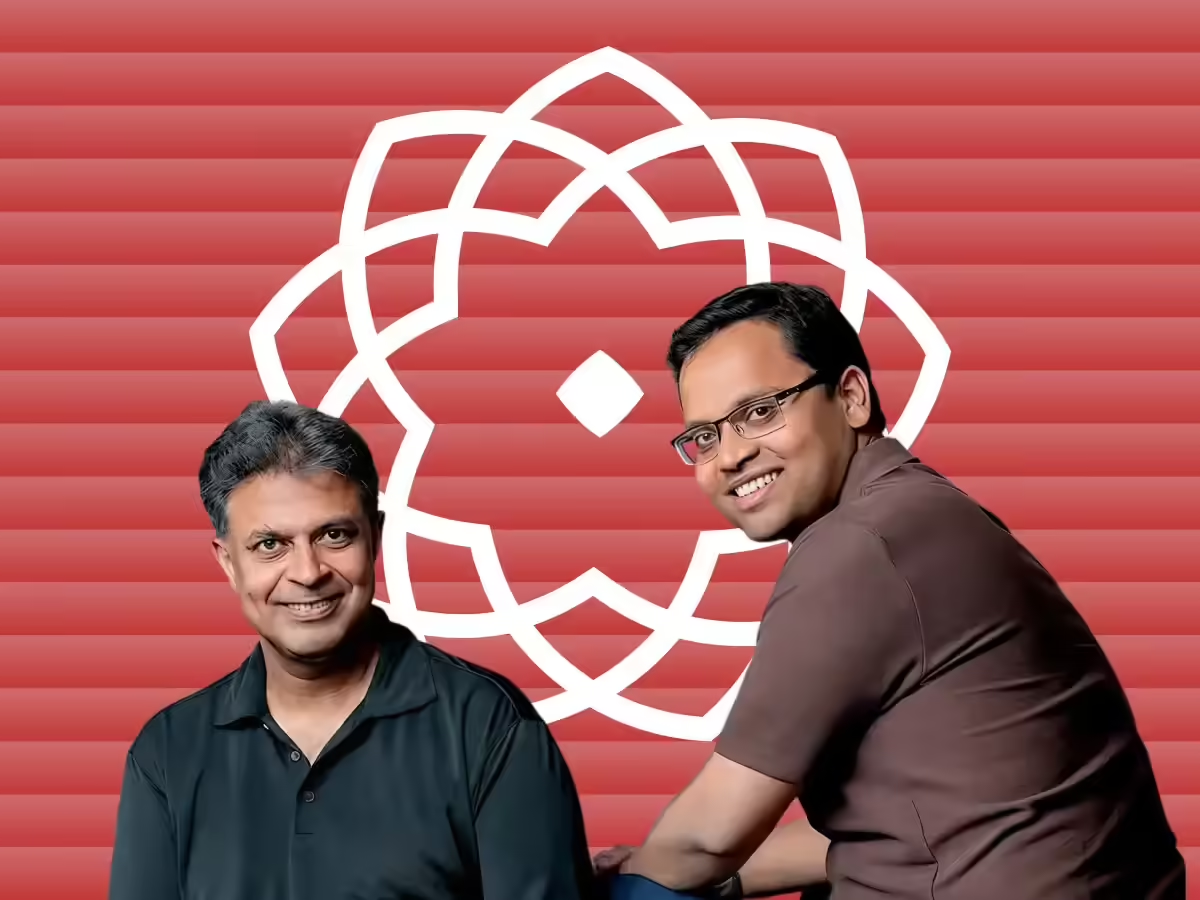
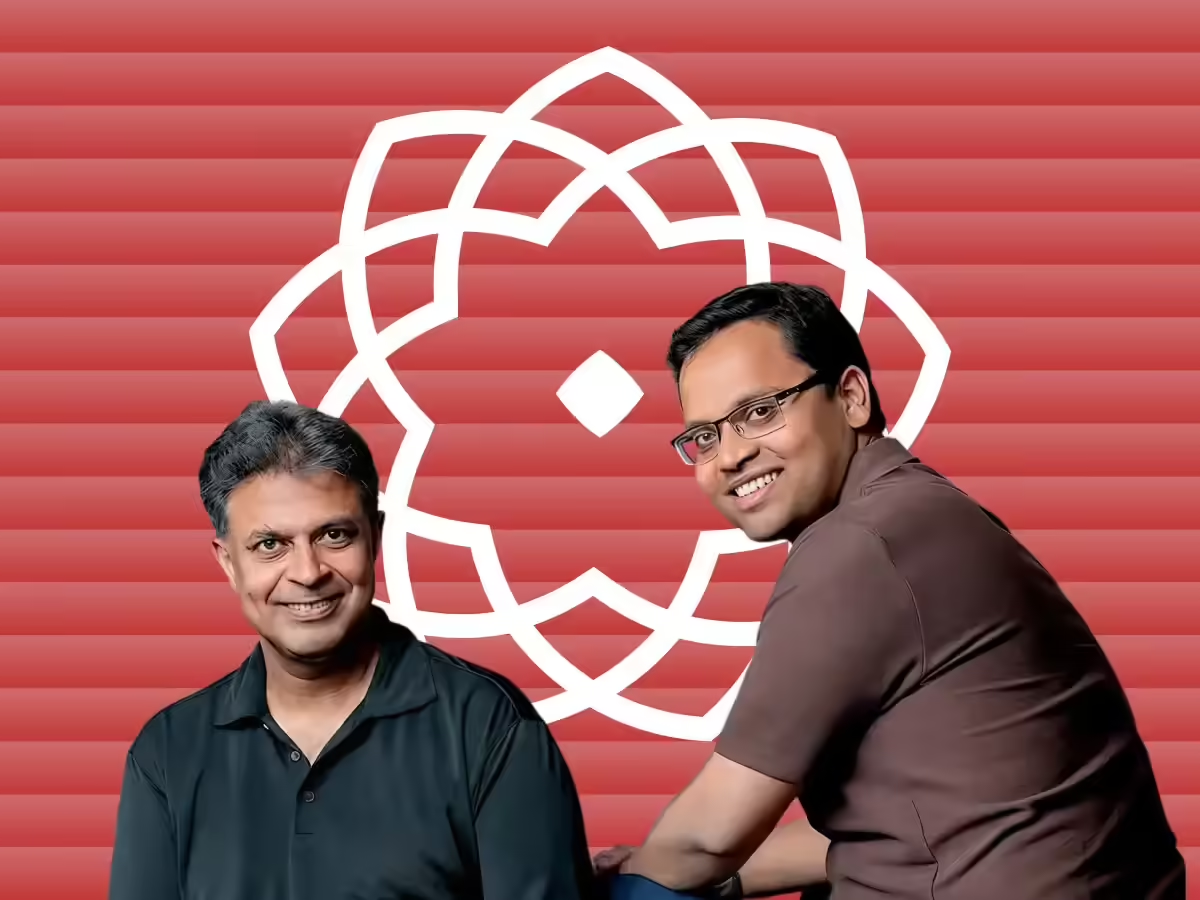
Sarvam AI has raised $234 million in a round led by HCLTech, valuing the Bengaluru startup at $1.5 billion. The round is expected to close at $300 million, with Bessemer Venture Partners and existing backers Khosla Ventures and Peak XV Partners also participating. HCLTech alone committed $150 million for a 10.46% stake.
This marks the first time an Indian IT services giant has made a significant bet on the foundation model ecosystem. Cofounder Vivek Raghavan spoke to ET about where the money goes and why he thinks India needs its own AI stack.
Why HCLTech as a strategic investor?
Raghavan framed the partnership around sovereignty. "We are in an era of sovereign AI," he said. "We've seen what happened with Fable 5 and Mythos... when you're running a sovereign AI company, it's important to get investment that is Indian."
He was referring to recent restrictions on advanced AI models from global providers. After Anthropic limited access to certain capabilities in India, Sarvam's own Pratyush Kumar publicly warned against over-reliance on foreign models. The HCLTech deal is partly a response to that vulnerability.
Despite HCLTech's stake, Raghavan was clear that Sarvam will operate independently. "There is no question about that," he said. The two companies will explore joint go-to-market opportunities in India and abroad, but Sarvam plans to "use every possible channel to proliferate our technology."
Where will the $234 million go?
Raghavan identified four priorities: compute infrastructure, model training and finetuning, large-scale inferencing, and software layers for enterprise and government customers.
"One of the biggest factors in AI is the ability to get access to GPUs and hardware infrastructure," he said. "That will be an important use of the capital we are raising."
Sarvam supports 22 Indian languages through its foundational models, including Sarvam 105B and 30B. The company's conversational AI platform now handles over 2 million calls daily, with more than 300 million API calls processed last month. Raghavan said the business has "more than tripled" in recent months, though he did not disclose revenue figures.
The capital efficiency problem
Raghavan acknowledged a tension at the heart of Sarvam's strategy. The $234 million is the largest AI raise India has seen, but it is modest by global standards. OpenAI raised $6.6 billion in its last round. Anthropic has pulled in over $7 billion.
“The capital we have raised is very large in the Indian context, but it is still quite small compared with the global context. We will have to continue being capital efficient in how we do things.”
— Vivek Raghavan, cofounder, Sarvam AI
He said Sarvam needs "significantly more capital to develop frontier capabilities." This raise moves them to "the next orbit," but they are "still at the beginning of this race."
What does 'sovereign AI' actually mean?
Raghavan defined it broadly. Sovereignty is not just about training models on Indian data or hosting them in India. It means controlling the full stack: compute infrastructure, training frameworks, inferencing at scale, and what he called "agentic orchestration."
"If you want to be completely atmanirbhar in AI, we need to play across all these layers," he said, using the Hindi term for self-reliance that became a policy buzzword under the Modi government.
He estimated that 95% of enterprise AI use cases can now run on sovereign models. "There may be areas where we need to build larger models than we have today, and that is something we will focus on."
Notably, Raghavan expanded the concept beyond national borders. "Sovereign does not necessarily mean only country sovereign. It can also mean enterprise sovereign." A European bank that wants AI without routing data through US hyperscalers is a potential Sarvam customer.
Enterprise and government, not consumers
Sarvam will not chase the consumer market. Raghavan was blunt about why: "Even with differential pricing, global companies lose money on those offerings in many cases."
The focus stays on enterprise and government clients. These are buyers who will pay for models tuned to Indian languages and who have compliance or sovereignty concerns that global providers cannot address.
Bessemer partner Pankaj Mitra, whose firm participated in the round, said Sarvam will be among the "biggest bets" in India's technology ecosystem over the next decade.
Context on how AI infrastructure companies are financing compute buildouts
Related perspective on AI's impact on enterprise technology
The HCLTech angle
For HCLTech, this is a strategic hedge. Indian IT services companies have built their businesses on implementing software from American vendors. If foundation models become the new platform layer, those vendors could capture more of the value chain.
Backing Sarvam gives HCLTech a proprietary model provider it can integrate into client projects. The $150 million buys optionality: if sovereign AI becomes a meaningful enterprise category, HCLTech has a horse in the race.
Frequently Asked Questions
How much did Sarvam AI raise in its latest funding round?
Sarvam AI raised $234 million in the first close, with the round expected to reach $300 million. HCLTech led with a $150 million investment.
What is Sarvam AI's valuation after this round?
The company is valued at $1.5 billion, making it a unicorn.
How many Indian languages does Sarvam AI support?
Sarvam's foundational models support 22 Indian languages.
Will Sarvam AI build consumer products?
No. Cofounder Vivek Raghavan said the company will focus on enterprise and government customers, not consumer-facing products like ChatGPT.
What does sovereign AI mean for Sarvam?
Sarvam defines it as controlling the full AI stack, from compute infrastructure to model training to inferencing, without dependence on foreign providers.
Logicity's Take
The real test for Sarvam is not whether it can build good models. It is whether Indian enterprises will pay a premium for sovereignty when OpenAI and Google offer cheaper, better-performing alternatives. Raghavan's 95% claim, that most use cases can run on sovereign models, will face scrutiny as competitors keep improving. HCLTech's involvement suggests at least one large buyer is willing to bet on the answer being yes.
Need Help Implementing This?
If you're evaluating sovereign AI solutions for your enterprise or exploring partnerships with Indian foundation model providers, reach out to the Logicity team for analysis and vendor comparisons.
Source: Tech-Economic Times / ET
Manaal Khan
Tech & Innovation Writer
Produced with AI assistance and reviewed by the Logicity editorial team. Learn more in our Editorial Policy.




