Key Takeaways
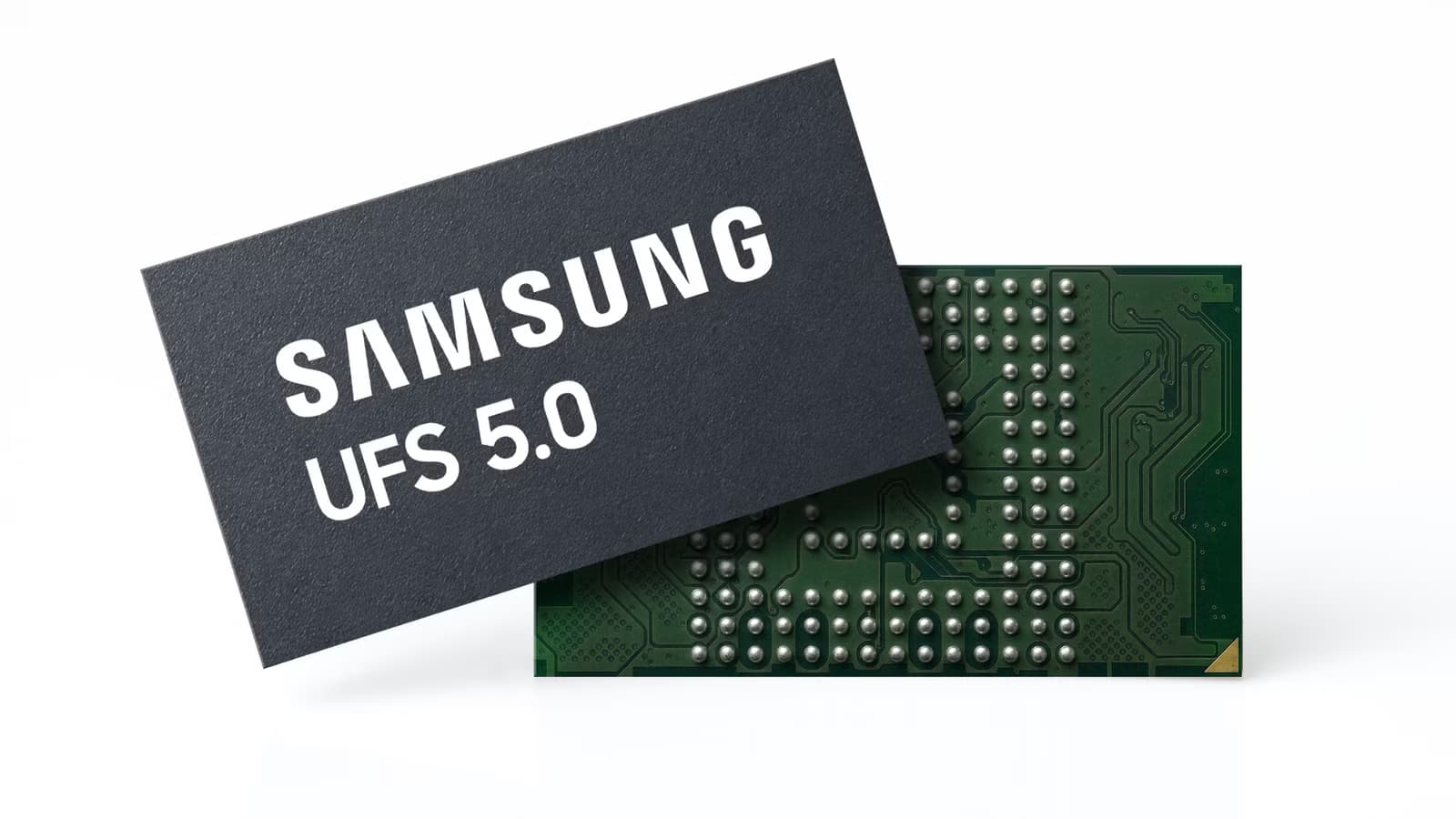
- UFS 5.0 delivers 10.08 GB/s read speeds, more than double UFS 4.0's 4.2 GB/s
- 40% power efficiency improvement lets phones run AI workloads without draining batteries
- 16.7% smaller die frees internal space for larger batteries or better cameras
Samsung has announced Universal Flash Storage 5.0, the first storage chip to break the 10 GB/s barrier on mobile devices. The new standard reads data at 10.08 GB/s, more than doubling UFS 4.0's speeds while consuming 40% less power. Mass production begins Q4 2026, with flagship phones expected to ship the technology by early 2027.
The speed jump matters less for loading apps, which already feel instant, and more for a specific bottleneck: on-device AI. When your phone summarizes a document, generates an image, or runs an AI agent, it typically sends data to cloud servers and waits for a response. That round trip adds latency and requires an internet connection. UFS 5.0 is designed to make those tasks happen entirely on the device.
Why does storage speed matter for on-device AI?
Modern AI models are large. A local large language model can occupy several gigabytes. When you ask it to process something, the phone's processor needs to pull model weights and data from storage into working memory. If storage is slow, even a fast chip sits idle waiting for data. UFS 5.0's 10.08 GB/s throughput removes that constraint.
The practical result: AI features that work offline, respond faster, and keep your data on your device. Privacy improves because sensitive documents or photos never leave the phone. Samsung frames this as enabling "near-instant responses" from AI features regardless of network conditions.
How does UFS 5.0 improve battery life?
Faster storage sounds like it would drain batteries faster. The opposite is true here. UFS 5.0 is 40% more power-efficient than its predecessor through aggressive power management that shuts down hardware when data isn't moving.
The efficiency gain works in two ways. First, the chip itself draws less power per gigabyte transferred. Second, because transfers complete faster, the processor can finish heavy tasks sooner and return to low-power states. Running a complex AI agent on UFS 5.0 should consume meaningfully less battery than the same task on UFS 4.0.
What else changes inside the phone?
Samsung shrunk the storage chip's physical footprint by 16.7%. In a smartphone where every millimeter is contested, that freed space can go toward a larger battery, improved cooling, or more advanced camera sensors. The company explicitly pitches UFS 5.0 as enabling "the next generation of mobile devices, including smart glasses and other AI-centric wearables."
For wearables especially, the combination of speed, efficiency, and small size matters. Smart glasses can't accommodate large batteries. Running AI locally without constant cloud connections becomes practical only when the storage layer keeps up without burning through power.
When will UFS 5.0 phones ship?
Samsung says mass production starts Q4 2026, which means October through December. Flagship smartphones using UFS 5.0 should arrive by early 2027. The Galaxy S26, expected around that timeframe, is a likely candidate. That phone is rumored to include a Snapdragon 8 Elite Gen 5 processor and 12GB of RAM, hardware that would benefit from faster storage throughput.
How does UFS compare to other storage formats?
UFS replaced eMMC as the dominant mobile storage format because eMMC couldn't read and write simultaneously. MicroSD cards still exist for expandable storage but run slower and less efficiently than embedded UFS chips. Each UFS generation has roughly doubled speeds: UFS 3.1 hit 2.1 GB/s, UFS 4.0 reached 4.2 GB/s, and now UFS 5.0 crosses 10 GB/s.
| Standard | Max Read Speed | Status |
|---|---|---|
| UFS 3.1 | 2.1 GB/s | Current midrange |
| UFS 4.0 | 4.2 GB/s | Current flagship |
| UFS 5.0 | 10.08 GB/s | Q4 2026 production |
Samsung dominates global memory chip production, so UFS 5.0 availability from Samsung typically means broad adoption follows. Competitors like SK Hynix, Kioxia, and Western Digital generally follow Samsung's lead on UFS standards within months.
Logicity's Take
Samsung is positioning UFS 5.0 as AI infrastructure, not just storage. The real bet here is that on-device AI becomes the default, not the exception. If that happens, storage speed becomes as important as processor speed. The 40% efficiency gain is arguably more significant than the raw speed increase. Phones don't need to load apps faster. They do need to run AI workloads without killing batteries in two hours.
Frequently Asked Questions
What is UFS 5.0?
Universal Flash Storage 5.0 is Samsung's new mobile storage standard with read speeds up to 10.08 GB/s, designed for on-device AI processing and improved power efficiency.
How much faster is UFS 5.0 than UFS 4.0?
UFS 5.0 offers 10.08 GB/s read speeds compared to UFS 4.0's 4.2 GB/s, more than doubling performance.
When will phones with UFS 5.0 be available?
Mass production starts Q4 2026, with flagship smartphones and wearables expected to ship with UFS 5.0 by early 2027.
Does UFS 5.0 affect battery life?
Yes, positively. UFS 5.0 is 40% more power-efficient than previous generations because it finishes data transfers faster and shuts down unused hardware.
Which phones will get UFS 5.0 first?
Samsung's Galaxy S26, expected in early 2027, is a likely candidate. Other Android flagships should follow within months.
Need Help Implementing This?
Logicity helps enterprise teams evaluate mobile hardware standards for app development and deployment. If you're planning AI features that depend on local processing, reach out for a technical consultation.
Source: MakeUseOf
Huma Shazia
Senior AI & Tech Writer
Produced with AI assistance and reviewed by the Logicity editorial team. Learn more in our Editorial Policy.