Key Takeaways
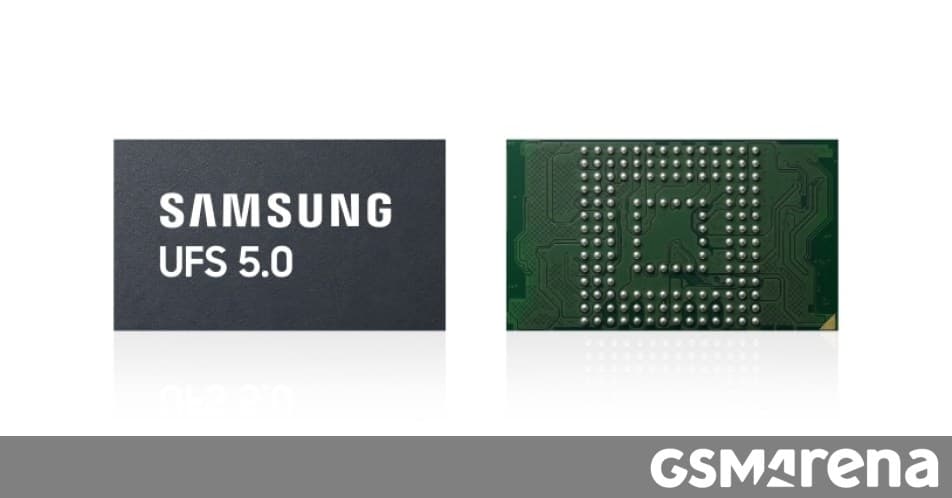
- UFS 5.0 delivers sequential read speeds of 10.8GB/s and write speeds of 9.8GB/s
- Samsung claims 40% better power efficiency and a 16.7% smaller package than UFS 4.1
- Mass production begins Q4 2025 with capacities up to 1TB
Samsung has announced its next-generation UFS 5.0 storage standard, claiming sequential read speeds of 10.8GB/s and write speeds of 9.8GB/s. That's roughly twice the throughput of the current UFS 4.1 solution. Mass production is scheduled for Q4 2025, with capacities reaching 1TB.
The company is positioning UFS 5.0 explicitly for on-device AI. The faster read speeds should reduce latency when loading large language models into memory, a bottleneck that matters more as phones run increasingly capable AI assistants locally rather than relying on cloud processing.
What are the actual UFS 5.0 specs?
Samsung says UFS 5.0 is built on JEDEC's latest embedded storage interface specification. The numbers: 10.8GB/s sequential reads, 9.8GB/s sequential writes. For context, that's fast enough to transfer a 50GB game file in under five seconds, at least in ideal conditions.
Beyond raw speed, Samsung claims two other improvements. Power efficiency is up more than 40% compared to UFS 4.1. The physical package is 16.7% smaller. Both matter for phone design. Better efficiency means less heat and longer battery life during storage-intensive tasks. A smaller footprint gives manufacturers room for larger batteries or thinner devices.
| Specification | UFS 4.1 | UFS 5.0 |
|---|---|---|
| Sequential Read | ~5.4 GB/s | 10.8 GB/s |
| Sequential Write | ~4.9 GB/s | 9.8 GB/s |
| Power Efficiency | Baseline | 40%+ improvement |
| Package Size | Baseline | 16.7% smaller |
| Max Capacity | 1TB | 1TB |
Why does Samsung emphasize on-device AI?
The timing is not accidental. Google's Gemini Nano, Apple's on-device intelligence features, and Samsung's own Galaxy AI all run large language models directly on the phone. These models can exceed several gigabytes in size. Loading them quickly from storage into RAM affects how snappy an AI assistant feels when you summon it.
Current UFS 4.1 storage is already fast by historical standards. But as on-device models grow more capable, they also grow larger. The storage subsystem becomes a potential chokepoint. Samsung is essentially future-proofing against a world where your phone runs AI models that rival what cloud servers handled two years ago.
The 40% power efficiency gain also matters here. Running inference on local AI models already strains batteries. If storage reads drain less power, that's headroom for the neural processing unit to do more work.
When will phones actually use UFS 5.0?
Samsung says mass production starts in Q4 2025. Historically, Samsung's own flagship Galaxy S series adopts new storage standards early. The Galaxy S26 series, expected in early 2026, is a likely candidate for first adoption. Other Android flagships from brands like OnePlus, Xiaomi, and Oppo typically follow within the same year.
Mid-range phones will take longer. UFS 4.0 only recently started appearing in devices outside the premium tier. Expect UFS 5.0 to remain a flagship-only feature through 2026 and possibly into 2027.
How does this affect Samsung's market position?
Samsung dominates the NAND flash memory market, which is worth roughly $50 billion globally. Announcing UFS 5.0 first reinforces that position. Competitors like SK Hynix, Micron, and Kioxia will follow with their own UFS 5.0 implementations, but Samsung sets the pace.
For Samsung's smartphone division, early access to in-house UFS 5.0 chips offers a brief competitive advantage. The Galaxy S26 could ship with storage that no iPhone or competing Android phone matches at launch. Apple uses its own storage controllers but relies on third-party NAND, which historically lags a generation behind Samsung's flagships.
Samsung's software updates for mid-range devices
Should you wait for UFS 5.0?
Probably not, unless you're already planning to buy a 2026 flagship. Storage speed improvements follow diminishing returns for most users. The jump from UFS 3.1 to UFS 4.0 was dramatic. The jump from UFS 4.1 to UFS 5.0 will feel incremental for everyday tasks like launching apps or loading games.
Where UFS 5.0 will shine is in sustained workloads: recording 8K video for extended periods, running complex on-device AI tasks, or transferring large files. If those aren't your daily use cases, current flagship storage is more than adequate.
Logicity's Take
Samsung's UFS 5.0 announcement is less about raw speed bragging rights and more about owning the infrastructure layer for on-device AI. As Google, Apple, and Samsung itself push local AI processing to differentiate their phones, storage becomes a competitive bottleneck. Samsung controlling both the chip and the standard gives it leverage that pure software companies cannot match. The real question is whether the 40% efficiency claim holds up under real-world AI workloads, not synthetic benchmarks.
Frequently Asked Questions
How fast is Samsung UFS 5.0 compared to UFS 4.1?
Samsung claims UFS 5.0 is twice as fast, with sequential read speeds of 10.8GB/s and write speeds of 9.8GB/s, compared to approximately 5.4GB/s and 4.9GB/s for UFS 4.1.
When will UFS 5.0 phones be available?
Mass production begins Q4 2025. The first phones with UFS 5.0 will likely arrive in early 2026, starting with Samsung's Galaxy S26 series and other Android flagships.
Will UFS 5.0 improve battery life?
Samsung claims UFS 5.0 is 40% more power efficient than UFS 4.1, which should help battery life during storage-intensive tasks like loading AI models or recording high-resolution video.
What is the maximum storage capacity for UFS 5.0?
Samsung has announced UFS 5.0 will be available in capacities up to 1TB, matching the current maximum for UFS 4.1.
Why does UFS 5.0 matter for on-device AI?
Large language models running locally on phones can be several gigabytes in size. Faster storage reduces the time needed to load these models into memory, making AI assistants feel more responsive.
Need Help Implementing This?
If you're building mobile apps that depend on storage performance or planning hardware strategies around on-device AI, reach out to discuss how upcoming storage standards affect your roadmap. Contact us at hello@logicity.in.
Source: GSMArena.com / Siddharth
Manaal Khan
Tech & Innovation Writer
Produced with AI assistance and reviewed by the Logicity editorial team. Learn more in our Editorial Policy.