Key Takeaways
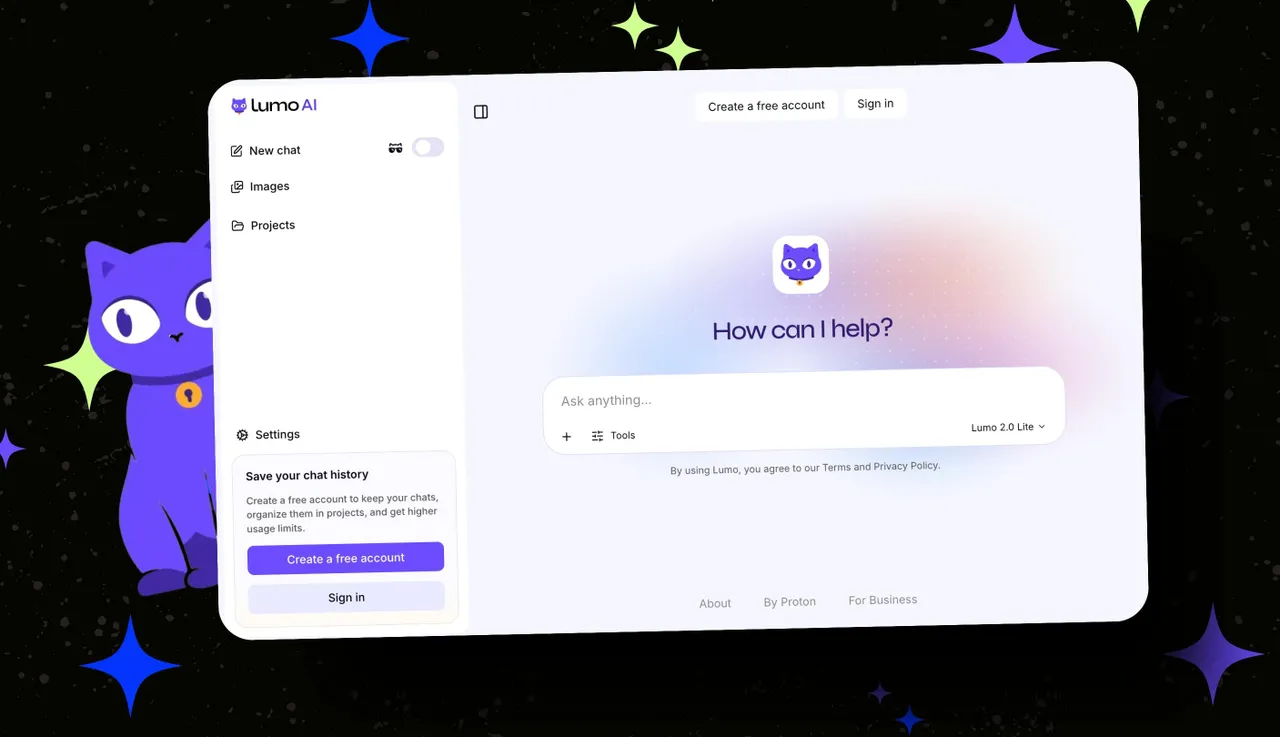
- Lumo 2.0 scores 127% higher on AI benchmarks than version 1.4, with new reasoning and fast modes
- Proton's zero-access encryption means user queries cannot be read by Proton or used for model training
- New features include image processing, live web search with citations, contextual memory, and secure project workspaces
Proton, the Swiss company behind ProtonMail and ProtonVPN, released Lumo 2.0 on July 1, billing it as the biggest update to its privacy-focused AI chatbot since launch. The headline claim: a 127% improvement in reasoning, speed, and knowledge benchmarks over version 1.4, measured on the independent Artificial Analysis Intelligence Index.
More than 10 million people have used Lumo since Proton first shipped it in 2025. The pitch remains the same. ChatGPT and Claude train on user conversations. Lumo does not. Your prompts stay encrypted under Swiss jurisdiction, and Proton cannot read them even if compelled by a government.
What Lumo 2.0 actually adds
Proton introduced two response modes. "Fast" handles simple queries with minimal latency. "Reasoning" kicks in when a question demands multi-step logic, trading speed for depth. Users pick which mode they want, or can let the model decide.
Image handling is new. Lumo 2.0 processes images alongside text in a single conversation, with the same encryption applied to both. Image generation from prompts has also improved, though Proton did not publish benchmark comparisons on that front.
Web search now pulls live results and displays citations. Proton says this reduces hallucinations, a persistent problem in large language models. The model can now fetch current news, finance data, and weather without relying on stale training data.
For business users, contextual memory is the standout. You control how much Lumo remembers about your preferences and past queries. That memory improves future answers, but you can wipe it at any time. A new "Projects" feature lets you organize conversations, files, and custom instructions into secure, isolated workspaces.
Why zero-access encryption matters for enterprise
OpenAI's default settings send your prompts into a training pipeline. Opt-out exists, but enforcement is opaque. Google's Gemini and Anthropic's Claude have similar policies with varying degrees of transparency.
Proton's architecture is different by design. Queries are encrypted end-to-end before leaving your device. Proton's servers process the request without decrypting the content. The company cannot hand over conversation logs to a regulator because it cannot read them. Swiss privacy law, already among the strictest in the world, adds another layer.
"We built Lumo to prove you don't have to sacrifice privacy for intelligence," Proton CEO Andy Yen said. "Your data stays yours, encrypted, on our servers in Switzerland, never used for training."
For CTOs evaluating AI tools, this matters in regulated industries. Healthcare, finance, and legal teams face compliance requirements that make sending sensitive data to US-based AI providers risky. Proton's Swiss hosting and zero-access model sidestep GDPR exposure and reduce the attack surface for data breaches.
How Lumo compares to ChatGPT and Claude
On raw capability, Lumo 2.0 still trails GPT-4o and Claude 3.5 Sonnet in most third-party benchmarks. The 127% improvement is relative to Proton's own earlier versions, not to OpenAI or Anthropic. Proton has not published head-to-head scores.
The tradeoff is explicit. You get weaker top-end performance in exchange for provable privacy. For tasks like document summarization, Q&A, and internal knowledge management, that tradeoff may be worth it. For frontier research or complex code generation, ChatGPT and Claude remain ahead.
Pricing details for Lumo 2.0 were not disclosed in Proton's announcement. Lumo is bundled with Proton's existing subscription tiers, which start at free and scale to paid plans covering Mail, VPN, Drive, and Calendar. Expect business tiers to follow as Proton targets enterprise adoption.
Who should consider Lumo 2.0
If your team already uses Proton's suite, Lumo slots in without adding another vendor. The encryption is consistent across Mail, Drive, and now AI. That integration is the real value. A CFO can ask Lumo to analyze a spreadsheet stored in Proton Drive, and the entire workflow stays encrypted.
Privacy-conscious consumers are the other obvious audience. Journalists, activists, and researchers working with sensitive sources have reason to avoid US-based AI providers. Proton's track record, including surviving legal challenges without compromising user data, lends credibility.
Logicity's Take
Proton is betting that privacy will become a premium feature, not a niche one. As AI tools move from novelty to infrastructure, the compliance burden will grow. Lumo 2.0 is not the smartest model on the market. It is the most defensible one for teams that cannot afford a data leak headline. Compare this to running AI workloads on [Perplexity](https://logicity.in/r/perplexity), which offers web search with citations but relies on US infrastructure. For European enterprises, Proton's Swiss jurisdiction is a genuine differentiator. The question is whether Lumo can close the capability gap fast enough to matter.
Disclosure
Some links in this post are affiliate links — Logicity earns a commission if you sign up, at no extra cost to you. We only link products we have used or actively recommend.
Frequently Asked Questions
Is Proton Lumo 2.0 free?
Lumo is included in Proton's subscription tiers, which start with a free plan. Premium features may require a paid subscription, though Proton has not published specific pricing for Lumo 2.0.
Does Proton train AI models on user data?
No. Proton uses zero-access encryption, meaning user queries are encrypted end-to-end and cannot be read by Proton or used to train AI models.
How does Lumo 2.0 compare to ChatGPT?
Lumo 2.0 scores lower than GPT-4o on third-party benchmarks but offers provable privacy guarantees that ChatGPT does not. The tradeoff is weaker performance for stronger data protection.
Where is Proton Lumo data stored?
All data is stored in Switzerland under Swiss privacy law. Proton cannot access or decrypt user queries, even if legally compelled.
Can Lumo 2.0 process images?
Yes. Lumo 2.0 can process images and text in the same conversation, with the same encryption standards applied to both. It can also generate images from text prompts.
Another significant AI infrastructure investment reshaping the competitive landscape
Related perspective on how AI tools change business operations and metrics
Need Help Implementing This?
Evaluating privacy-first AI tools for your organization? Logicity can help you assess compliance requirements and integration options. Contact us for a consultation on enterprise AI strategy.
Source: Latest news
Manaal Khan
Tech & Innovation Writer
Produced with AI assistance and reviewed by the Logicity editorial team. Learn more in our Editorial Policy.




