Procore reported Q2 FY26 results on July 31, 2026, showing $375 million in revenue, 16% year-over-year growth, and its first positive GAAP operating margin in company history. Hours later, it announced an $845 million all-cash acquisition of DroneDeploy. The deal valued the drone mapping company at roughly 10.8x trailing twelve-month revenue. Procore's own enterprise value trades at 4.3x forward revenue.

That gap tells the story. The category leader in construction software is paying more than twice its own multiple for a perception-layer company one-twentieth its size. Procore is betting that owning the data of record is worthless without the ability to see what's physically happening on a jobsite.
Why Procore paid 11x for a drone company
DroneDeploy has trailing twelve-month revenue of approximately $78 million, gross margins above 80%, and runs at cash flow breakeven. At $845 million, Procore is paying 10.8x TTM revenue for a company that provides what it calls "visual intelligence," bridging the physical jobsite to the digital record.
The financing structure is as notable as the price. Procore has about $656 million in cash and marketable securities, but it arranged a committed bridge facility to fund a majority of the purchase. The company said it will evaluate a permanent capital structure "in the most EPS-accretive manner." This is Procore taking on real leverage for the first time.
Combined with Datagrid, acquired earlier this year for roughly $159 million, Procore is assembling what it calls "digital coworkers": real-time perception as the eyes and ears (DroneDeploy), advanced reasoning as the brain (Datagrid), and an auditable platform where actions get taken. The stated value proposition: offsetting labor shortages and saving time and money.
Two acquisitions in six months for roughly $1 billion combined, at a company holding R&D roughly flat. That's a deliberate build-versus-buy stance on AI.
The P&L discipline behind the first GAAP profit
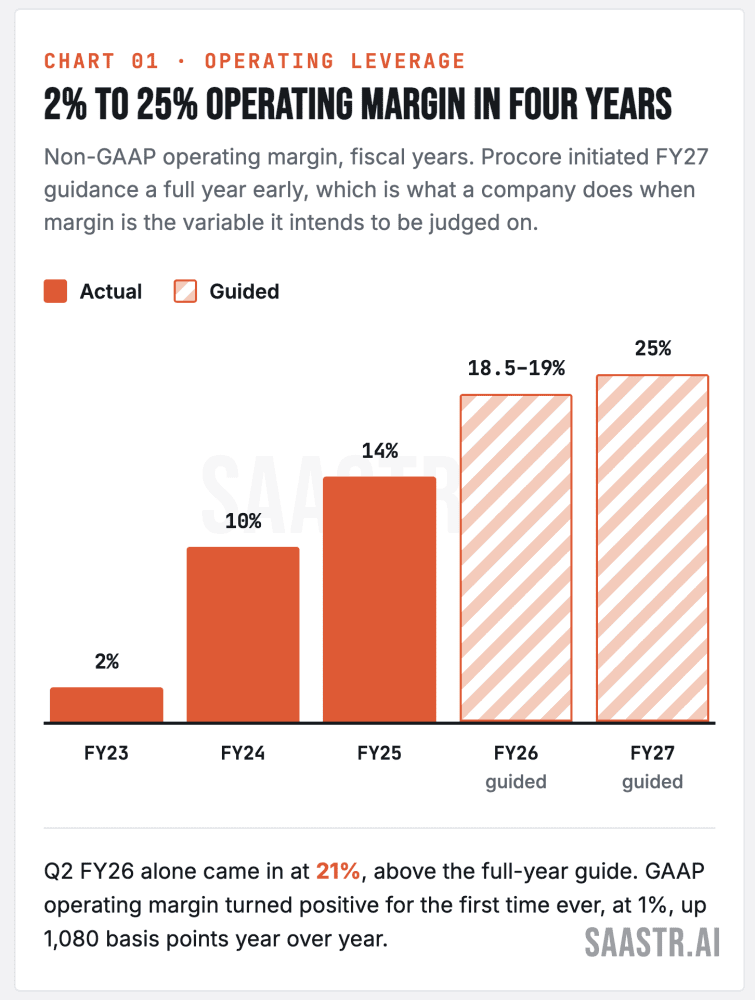
The margin story is more dramatic than the headline suggests. Total GAAP operating expenses hit $295.5 million versus $286.5 million a year ago, up 3.1% against 15.8% revenue growth. Procore added $51 million of quarterly revenue on $9 million of incremental opex.
Sales and marketing did the heaviest lifting. GAAP S&M spending was $145.8 million versus $141.9 million, up 2.7%, and actually declined sequentially from $149.2 million in Q1. S&M as a percentage of revenue dropped from 44% to 39%.
R&D deserves honest scrutiny. In Q1, R&D dollars declined year over year in absolute terms. That didn't repeat. GAAP R&D hit $93.3 million, up 5%, though part of that increase is Datagrid acquisition expense. Non-GAAP R&D was $67.4 million, up 3.4%. R&D as a percentage of revenue has declined from its peak, but absolute dollars are now at least growing again.
The retention and expansion math
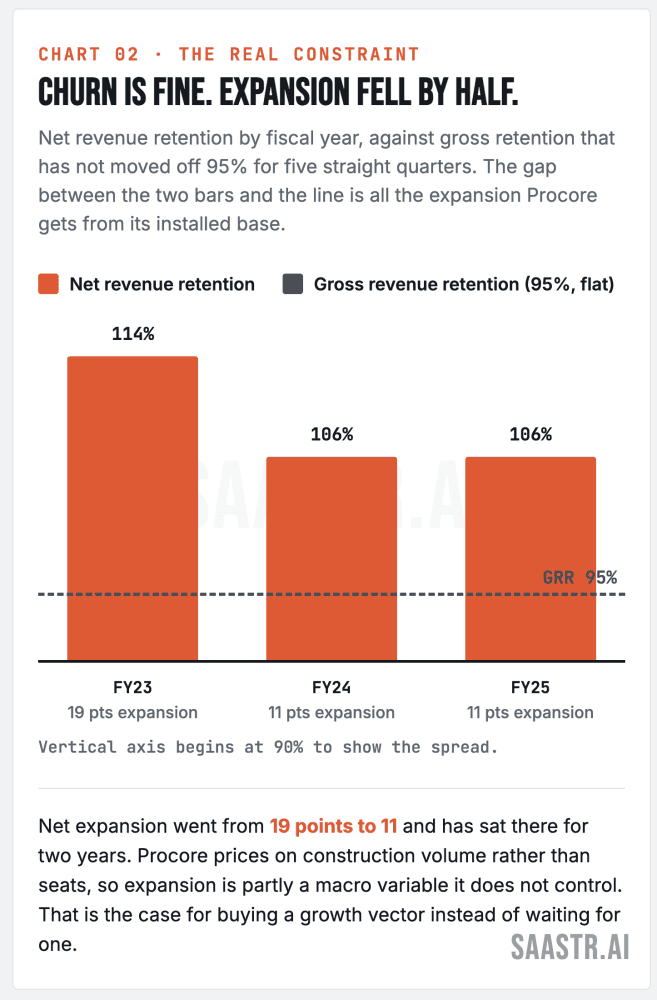
Gross revenue retention sits at 95%. Net revenue retention is 106%. These are solid numbers for construction software, though net retention below 110% means Procore needs new logos to grow faster than mid-teens.
The company now has 2,871 customers paying more than $100,000 in ARR, up 14% year over year. These accounts represent 68% of total ARR. Concentration in large accounts is a double-edged sword: higher retention and expansion potential, but longer sales cycles and more exposure to construction market cycles.
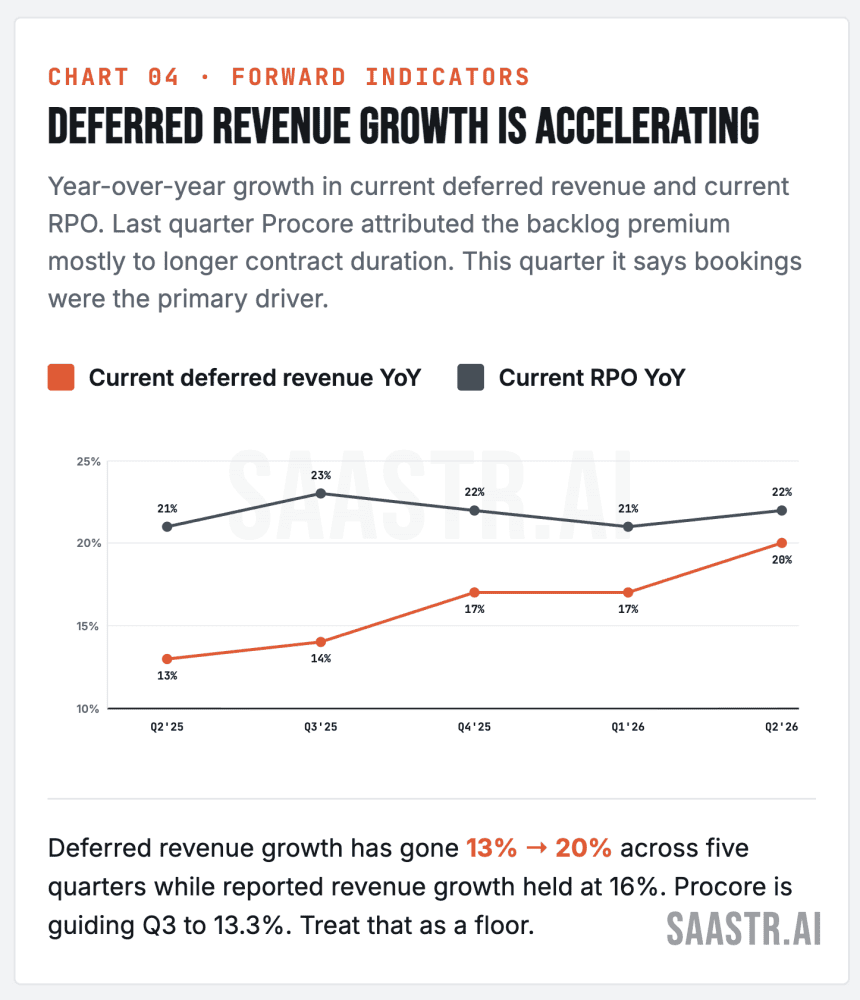
Free cash flow hit $65 million, up 507% year over year. That's what makes the DroneDeploy acquisition possible without equity dilution.
New leadership, same playbook
Procore is six months into a full leadership swap. Ajei Gopal took over as CEO in November 2025 from founder Tooey Courtemanche, who remains Chairman. Rachel Pyles is CFO and Walt Hearn is CRO. All three came from Ansys, where Gopal was CEO from 2017 to 2025 and led the company through its $35 billion sale to Synopsys.
The Ansys playbook is visible: aggressive margin expansion, strategic M&A funded with debt, focus on large enterprise accounts. Gopal ran Ansys to a premium exit by making simulation software indispensable to engineering workflows. The bet is that construction project management can follow the same path.
Logicity's Take
For vertical SaaS founders, the DroneDeploy deal is a pricing signal. Incumbents with slow-growth multiples will pay AI-native multiples for the perception layer. If you have a sensing or capture business in a vertical, the incumbent platform is your buyer, and they will stretch. The corollary: watch what category leaders are buying rather than building. Two acquisitions for $1 billion combined at a company holding R&D flat is a deliberate statement about internal AI capability.
What the valuation gap means
Procore trades at roughly 4.3x ARR, or about $6.5 billion enterprise value on a $1.5 billion ARR run rate. It paid 10.8x for DroneDeploy. The multiple arbitrage only works if DroneDeploy's capabilities drive retention and expansion that wouldn't happen otherwise.
The company guided FY27 non-GAAP operating margin to 25%, up from 21% in Q2. That implies continued opex discipline even as integration costs hit. Management says the deal is accretive to organic growth with no material impact to margin guidance. That's a bold claim for an $845 million acquisition of a company at breakeven.
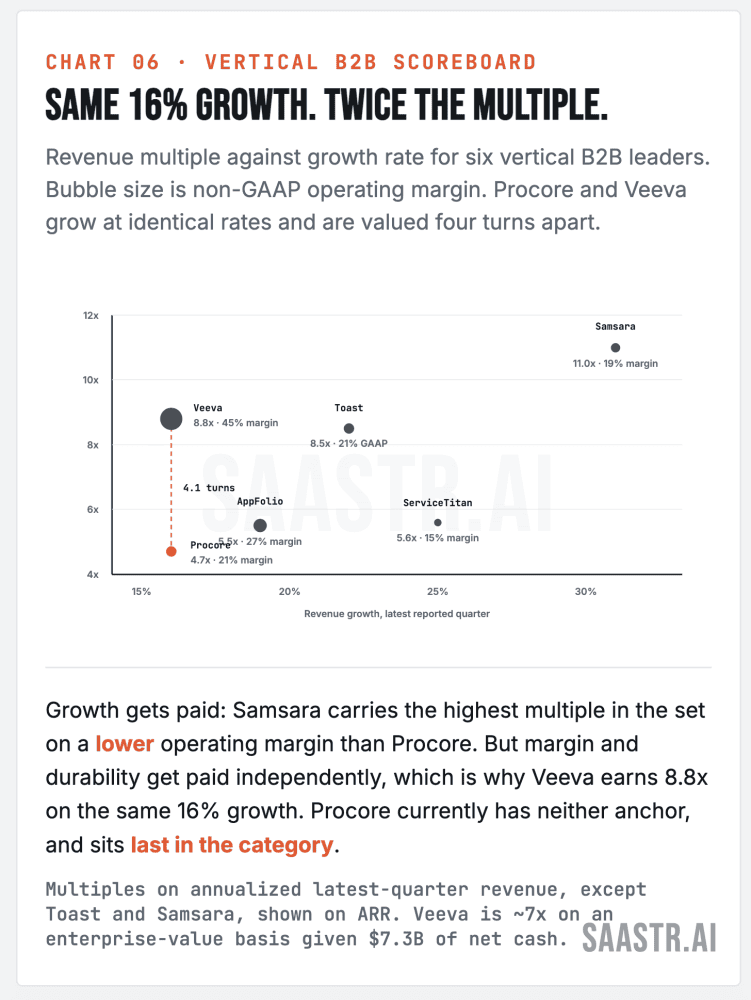
The framing, moving from "system of collaboration and record" to "system of intelligence for construction," is the clearest articulation of an AI thesis from a vertical incumbent. Whether the market rewards it depends on whether 106% net retention ticks up or down over the next four quarters.
Another vertical AI play targeting operational workflows in a legacy industry
Need Help Implementing This?
Building a vertical SaaS company and thinking through build-versus-buy on AI capabilities? Logicity covers the strategies that work. Subscribe for weekly analysis on SaaS growth, M&A, and operational benchmarks.
Source: SaaStrAI
Huma Shazia
Senior AI & Tech Writer
Produced with AI assistance and reviewed by the Logicity editorial team. Learn more in our Editorial Policy.