Key Takeaways

- GPT-Live uses full-duplex architecture to listen and speak simultaneously, eliminating the rigid turn-taking of previous voice modes
- Complex queries get delegated to GPT-5.5 in the background, boosting accuracy from 0.7% to 75.2% on agent-based web search benchmarks
- Users preferred GPT-Live-1 over Advanced Voice Mode in 75.7% of cases during OpenAI's evaluations
OpenAI has released GPT-Live, a voice model that can listen and speak at the same time. The full-duplex architecture eliminates the awkward pauses of previous ChatGPT voice modes, where users had to wait for the AI to finish before responding. Two versions are rolling out globally: GPT-Live-1 for paying subscribers on Go, Plus, and Pro plans, and GPT-Live-1 mini for free accounts.
The bigger shift is architectural. When a question requires web search, reasoning, or agent capabilities, GPT-Live hands the task to GPT-5.5 running in the background. The conversation keeps flowing while the heavier model works. OpenAI says the system is built so GPT-Live stays connected to whatever frontier model is current.
How does full-duplex change AI voice interaction?
Traditional voice assistants, including ChatGPT's older Advanced Voice Mode, use half-duplex audio. The AI waits for you to stop talking, processes your input, then responds. Real human conversation doesn't work that way. People overlap, interrupt, and give verbal nods like "mhmm" to signal they're following along.
GPT-Live makes decisions multiple times per second about whether to speak, listen, pause, or interrupt. It uses filler phrases to acknowledge the speaker without taking over the conversation. Users can cut in mid-sentence or ask the model to slow down.
Nvidia released a similar open-source model called PersonaPlex earlier this year, but OpenAI's implementation ships directly to ChatGPT's 100 million+ weekly users across iOS, Android, and the web.
The benchmark gap between GPT-Live and Advanced Voice Mode
The performance difference is stark. On GPQA, a scientific reasoning benchmark, GPT-Live-1 at high reasoning level hits 84.2% accuracy. Advanced Voice Mode scores 45.3%. The gap widens on BrowseComp, which tests agent-based web search. GPT-Live-1 reaches 75.2%. Advanced Voice Mode manages 0.7%.
That 0.7% figure explains why previous voice modes felt limited. They answered questions using only their own parameters, with no ability to search the web or delegate to more capable models. For anything beyond simple queries, they were unusable for real work.
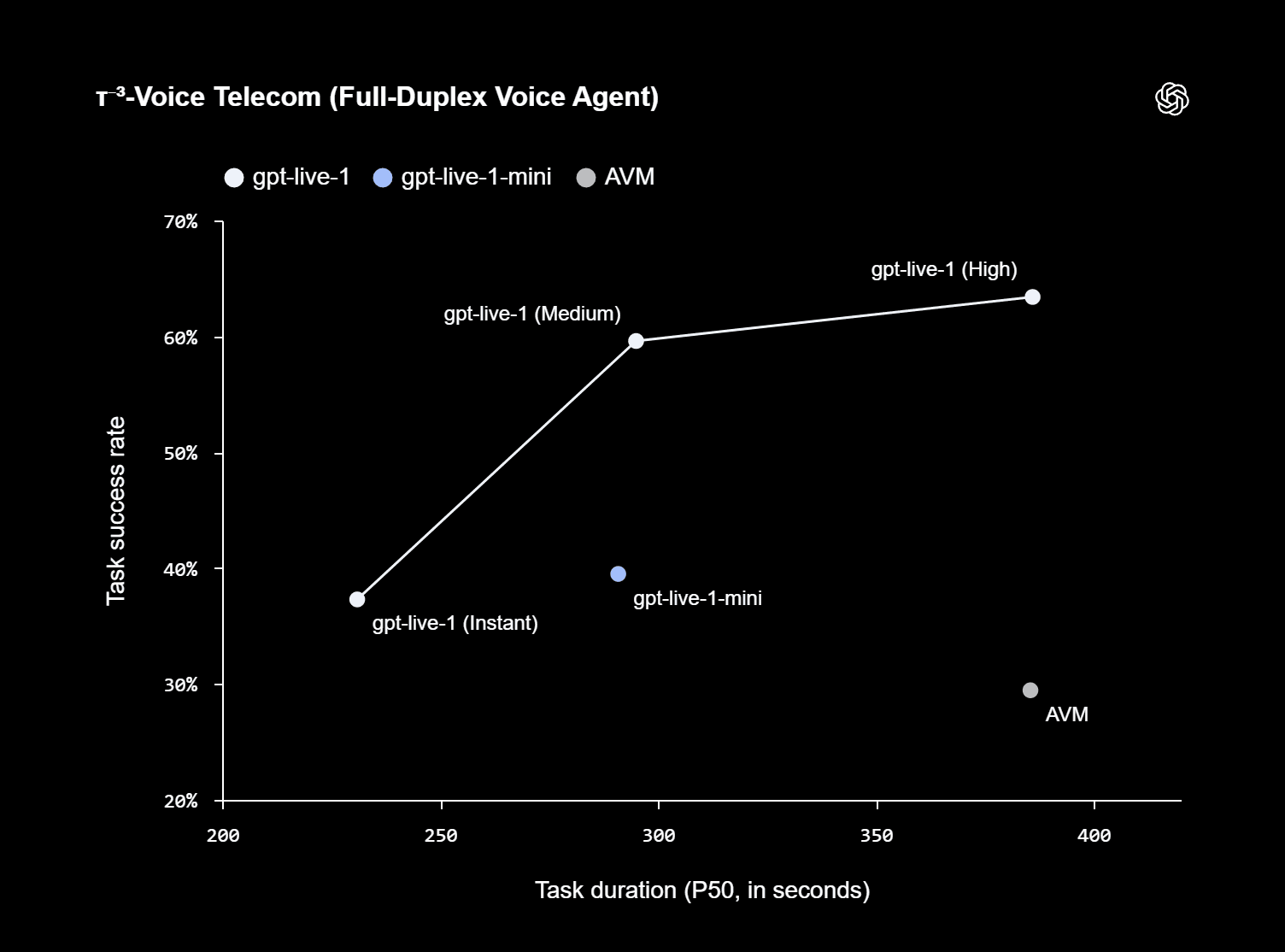
OpenAI's internal tau3 Voice Telecom test measures full-duplex voice agents on realistic telecom support tasks. GPT-Live-1 at high reasoning completes about 65% of tasks in roughly 385 seconds. Advanced Voice Mode hits 30% and takes just as long. The instant reasoning tier finishes 37% of tasks in around 225 seconds, trading accuracy for speed.
User preference and the reasoning level trade-off
In OpenAI's evaluations, users preferred GPT-Live-1 over the previous Advanced Voice Mode in 75.7% of comparisons. The mini version, available on free accounts, was preferred 69.2% of the time.
Users can now select a reasoning level. "Instant" delivers quick answers with less background processing. "Medium" and "High" tell ChatGPT to spend more time thinking, routing more work to GPT-5.5. The trade-off is latency versus accuracy, and users get to choose based on the task.
What's missing at launch
GPT-Live doesn't yet support video or screen sharing. The older Standard and Advanced Voice Modes, which include those features, will remain available for now. OpenAI says video and screen sharing are coming soon.
API access isn't live yet either. Developers can sign up through a form, and OpenAI says it plans to add API support soon. Until then, builders who want to integrate GPT-Live into their own products will have to wait.
The update also adds visual cards during voice conversations. ChatGPT can now display weather forecasts, stock prices, or sports scores on screen while talking. OpenAI revamped the nine available voices for GPT-Live as well.
The safety question around human-sounding AI
More natural AI conversation raises safety concerns. Research shows people tend to treat AI models like humans and can be talked into actions with serious consequences. Heavy voice model users appear even more susceptible to this effect.
OpenAI hasn't detailed specific safety measures for GPT-Live, but the pattern is clear: as voice AI gets more convincing, the line between tool and trusted advisor blurs. Product teams building on this technology will need to think carefully about how users perceive their AI's suggestions.
Logicity's Take
The background delegation architecture is the real story here. OpenAI solved the voice model intelligence problem by treating it as a routing problem. GPT-Live handles conversation flow while GPT-5.5 handles reasoning. This approach means voice interfaces can now match text interfaces in capability. For product teams building voice features, the API waitlist is worth joining early. The 75.2% vs 0.7% gap on web search tasks shows how far ahead this architecture is. Competitors like Google's Gemini Live and Nvidia's PersonaPlex will need similar delegation patterns to keep pace. Expect API pricing to reflect the compute cost of running two models simultaneously.
Frequently Asked Questions
What is GPT-Live?
GPT-Live is OpenAI's new voice model for ChatGPT that uses full-duplex architecture to listen and speak simultaneously, making conversations feel more natural than previous voice modes.
Is GPT-Live free to use?
GPT-Live-1 mini is available on free ChatGPT accounts. GPT-Live-1, the more capable version, requires a Go, Plus, or Pro subscription.
Can GPT-Live search the web during conversations?
Yes. GPT-Live delegates web searches and complex reasoning tasks to GPT-5.5 in the background while maintaining the conversation.
When will GPT-Live API access be available?
OpenAI says API access is coming soon. Developers can sign up through a form on OpenAI's website to join the waitlist.
Does GPT-Live support video calls?
Not at launch. Video and screen sharing features are planned but not yet available. The older Advanced Voice Mode still supports these features.
Comparison of automation approaches relevant to teams evaluating AI integration strategies
Need Help Implementing This?
Building voice AI into your product? Our team can help you evaluate GPT-Live API options and design conversation flows that work for your users. Get in touch at hello@logicity.in.
Source: The Decoder / Matthias Bastian
Huma Shazia
Senior AI & Tech Writer
Produced with AI assistance and reviewed by the Logicity editorial team. Learn more in our Editorial Policy.