Key Takeaways
- OpenAI is hiring a dedicated product manager to build family-focused ChatGPT experiences for parents, caregivers, and older adults
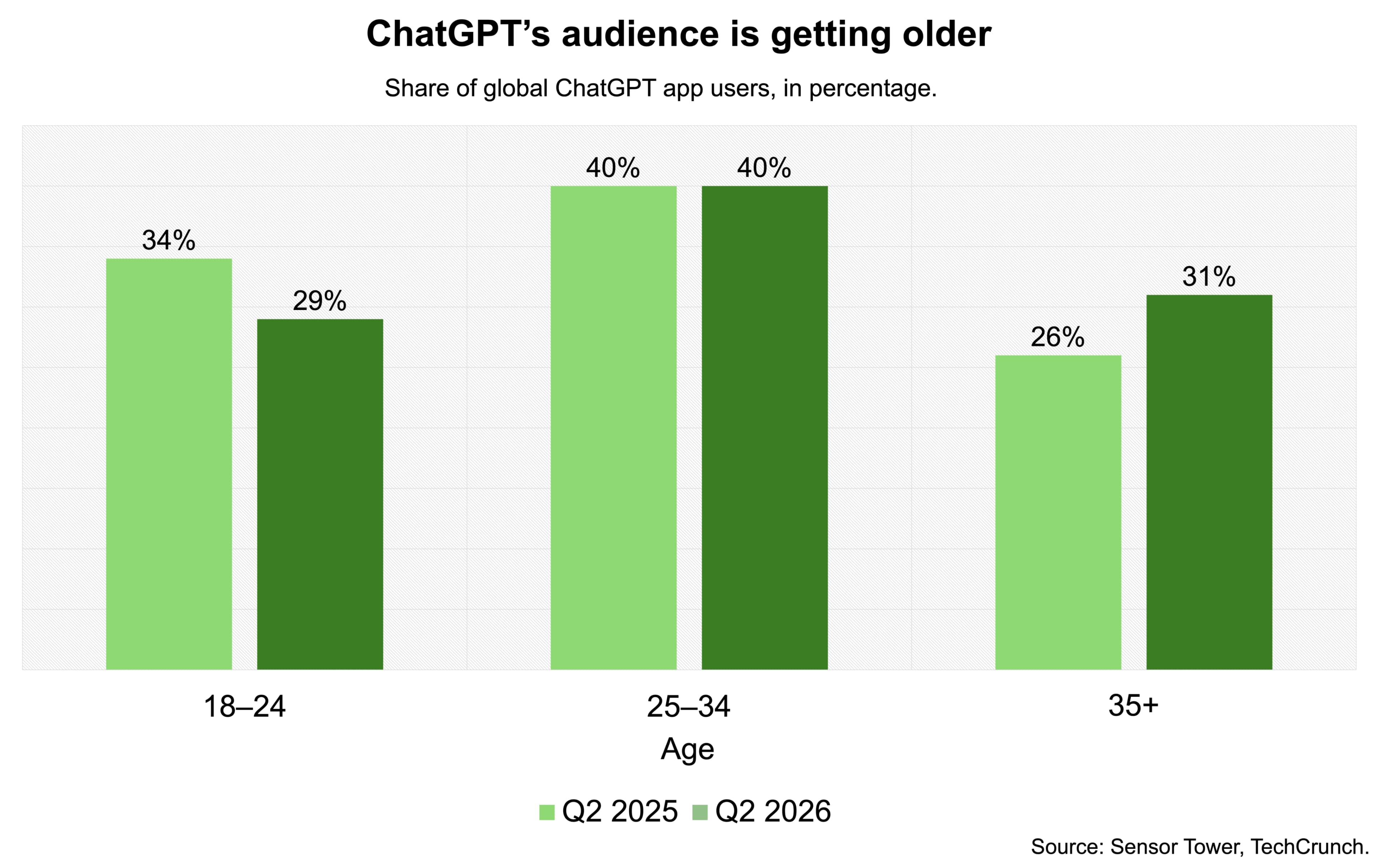
- ChatGPT's user demographics are shifting: users 35+ grew from 26% to 31% globally, while 18-24 users dropped from 34% to 29%
- Nearly 1 in 4 U.S. parents with smartphones now use ChatGPT, up from 16% a year ago
OpenAI is hiring a product manager in San Francisco to build ChatGPT experiences for families, caregivers, and older adults. The move signals a strategic pivot: OpenAI now sees its flagship product not just as a productivity tool for individuals but as household technology that needs to work for multiple generations under one roof.
The job posting calls for experience building products for parents and families, along with "trust-sensitive consumer experiences." OpenAI did not respond to TechCrunch's request for comment.
Who's actually using ChatGPT now?
ChatGPT's audience is getting older. Sensor Tower data shared with TechCrunch shows the share of global users aged 35 and above rose to 31% in Q2, up from 26% a year earlier. Meanwhile, users aged 18 to 24 dropped from 34% to 29%.
Parents are adopting fast. Nearly one in four U.S. smartphone users who are parents used ChatGPT during Q2, up from 16% a year earlier. Google's Gemini still leads among parents at 32% reach, followed by ChatGPT at 24%, Claude at 4%, and Copilot at 2%.
ChatGPT is adding older users faster than competitors. Users 45+ grew three percentage points year-over-year, compared to two points for Copilot. Claude and Gemini saw declines in that cohort.
Why families require different AI products
"This is similar to the path Google, Apple, and Meta eventually followed as their platforms became embedded in everyday life, but AI raises the stakes because the assistant is not just mediating content or devices," Ben Bajarin, CEO of Creative Strategies, told TechCrunch.
The distinction matters. A search engine shows you links. A chatbot converses. That conversational nature creates different risks when children interact with it, especially if they mistake the AI for a human confidant.
Stephen Balkam, CEO of the Family Online Safety Institute, called the hiring "safety by redesign." His point: ChatGPT launched for adults, and retrofitting safety features is harder than building them from scratch.
“You take the initial product or service that was released… not really with kids in mind… so this is a much-needed reaction and response.”
— Stephen Balkam, CEO, Family Online Safety Institute
Parents underestimate how often kids use AI
New research from the Family Online Safety Institute found a perception gap. While 27% of U.S. parents said their child had used generative AI in the past week, 38% of children reported doing so. The survey covered more than 4,000 families in the U.S. and Australia.
That 11-point gap suggests many parents have limited visibility into how their kids interact with AI tools. For companies like OpenAI, the implication is clear: parental controls only work if parents know to use them.
OpenAI's existing safety measures
OpenAI has already introduced several safety features over the past year:
- Parental controls for teen accounts
- Routing sensitive conversations to reasoning models designed to handle distress signals
- A "Trusted Contact" feature that can alert a family member or caregiver in potential self-harm cases
These features came under pressure. OpenAI has faced multiple lawsuits from parents alleging ChatGPT contributed to harm suffered by their children, including cases involving suicide.
Balkam argues AI companies have a chance to avoid repeating social media's mistakes. Platforms like Facebook and Instagram spent years treating children like adults before adding stronger safeguards. Public pressure and regulatory scrutiny forced the change. OpenAI can design for families from the start.
What this means for AI competition
The demographic shift is not unique to ChatGPT. Users aged 25 to 34 account for 40% of global app audiences for Claude, Gemini, and ChatGPT alike. Microsoft's Copilot skews older: 20% of its users are 45+, compared to 14% for Claude, 12% for Gemini, and 11% for ChatGPT.
But ChatGPT's growth among parents positions it for household integration in a way competitors haven't matched. If OpenAI builds family-specific features that parents trust, it creates switching costs that extend beyond the individual user.
OpenAI has also partnered with the San Antonio Spurs Community Impact organization and the Positive Coaching Alliance to explore AI's role in learning, coaching, and youth engagement. These workshops signal a broader institutional play beyond consumer households.
Logicity's Take
OpenAI's family hire is less about safety PR and more about market expansion math. Individual power users cap out. Households multiply. If ChatGPT becomes the default AI for a family of four, that's potentially four paid subscriptions. Competitors like Google have family-sharing baked into their subscription model already. OpenAI will likely need similar features. For enterprise leaders, the lesson is that consumer AI adoption is now a household decision, not an individual one. That changes procurement psychology for prosumer tools that blur work and home use.
Frequently Asked Questions
Does ChatGPT have parental controls?
Yes. OpenAI introduced parental controls for teen accounts in 2025, including conversation monitoring options and content restrictions. The new family-focused product manager will likely expand these features.
What age group uses ChatGPT the most?
Users aged 25-34 account for 40% of ChatGPT's global audience. The 35+ demographic is growing fastest, rising from 26% to 31% year-over-year.
Is ChatGPT safe for children?
OpenAI has added safety features like routing distress signals to reasoning models and a Trusted Contact alert system. However, lawsuits from parents allege the platform has contributed to harm, and the company is still building out child-specific safeguards.
How does ChatGPT compare to Gemini for families?
Google's Gemini has wider reach among U.S. parents (32% vs 24% for ChatGPT), but ChatGPT is adding parental users faster and is now investing in dedicated family product development.
Context on how AI adoption metrics are shifting across consumer and enterprise segments
Need Help Implementing This?
Contact Logicity's advisory team for guidance on AI strategy, family-safe product design, or enterprise adoption frameworks. We help CTOs and founders navigate these shifts before they become competitive gaps.
Source: TechCrunch / Jagmeet Singh
Demographic shifts driving OpenAI's family focus
The new article provides detailed demographic data on ChatGPT's user base: users aged 35+ grew from 26% to 31% year-over-year, while 18-24 users declined from 34% to 29%. It also reveals that nearly 1 in 4 US smartphone-using parents used ChatGPT (up 9% YoY), and includes comparative data showing ChatGPT is adding older users faster than Claude, Gemini, and Copilot.
Manaal Khan
Tech & Innovation Writer
Produced with AI assistance and reviewed by the Logicity editorial team. Learn more in our Editorial Policy.