Key Takeaways
- Nvidia built a desktop RTX 3050 Ti prototype but never released it to consumers
- The cancelled GPU had 3,328 CUDA cores, 30% more than the retail RTX 3050
- Market timing during the GPU shortage likely killed the product
A GPU That Almost Was
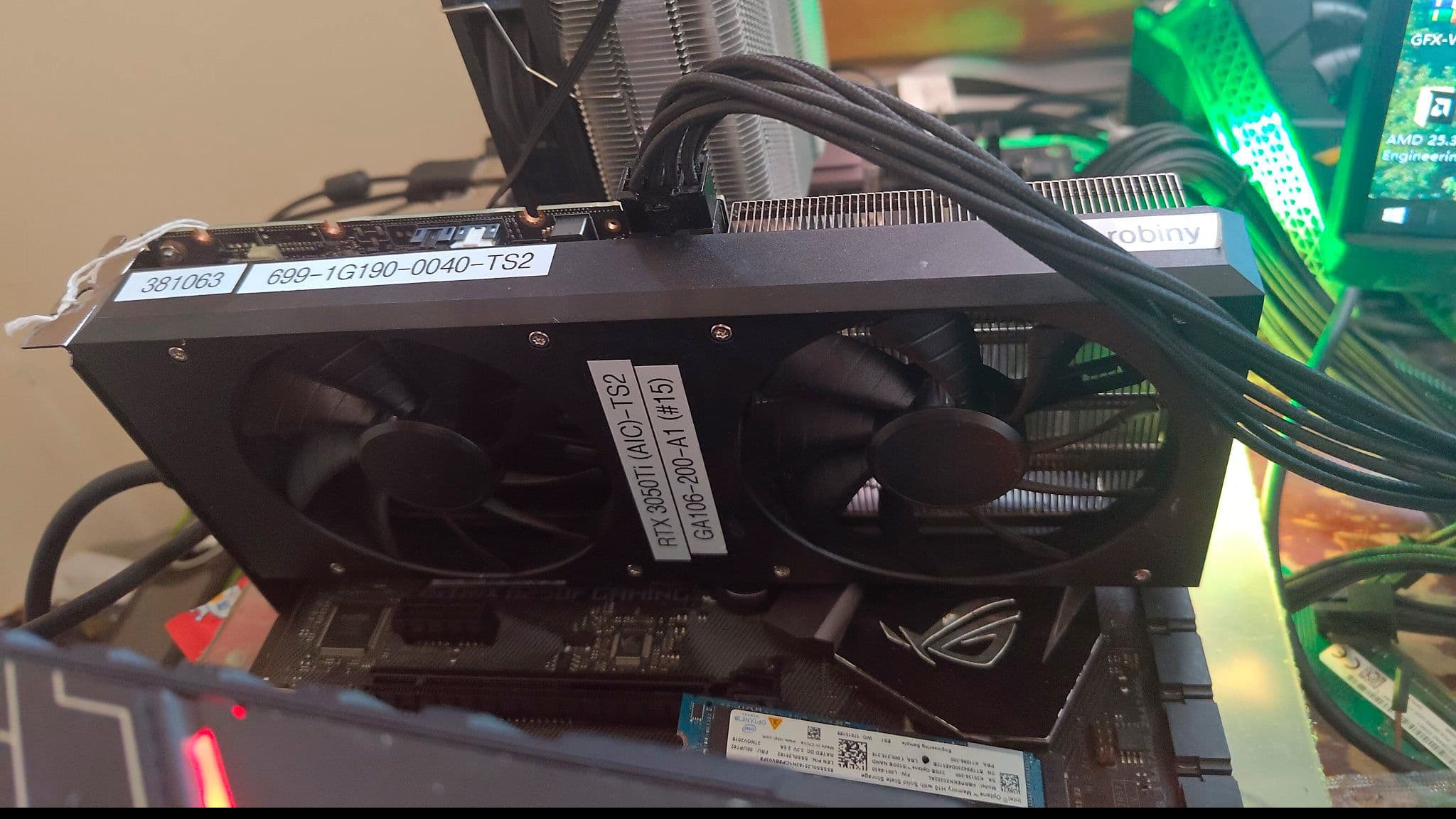
Hardware leaker Gok has published photos and benchmark results of a GeForce RTX 3050 Ti desktop graphics card. The catch: Nvidia never sold this GPU. While a mobile RTX 3050 Ti exists for laptops, this desktop version remained a prototype, apparently cancelled before reaching store shelves.
The engineering sample reportedly came from a company called Robiny and uses Nvidia's PG190 SKU 40 design board. It runs on the GA106 silicon, the same chip found in both the RTX 3050 and RTX 3060.
The Specifications Tell the Story
A perfect GA106 die contains 30 Streaming Multiprocessors (SMs). The RTX 3050 Ti prototype has 26 enabled, giving it 87% die utilization. This translates to 3,328 CUDA cores. For comparison, the retail RTX 3060 has 3,584 cores (about 7% more), while the RTX 3050 has just 2,560 cores (30% fewer).
The memory configuration is particularly interesting. The prototype uses a 192-bit memory bus, matching the RTX 3060. The retail RTX 3050, by contrast, shipped with a narrower 128-bit bus. This wider bus would have given the 3050 Ti significantly better memory bandwidth.
| Specification | RTX 3060 | RTX 3050 Ti (Prototype) | RTX 3050 |
|---|---|---|---|
| CUDA Cores | 3,584 | 3,328 | 2,560 |
| Memory Bus | 192-bit | 192-bit | 128-bit |
| VRAM | 12 GB | 6 GB | 8 GB |
| Bandwidth | 360 GB/s | 336 GB/s | 224 GB/s |
| TDP | 170W | Unknown | 130W |
| Launch Price | $329 | N/A | $249 |
Clock speeds on the prototype run higher than the RTX 3060. The base clock sits at 1,410 MHz compared to the 3060's 1,320 MHz, though both cards share a 1,777 MHz boost clock. Higher clocks on fewer cores follows a predictable pattern in GPU design.
Benchmark Results
The engineering sample scored 7,787 points in 3DMark Time Spy's graphics test. This places it exactly where you'd expect: between the RTX 3050 and RTX 3060. The result confirms this wasn't just a paper design. Nvidia had working silicon.
Why Nvidia Cancelled It
The Ampere generation launched into chaos. First came the cryptocurrency mining boom, which created artificial demand for any GPU that could hash. Then COVID-19 disrupted supply chains globally. Graphics cards sold for double or triple their MSRP on secondary markets.
In that environment, Nvidia had no incentive to release another SKU. The RTX 3050 Ti would have competed with the RTX 3060, potentially cannibalizing sales of the higher-margin card. When demand already exceeds supply, adding more products just complicates manufacturing.
The 6 GB VRAM specification also raises questions about long-term viability. Modern games increasingly demand more than 6 GB of video memory at higher settings. Even at launch, this limitation might have drawn criticism.
Community Response
Discussion on Reddit's r/nvidia and r/hardware forums has been mixed. Some users expressed frustration that the card never launched, calling it an ideal budget-midrange option that could have competed with AMD's offerings at the time. Others argued the 6 GB VRAM would have handicapped the card anyway, making cancellation a mercy killing.
Engineering samples like this occasionally surface years after a product line ends. They serve as historical artifacts, showing the decisions GPU makers considered but ultimately rejected. For hardware enthusiasts, they're a glimpse at alternate timelines.
Logicity's Take
Frequently Asked Questions
Did Nvidia ever release an RTX 3050 Ti?
Yes, but only for laptops. The mobile RTX 3050 Ti shipped in gaming notebooks. The desktop version shown in these leaks was never released to consumers.
How does the RTX 3050 Ti compare to the RTX 3060?
The prototype had 3,328 CUDA cores versus the 3060's 3,584 cores, about 7% fewer. Both used a 192-bit memory bus, but the 3060 had 12 GB of VRAM while the 3050 Ti had only 6 GB.
Why was the RTX 3050 Ti desktop cancelled?
Likely a combination of the GPU shortage making new SKUs unnecessary and concerns about cannibalizing RTX 3060 sales. The 6 GB VRAM limitation may have also factored into the decision.
What GPU architecture does the RTX 3050 Ti use?
The prototype uses Nvidia's Ampere architecture, specifically the GA106 die built on Samsung's 8nm process. This same silicon powers both the RTX 3050 and RTX 3060.
Need Help Implementing This?
Source: Latest from Tom's Hardware
Huma Shazia
Senior AI & Tech Writer
Produced with AI assistance and reviewed by the Logicity editorial team. Learn more in our Editorial Policy.