Key Takeaways
- MAI-Thinking-1 is Microsoft's first reasoning model with 35 billion active parameters and benchmarks roughly on par with Deepseek V3.2
- Frontier Tuning lets companies use reinforcement learning on their own workflows, claiming GPT-5.4 performance at one-tenth the cost
- Scout is an always-on background agent that handles scheduling and meeting prep without user prompts
Microsoft used its Build 2026 conference to announce seven AI models developed entirely in-house. The lineup includes the company's first reasoning model, a coding assistant, image generation, transcription, and voice synthesis. Alongside the models, Microsoft introduced a new enterprise tuning method and an autonomous agent that works in the background.
The announcements signal Microsoft's push to reduce reliance on external AI providers. Every model in the new MAI family shares the same data foundation, infrastructure, and evaluation pipeline. They're available through Azure Foundry, and developers can now fine-tune the weights themselves.
MAI-Thinking-1: Microsoft's First Reasoning Model
The centerpiece is MAI-Thinking-1, a 1-trillion-parameter model with 35 billion active parameters. It has a 128,000-token context window and is built for multi-step instructions, long contexts, and code generation.
Microsoft AI chief Mustafa Suleyman said the model was trained from scratch on clean data without distillation from third-party models. That's a pointed comment about practices at competing labs. According to Microsoft, MAI-Thinking-1 matches leading models on key software engineering benchmarks and was preferred over Anthropic's Sonnet 4.6 in internal blind comparisons.
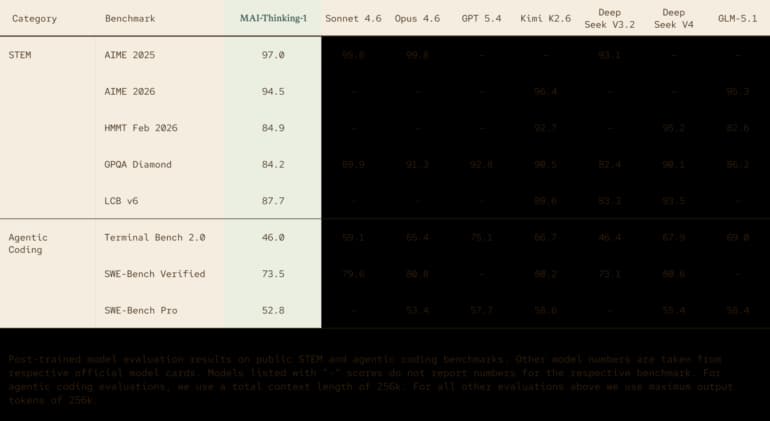
The published benchmarks tell a more modest story. MAI-Thinking-1 lands roughly on par with Deepseek V3.2, not ahead of it. That's respectable for Microsoft's first reasoning model, but it doesn't yet challenge the top tier.
Six More Models Across Different Tasks
Beyond reasoning, the MAI family covers six specialized areas:
- MAI-Code-1-Flash: A 5-billion-parameter agentic coding model. Microsoft says it's comparable to Anthropic's Haiku but cheaper to run. It's integrated into GitHub Copilot and Visual Studio Code.
- MAI-Image-2.5: Handles text-to-image and image editing. It ranks second on the Arena-Score image benchmark, behind GPT-Image-2 and ahead of Google's Nano-Banana models.
- MAI-Transcribe-1.5: Pitched as the fastest transcription model, supporting 43 languages.
- MAI-Voice-2: Generates speech in 15 languages and can clone voices from short audio samples.
The image generation result is notable. Microsoft beating Google on a major image benchmark represents a reversal from just two years ago, when Microsoft relied entirely on OpenAI's DALL-E for image generation.
Frontier Tuning: The Enterprise Cost Play
Microsoft paired the models with a new approach called Frontier Tuning. Customers can use reinforcement learning environments to align models directly with their own workflows. The idea: the most valuable training data is the actual work traces an agent leaves behind inside an organization.
“Frontier Tuning represents the first time companies can truly encode their own institutional wisdom into a foundational reasoning engine without risking data leakage.”
— Sarah Bird, Lead Researcher at Microsoft AI
The cost claim is aggressive. If accurate, it would make custom enterprise models economically viable for mid-sized companies, not just tech giants. The catch is that customers need to generate enough work traces to train on, which requires running agents at scale first.
Scout: The Always-On Background Agent
Microsoft also introduced Scout, an autonomous background agent that handles office tasks like scheduling and meeting prep. Unlike Copilot, which responds to prompts, Scout runs continuously and acts on its own.
“We are moving from Copilots that assist to Autopilots that operate. Scout isn't just listening; it's anticipating.”
— Kevin Scott, CTO of Microsoft
The shift from reactive to proactive AI has been building for months. Scout represents Microsoft's bet that users will trust an agent to take action without asking permission first. That's a significant behavioral change, and it raises obvious questions about oversight and error correction.
Developer Hardware and a New OS
The software announcements came alongside hardware. Microsoft announced local developer hardware and a new operating system built specifically for AI agents. Details were limited, but the message is clear: Microsoft wants to own the full stack, from silicon to application layer.
Community Reaction: Interest and Skepticism
Discussion on r/MachineLearning and Hacker News has focused on Frontier Tuning. Developers are interested in the technical promise of reinforcement learning on agent traces versus standard RAG approaches. The method could solve a real problem: enterprise data is often too messy for traditional fine-tuning.
Scout drew more skepticism. Users debated privacy implications and what some called "agent creep," the gradual expansion of autonomous software into areas where human oversight is assumed. Microsoft hasn't detailed what actions Scout can take without confirmation or how errors are surfaced.
Logicity's Take
What This Means for Enterprise AI Strategy
Microsoft is pitching a different value proposition than OpenAI or Anthropic. Instead of chasing the best foundation model, Microsoft is competing on customization and integration. If Frontier Tuning delivers on its cost claims, enterprises could run specialized models that match frontier performance for routine tasks at a fraction of the price.
The Scout agent represents a longer-term bet. Autonomous background agents require significant trust from users and IT departments. Microsoft has the advantage of already being embedded in enterprise workflows through Office and Teams. Whether that's enough to overcome natural skepticism about always-on AI remains to be seen.
Anthropic's competing expansion into enterprise AI markets
The limits of AI autonomy in high-stakes applications
Frequently Asked Questions
What is MAI-Thinking-1?
MAI-Thinking-1 is Microsoft's first reasoning model, featuring 35 billion active parameters and a 128,000-token context window. It's designed for multi-step instructions, long contexts, and code generation.
How does Frontier Tuning work?
Frontier Tuning uses reinforcement learning on the actual work traces that AI agents generate within an organization. This lets companies customize models to their specific workflows without traditional fine-tuning.
What is Microsoft Scout?
Scout is an always-on background agent that handles office tasks like scheduling and meeting preparation autonomously, without requiring user prompts.
How does MAI-Thinking-1 compare to other reasoning models?
Published benchmarks show MAI-Thinking-1 performs roughly on par with Deepseek V3.2. Microsoft claims it was preferred over Anthropic's Sonnet 4.6 in internal comparisons.
When will these Microsoft AI models be available?
The models are available through Azure Foundry. For the first time, developers can also fine-tune the weights themselves.
Need Help Implementing This?
Source: The Decoder / Maximilian Schreiner
Huma Shazia
Senior AI & Tech Writer
Produced with AI assistance and reviewed by the Logicity editorial team. Learn more in our Editorial Policy.