Key Takeaways

- Microsoft's in-house MAI models now handle tens of thousands of requests weekly in Excel and Outlook, replacing OpenAI and Anthropic
- Microsoft's head of AI Mustafa Suleyman stated the goal is to 'eliminate' Anthropic costs entirely
- MAI-Thinking 1 benchmarks show it trails OpenAI and Anthropic models, landing closer to Deepseek V3.2
Microsoft is quietly swapping out OpenAI and Anthropic AI models for its own in-house alternatives across Copilot products. Excel, Outlook, and GitHub Copilot now run on Microsoft's MAI models for tens of thousands of requests weekly, according to Bloomberg. The company's stated goal: stop paying its AI partners entirely.
The shift marks a significant strategic pivot. Microsoft has invested over $13 billion in OpenAI and built its enterprise AI story around that partnership. Now it's building the infrastructure to walk away from those costs, even if its own models underperform the alternatives.
What Microsoft actually said about cutting AI costs
Mustafa Suleyman, Microsoft's head of AI, was blunt about the company's intentions in June. "We pay a lot of money to Anthropic, so our goal is to reduce and ultimately eliminate that cost," he said. That's not subtle corporate hedging. It's a direct statement of intent to phase out third-party AI providers.
The timing is notable. Microsoft recently argued that vendor lock-in with OpenAI and Anthropic is problematic, positioning itself as a "platform-neutral alternative." The company seems to want both: freedom from AI vendor dependency for itself, and a reputation as an open platform for customers.
How MAI models compare to OpenAI and Anthropic
At Build conference, Microsoft unveiled MAI-Thinking 1, its first reasoning model. The company claimed it matched Sonnet 4.6 and Opus 4.6 in coding tasks based on human evaluations. The published benchmarks told a different story.
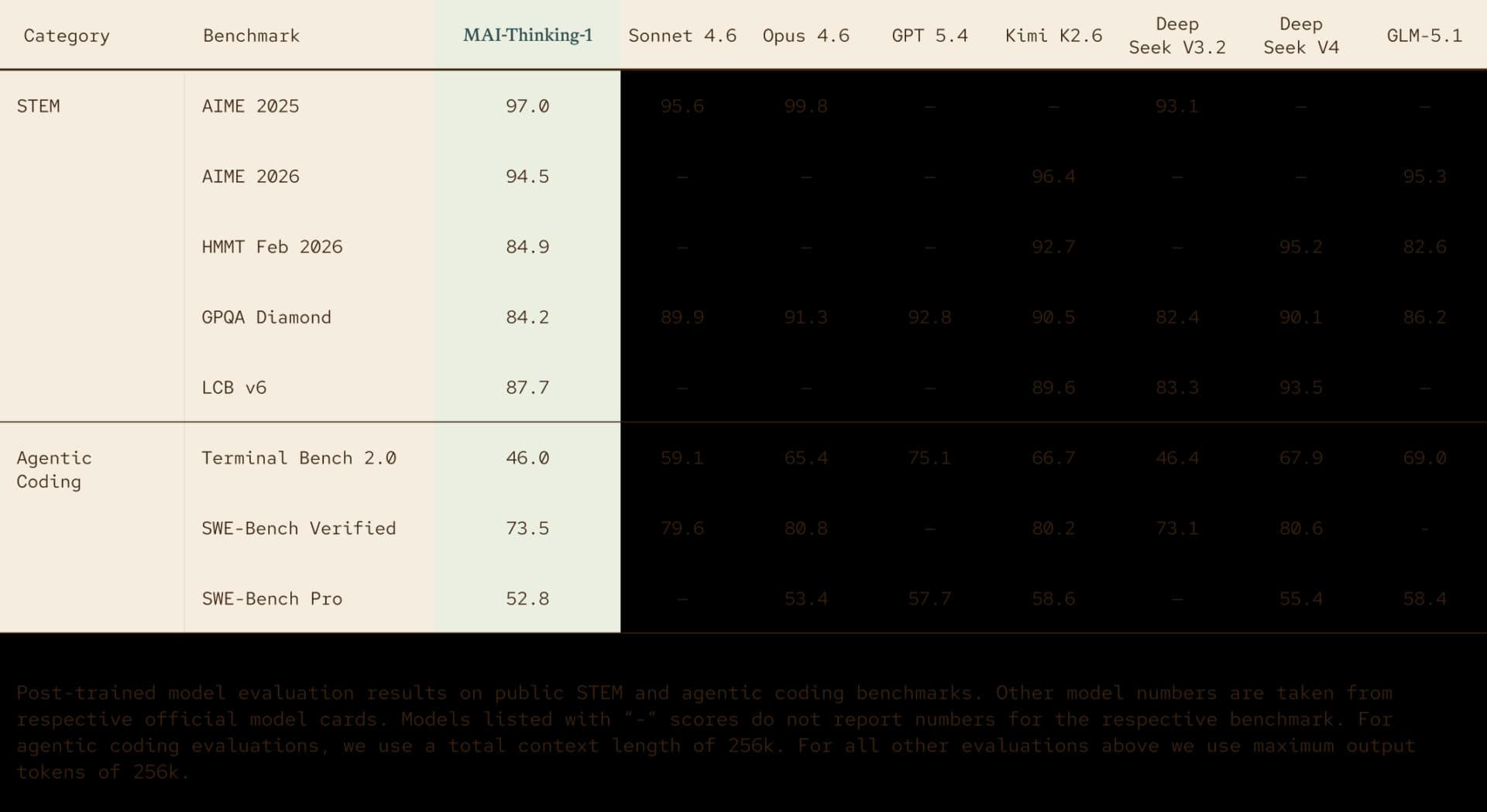
MAI-Thinking 1 trailed both OpenAI and Anthropic models by wide margins in standard benchmarks. It landed roughly on par with Deepseek V3.2, a capable but not frontier-class model. For enterprise customers paying Copilot subscription fees, this gap matters.
What this means for Copilot pricing
Microsoft CEO Satya Nadella hinted that AI billing could shift toward usage-based pricing instead of flat-rate subscriptions. One likely structure: cheaper MAI models become the default, with OpenAI or Anthropic models available as premium add-ons.
This would let Microsoft pass its third-party AI expenses directly to customers who want the better models, while capturing fuller margins on users who stick with defaults. It's a sensible business model. It's also a potential downgrade for anyone currently paying Copilot rates and expecting frontier AI quality.
Teams that built workflows around GitHub Copilot's current capabilities should watch for quality changes. The shift won't happen overnight, but the direction is clear.
The training data question
Microsoft claims MAI models are trained on "clean, commercially licensed data," making them safe for enterprise use. The technical paper tells a more complicated story. Microsoft used Common Crawl, the same freely accessible web dataset that every major AI company uses for training.
Common Crawl's legal status for AI training remains unsettled. Microsoft isn't doing anything different from competitors here, but it is marketing its approach as uniquely clean. Enterprise buyers should understand that distinction.
The broader industry pattern
Microsoft's move mirrors a wider trend. Google, Amazon, Meta, and Apple are all building proprietary AI capabilities rather than relying on third-party providers. The economics are straightforward: owning the models means better margins, more control over development timelines, and reduced dependency risk.
Microsoft's Phi series of smaller models already demonstrated the company can build competitive AI without OpenAI. The MAI family extends that to larger models. Whether those models can actually match frontier performance is a separate question from whether Microsoft will use them anyway.
Logicity's Take
This is cost optimization dressed as product development. Microsoft will save money. Customers may not notice quality changes in routine tasks like email drafting or basic spreadsheet formulas. But for complex coding assistance or reasoning-heavy workflows, the gap between MAI models and GPT-4/Claude 3.5 will surface. Product teams relying on Copilot should build evaluation frameworks now to catch capability regressions. Alternatives like Cursor (which lets users bring their own API keys) or direct API access through OpenAI or Anthropic offer more control over model selection, though at different price points and integration costs.
Timeline and rollout scope
MAI models currently handle only a small fraction of total Copilot requests. Microsoft hasn't announced a specific timeline for expanding coverage, but the company's stated goal of eliminating third-party AI costs suggests an aggressive rollout over the next 12-18 months.
A proprietary transcription model is expected in Teams soon. GitHub Copilot already uses MAI models for some requests. The pattern is clear: Microsoft is methodically replacing external dependencies across its product suite.
Frequently Asked Questions
Will Microsoft Copilot still use GPT-4 or Claude?
For now, yes. Microsoft is gradually shifting to in-house MAI models but hasn't fully phased out OpenAI or Anthropic yet. The company may offer premium tiers with third-party models at additional cost.
Are Microsoft MAI models as good as GPT-4 or Claude?
Published benchmarks show MAI-Thinking 1 trails OpenAI and Anthropic models significantly, landing closer to Deepseek V3.2. Microsoft claims competitive performance in human evaluations for coding tasks.
Will Copilot subscription prices change?
Microsoft hinted at usage-based pricing. One likely model: cheaper MAI defaults with premium add-ons for OpenAI or Anthropic access.
Is Microsoft MAI training data legally clean?
Microsoft claims commercially licensed data, but the technical paper confirms Common Crawl usage, the same dataset every major AI company uses. Its legal status for AI training remains unsettled.
Anthropic's agent capabilities that Microsoft is moving away from
Need Help Implementing This?
If your team relies on GitHub Copilot or Microsoft 365 AI features, now is the time to build quality evaluation frameworks. Reach out to Logicity for guidance on monitoring AI tool performance and building backup strategies with direct API access.
Source: The Decoder / Matthias Bastian
OpenAI responds: GPT 5.6 named 'preferred model' for Copilot
OpenAI has responded to the Bloomberg report about Microsoft replacing its models by announcing GPT 5.6 will become the 'preferred model' for Microsoft 365 Copilot. This is a direct response/update to the cost-cutting story, with OpenAI attempting to counter narratives about the companies drifting apart. The new article also specifies the apps affected (Word, Excel, PowerPoint, Cowork) and includes a quote from OpenAI's blog post.
Huma Shazia
Senior AI & Tech Writer
Produced with AI assistance and reviewed by the Logicity editorial team. Learn more in our Editorial Policy.