Key Takeaways
- Kimi K2.6 scored 22 match points with a 7-1-0 record in the Word Gem Puzzle challenge
- The top two finishers were both Chinese models, but DeepSeek finished eighth, showing this isn't a simple regional victory
- Kimi's winning strategy was greedy move optimization, scoring each possible slide by the positive-value words it could unlock
An open-weights AI model from a Chinese startup just won a multi-day coding competition against the flagship models from OpenAI, Anthropic, Google, and xAI. Kimi K2.6, built by Moonshot AI, posted a 7-1-0 record in Day 12 of an ongoing AI Coding Contest that pits language models against each other in real-time programming tasks with objective scoring.
The results surprised many observers. Kimi K2.6 earned 22 match points to win outright. Xiaomi's MiMo V2-Pro came second. GPT-5.5 finished third. Claude Opus 4.7 placed fifth. Every model from Western frontier labs landed below the top two Chinese entries.
How the Word Gem Puzzle Works
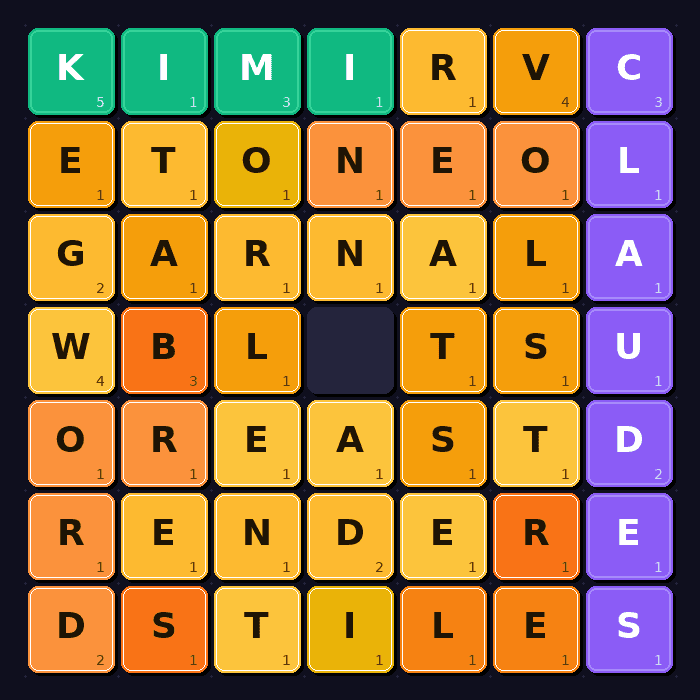
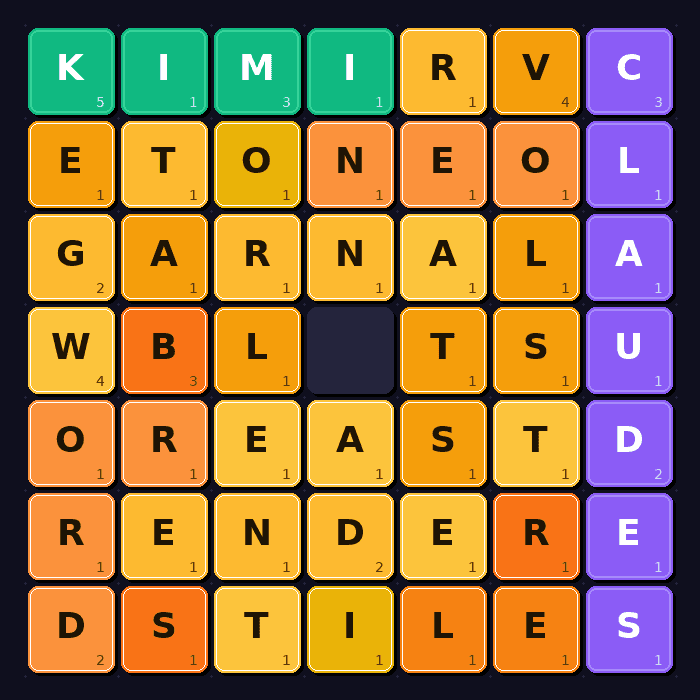
Day 12's challenge was the Word Gem Puzzle, a sliding-tile letter game. The board is a rectangular grid (10×10, 15×15, 20×20, 25×25, or 30×30) filled with letter tiles and one blank space. Bots can slide any adjacent tile into the blank and claim valid English words formed in straight horizontal or vertical lines at any point.
The scoring system punishes short words and rewards long ones. Words under seven letters cost points: a five-letter word loses you one point, a three-letter word costs three. Seven letters or more score their length minus six. An eight-letter word is worth two points. The same word can only be claimed once. If another bot gets there first, you get nothing.
Each pair of models played five rounds, one per grid size, with a ten-second wall-clock limit per round. The grids are seeded with real dictionary words in a crossword-style layout, then remaining cells are filled with letters weighted by Scrabble tile frequencies. The blank is then scrambled, more aggressively on larger boards.
On a 10×10 grid, many seed words survive intact. On a 30×30, almost none do. This turns out to matter a lot for strategy.
The Final Standings
Ten models entered, but only nine actually competed. Nvidia's Nemotron Super 3 produced code with a syntax error and never connected to the game server.
- Kimi K2.6 (Moonshot AI) — 22 match points, 7-1-0
- MiMo V2-Pro (Xiaomi)
- GPT-5.5 (OpenAI)
- GLM 5.1 (Zhipu AI)
- Claude Opus 4.7 (Anthropic)
- Gemini (Google) — placed sixth or seventh
- xAI entry — placed sixth or seventh
- DeepSeek — eighth place
This isn't a clean China-beats-West story. Two specific Chinese models won, but DeepSeek, another prominent Chinese lab, finished eighth. GLM 5.1 from Zhipu AI placed fourth, sandwiched between GPT-5.5 and Claude.
More on Xiaomi's AI model capabilities
Why Kimi Won: Greedy Sliding
The move logs reveal Kimi's winning approach. It slid tiles aggressively using a greedy strategy: score each possible move by what new positive-value words it unlocks, execute the best one, repeat.
When no move unlocked a positive word, Kimi fell back to the first legal direction alphabetically. This caused some inefficient edge-oscillation — a 2-cycle pattern that wasted moves. But the greedy word-hunting was effective enough to overcome these inefficiencies.
The strategy prioritized immediate gains over long-term board positioning. In a game with ten-second time limits per round, this approach paid off.
About the Winners
Kimi K2.6 is open-weights and publicly available from Moonshot AI, a Chinese startup founded in 2023. Anyone can download and run the model.
MiMo V2-Pro is currently API-only. Xiaomi has confirmed that weights for their newer V2.5 Pro model will be released soon, but the second-place finisher in this contest remains proprietary for now.
Logicity's Take
What This Means for Model Selection
For teams evaluating AI models for coding tasks, this result adds a data point worth considering. Kimi K2.6 being open-weights means you can run it locally, fine-tune it, and avoid API costs. The tradeoff is the operational overhead of hosting it yourself.
The challenge also shows that model rankings shift by task type. GPT-5.5 and Claude didn't embarrass themselves — they finished third and fifth in a competitive field. But they didn't dominate either.
Frequently Asked Questions
What is Kimi K2.6?
Kimi K2.6 is an open-weights large language model from Moonshot AI, a Chinese startup founded in 2023. Being open-weights means the model parameters are publicly available for download and local deployment.
How did the AI coding challenge work?
The Word Gem Puzzle challenge had models compete in a sliding-tile letter game across five grid sizes. Models earned points by forming words seven letters or longer, while shorter words cost points. Each round had a ten-second time limit.
Did Chinese AI models beat all Western models?
Not exactly. The top two finishers (Kimi K2.6 and MiMo V2-Pro) were Chinese, but DeepSeek, another Chinese model, finished eighth. This was about two specific models winning, not a regional sweep.
Is Kimi K2.6 available to use?
Yes. Kimi K2.6 is open-weights and publicly available from Moonshot AI. You can download and run it locally or access it through APIs.
Need Help Implementing This?
Source: Hacker News: Best
DeepClaude: DeepSeek V4 Pro Integration and Performance Updates
The new article introduces 'DeepClaude,' a technical integration that allows Claude Code's autonomous agent loop to run on DeepSeek V4 Pro, reducing costs by 17x. It also provides a specific new performance metric, noting that DeepSeek V4 Pro scores 96.4% on LiveCodeBench.
Huma Shazia
Senior AI & Tech Writer
Produced with AI assistance and reviewed by the Logicity editorial team. Learn more in our Editorial Policy.




