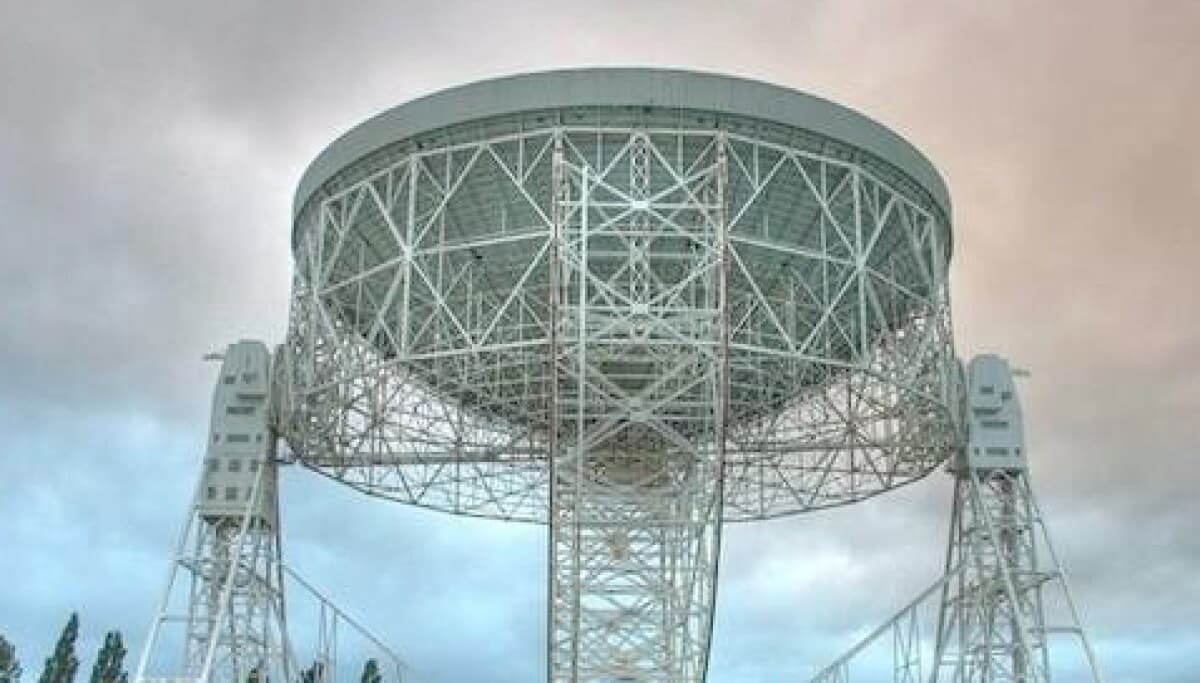
Jodrell Bank Observatory will lose its UK government funding for the e-MERLIN radio telescope array in 2028 after UK Research and Innovation announced cuts to astronomy budgets. The decision threatens one of Britain's most recognizable scientific institutions and its 76-meter Lovell Telescope, which has operated continuously since 1957.
The cut stems from a 2.7 percent reduction to the UK's Particle Physics, Astronomy and Nuclear Physics budget over four years. Professor Michele Dougherty, Executive Chair of the Science and Technology Facilities Council, called the situation one requiring "some tough, but necessary, decisions."
What is being cut?
UK's iconic Jodrell Bank telescope faces axe in science cuts (UK) 27/Jul/2026
The primary casualty is e-MERLIN, a network of radio telescopes across England operated from Jodrell Bank in Cheshire. The array includes the Lovell Telescope, a 250-foot steerable dish that will turn 70 next year. The telescope tracked Soviet and American spacecraft during the Space Race and remains a working scientific instrument.
Jodrell Bank is not the only victim. UKRI is also withdrawing future funding for the James Clerk Maxwell Telescope in Hawaii. The Birmingham Solar Oscillations Network, which has studied the Sun for decades, has been invited to apply for funding at 60 percent of previous planning assumptions.
Royal Astronomical Society President Professor Jim Wild called the decision "devastating news for UK astronomy," adding: "At a time when technological innovation is crucial to our country's prospects, discarding unique, globally significant observatories threatens both our scientific future and the inspiration of future generations of astronomers."
The institutional chaos behind the cuts
Professor Brian Cox, who holds a particle physics chair at the University of Manchester, blamed the decision on structural dysfunction within UK science governance.
Cox posted that the cuts result from "many bad legacy decisions taken by UKRI hastily and without proper consultation, overseen by a government department that no longer exists." UKRI was sponsored by the Department for Science, Innovation and Technology, which the UK government recently scrapped and redistributed.
The timing compounds the problem. With the sponsoring department gone, accountability for reversing the decision is unclear. Macclesfield MP Tim Roca said he would make the case "for protecting this world leading scientific institution," but acknowledged the budget only runs until 2028.
What happens next
Jodrell Bank's operators are working on alternatives. A spokesperson said the observatory "remains a major scientific, cultural and economic centre nationally and for the local area" and that staff would work with the University of Manchester and other partners to secure the future of both the Lovell Telescope and e-MERLIN.
The site gained UNESCO World Heritage status in 2019. Its Grade I listing and cultural significance could help attract heritage or tourism funding, but scientific operations require sustained, substantial investment that visitor revenue cannot replace.
Logicity's Take
For CIOs at UK research institutions, this is a warning shot. UKRI's decision reflects a broader pattern: when sponsoring departments get reorganized, long-running infrastructure programs become orphans. Any IT leader dependent on multi-year government funding should be mapping alternative revenue streams now, not when the axe falls. The 2028 deadline gives Jodrell Bank time, but not much.
The symbolic weight of a rusting telescope
The Lovell Telescope is not just infrastructure. It is one of the most recognizable scientific structures in Britain, visible for miles across the Cheshire plain. The prospect of it standing idle, or slowly corroding, carries political weight that budget spreadsheets do not capture.
Whether that symbolism translates into rescue funding remains to be seen. The clock is running.
Another historic UK scientific site finding new relevance through modern technology
Need Help Implementing This?
Contact Logicity for guidance on navigating funding transitions, infrastructure planning, or building resilient technology strategies for research institutions.
Source: www.theregister.com
Huma Shazia
Senior AI & Tech Writer
Produced with AI assistance and reviewed by the Logicity editorial team. Learn more in our Editorial Policy.