Key Takeaways
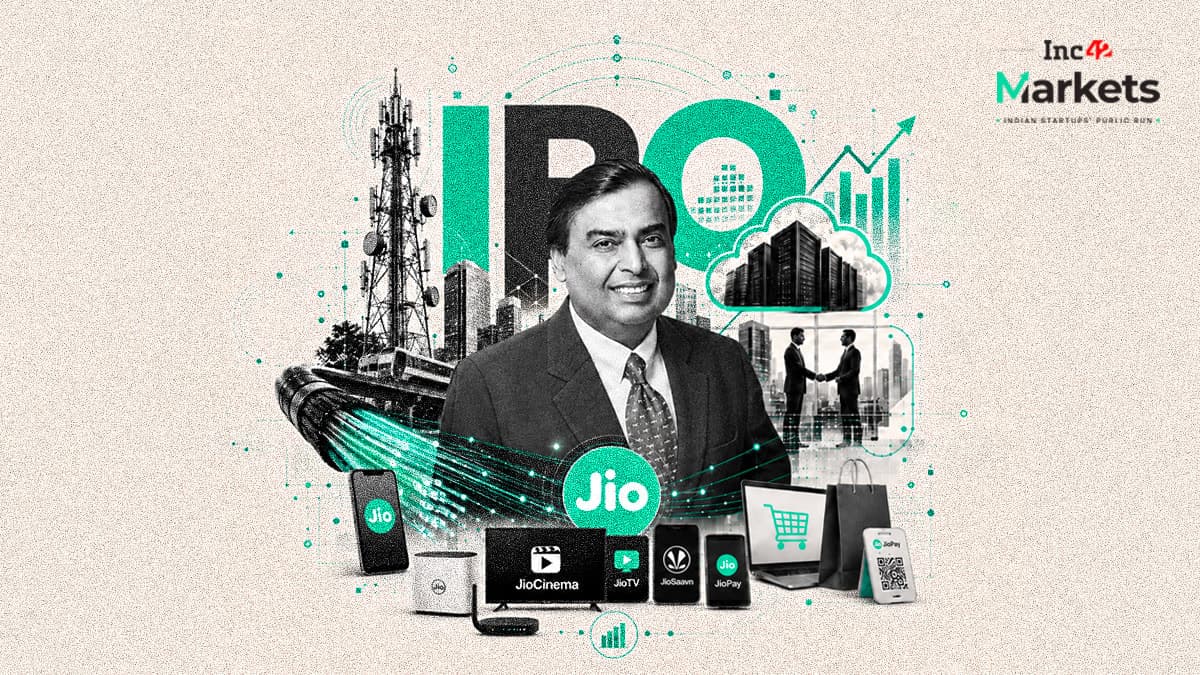
- Jio plans to issue 270 Mn new shares, potentially raising ₹37,700 Cr at a valuation of ₹11-12 Lakh Cr
- With 524.4 Mn subscribers, Jio's growth story shifts from user acquisition to revenue per user
- Investors are paying for optionality: AI, cloud, data centers, and enterprise services beyond telecom
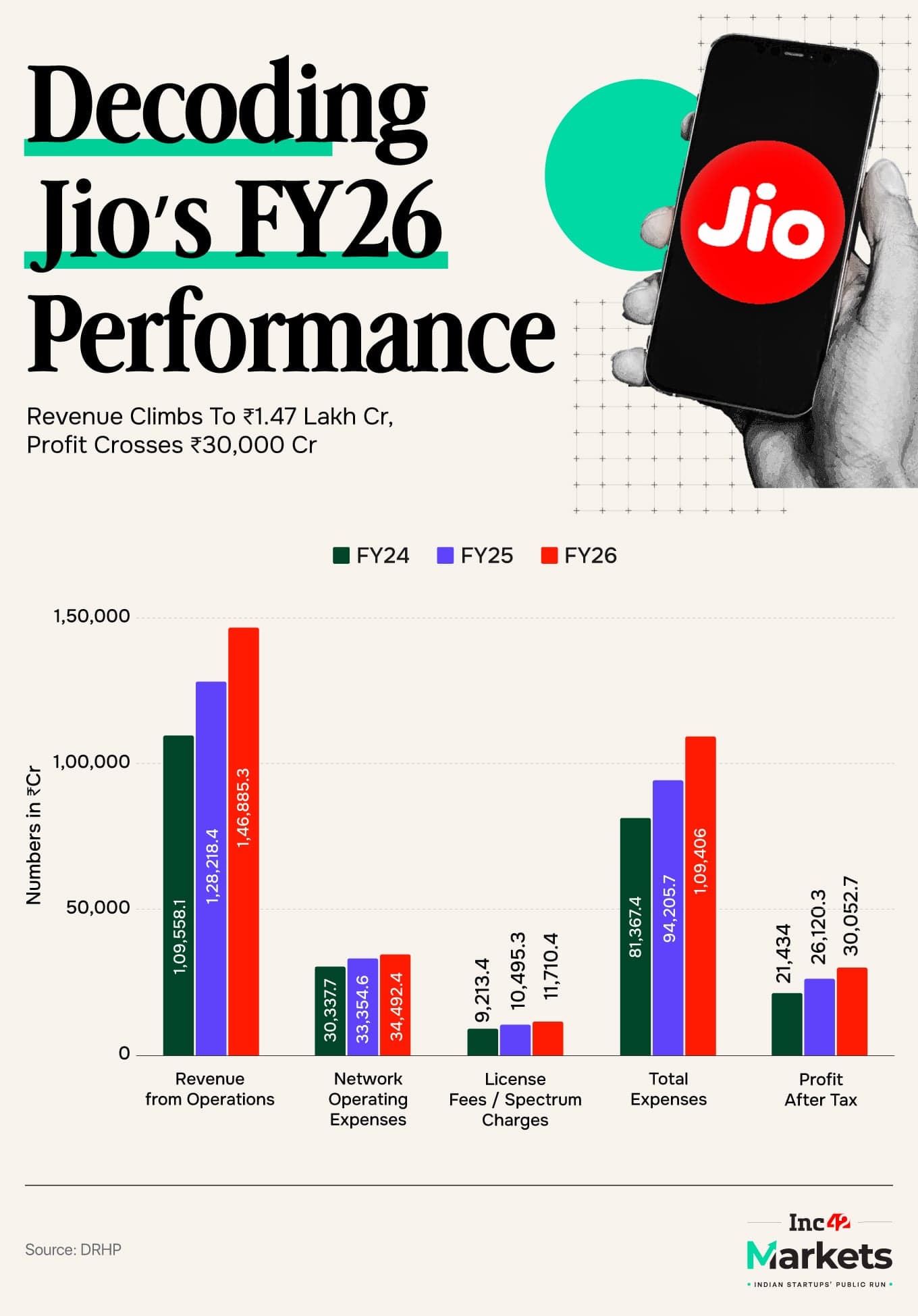
Jio Platforms has filed its draft red herring prospectus with SEBI for what could become India's largest initial public offering. The company plans to issue up to 270 million new shares, a transaction that could raise approximately ₹37,700 Cr and value Jio at ₹11-12 Lakh Cr (roughly $145 Bn). The filing arrived just days after the National Stock Exchange submitted its own IPO papers, signaling renewed confidence in Indian capital markets after months of subdued activity.
But the Jio IPO is not simply a telecom story. Reliance Industries has spent billions building infrastructure across retail, digital platforms, AI initiatives, and clean energy. The private equity firms and corporate investors that backed those bets are now waiting for returns. This listing is RIL's first attempt to separately value the digital empire it has assembled over the past decade.
Why is the Jio IPO happening now?
India's IPO market has been slow in 2026. Companies raised around $3.5 Bn through public offerings in the year so far, a sharp drop from the $20 Bn raised in each of the previous two years. Geopolitical uncertainty, volatile equity markets, and uneven foreign inflows pushed several marquee listings into waiting mode. Jio was among those holding back for better conditions.
Market analysts now expect activity to accelerate in the second half of 2026. The Jio filing, alongside NSE's, suggests large issuers believe sentiment has improved enough to proceed.
The subscriber race is over. What comes next?
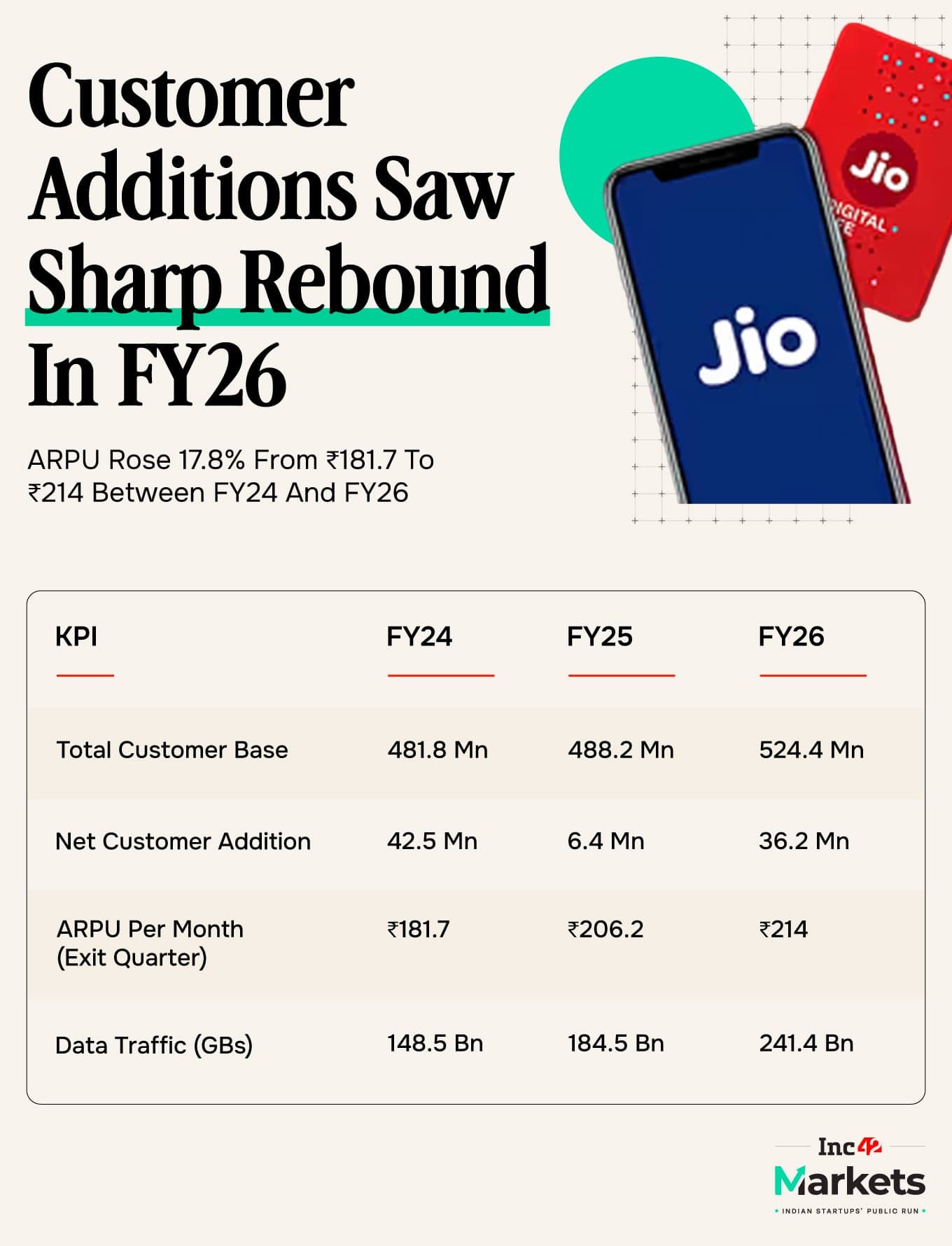
Jio is a mature business. With 524.4 million users on its network, the company's growth story no longer centers on adding subscribers. The next phase depends on how effectively it can earn from each customer it already has.
Telecom businesses typically evolve through three stages: building networks, acquiring subscribers, then monetizing them. Jio spent the past decade completing the first two, investing heavily in spectrum, fiber infrastructure, and customer acquisition. The result is extraordinary reach.
Scale creates leverage. Even modest improvements in average revenue per user can have outsized effects on earnings. Market analysts estimate that a ₹10 increase in monthly ARPU could translate into roughly ₹6,000 Cr of additional annual profit. Jio has completed the capital-intensive phase. Customer acquisition costs have normalized. Future revenue growth could increasingly flow straight to the bottom line.
The catch: telecom history is littered with dominant operators that failed to convert market share into sustained pricing power. Jio's subscriber base is formidable, but it does not automatically guarantee higher profitability.
How does fixed wireless access change the equation?
This is where broadband enters the picture. Jio has emerged as a leading player in fixed wireless access, using 5G networks to deliver home broadband without extensive fiber deployment. Broadband customers typically generate higher revenue, stay longer, and are more likely to buy additional services than mobile-only users.
More importantly, broadband serves as an entry point into Jio's wider digital ecosystem. By bundling entertainment, cloud storage, smart-home solutions, and enterprise services, the company can increase the value of each customer. Investors will likely focus not just on subscriber numbers but on how many services each user eventually adopts.
What are investors really paying for?
The most contentious aspect of Jio's valuation is that much of it depends on businesses that have not yet fully emerged. At ₹11-12 Lakh Cr, investors are not paying solely for telecom earnings. They are paying for optionality.
Reliance has spent the past year framing Jio as the foundation of a larger digital-infrastructure strategy. Artificial intelligence, cloud computing, enterprise software, data centers, and satellite connectivity all feature in the company's narrative. The question is whether these businesses can mature fast enough to justify the premium.
This is a bet on execution. Reliance has built a track record of converting infrastructure investments into profitable businesses. But cloud, AI, and enterprise software operate under different competitive dynamics than telecom. AWS, Microsoft Azure, and Google Cloud have entrenched positions. Jio will need to carve out defensible niches, likely by targeting Indian enterprises underserved by global players or by bundling services in ways competitors cannot easily match.
Can Jio justify a $145 Bn valuation?
The honest answer: it depends on how patient investors are. The telecom business alone, while highly profitable, probably does not support a ₹11-12 Lakh Cr valuation at current multiples. Investors are pricing in future cash flows from businesses that are still early-stage.

The private equity firms that backed Jio's expansion, including Silver Lake, KKR, and Vista Equity Partners, are waiting for exits. An IPO at premium valuations would validate their bets. But public market investors may apply more skepticism to businesses without proven unit economics.
The IPO also tests whether Indian markets can absorb a listing of this scale. At ₹37,700 Cr, Jio would be India's largest IPO by a significant margin. Strong demand would signal that domestic and institutional investors have appetite for mega-deals. Weak demand could force pricing concessions.
Logicity's Take
Jio's IPO is less about telecom and more about whether Reliance can replicate Amazon's playbook: use infrastructure dominance in one business to subsidize expansion into adjacent markets. The risk is that cloud, AI, and enterprise software require different capabilities than building cell towers. Reliance has the capital. The question is whether it has the organizational DNA to compete against Silicon Valley's best in software. If it does, the valuation looks cheap. If it doesn't, investors are paying a significant premium for optionality that may never convert.
Frequently Asked Questions
How much will the Jio IPO raise?
Jio plans to raise approximately ₹37,700 Cr ($4.5 Bn) by issuing up to 270 million new shares, valuing the company at ₹11-12 Lakh Cr.
When will Jio list on the stock market?
Jio has filed its DRHP with SEBI. The listing timeline depends on regulatory approval but is expected in the second half of 2026.
How many subscribers does Jio have?
Jio has 524.4 million subscribers on its network, making it India's largest telecom operator by user base.
Why is Jio's valuation considered high?
The ₹11-12 Lakh Cr valuation prices in not just telecom earnings but future businesses in AI, cloud computing, enterprise software, and data centers that are still emerging.
Who are the major investors in Jio?
Major investors include Silver Lake, KKR, Vista Equity Partners, and other private equity firms that backed Jio's expansion and are now awaiting returns through the IPO.
Need Help Implementing This?
If you're an institutional investor evaluating the Jio IPO or a business leader assessing how Jio's digital expansion affects your competitive landscape, reach out to Logicity's research team for deeper analysis and sector-specific insights.
Source: Inc42 Media / Gargi Sarkar
Huma Shazia
Senior AI & Tech Writer
Produced with AI assistance and reviewed by the Logicity editorial team. Learn more in our Editorial Policy.