Key Takeaways

- Jio Platforms filed its draft red herring prospectus with SEBI, targeting a $3 billion IPO with 27 crore new shares
- Indian IT stocks including TCS, Infosys, and Wipro fell 5-8% after Accenture trimmed its FY26 revenue growth forecast to 3-4%
- Meta's infrastructure head announced significant India expansion plans including a data centre in Jamnagar and custom silicon development in Bengaluru
Jio Platforms filed its draft red herring prospectus with SEBI on Friday, formally launching what could become one of India's largest tech IPOs. Hours earlier, Reliance Industries chairman Mukesh Ambani announced the listing at the company's annual general meeting, promising it would unlock significant value for investors.
The same day delivered a sharp blow to India's IT sector. TCS, Infosys, Wipro, and HCL Technologies shares dropped between 5% and 8% after Accenture slashed the upper end of its annual revenue growth forecast. The two events painted a split picture: optimism around India's digital infrastructure ambitions colliding with renewed fears about global tech spending.

What does Jio's IPO filing reveal?
The DRHP outlines a fresh issue of 27 crore new shares. Reports estimate the offering at roughly $3 billion. Jio plans to use most of the proceeds to pay down debt, with around Rs 27,500 crore earmarked for loan repayment.
Reliance Industries held 66.43% of Jio Platforms' pre-issue paid-up equity share capital as of the filing date. The structure matters: a fresh issue means capital flows into the business rather than simply cashing out existing shareholders. Analysts view this positively because it signals growth investment rather than an exit strategy.
Market watchers also expect the listing to help investors assign a standalone valuation to Jio's core telecom and digital businesses, separate from the broader Reliance conglomerate. This cleaner valuation could attract institutional investors who prefer pure-play exposure to India's digital infrastructure growth.
Why did Indian IT stocks fall so sharply?
The trigger was Accenture's revised guidance. The consulting giant trimmed its FY26 revenue growth forecast to 3-4%, down from the earlier 3-5% range. Its Q4 revenue projection of $17.75 billion to $18.4 billion also fell marginally below Wall Street's $18.47 billion estimate.
Accenture shares plunged 11%. Indian IT stocks followed. By mid-session on Friday, TCS had dropped 5.4% to Rs 2,083, Infosys fell 8% to Rs 1,041, HCL Technologies declined over 5%, and both Wipro and Tech Mahindra shed more than 4%.
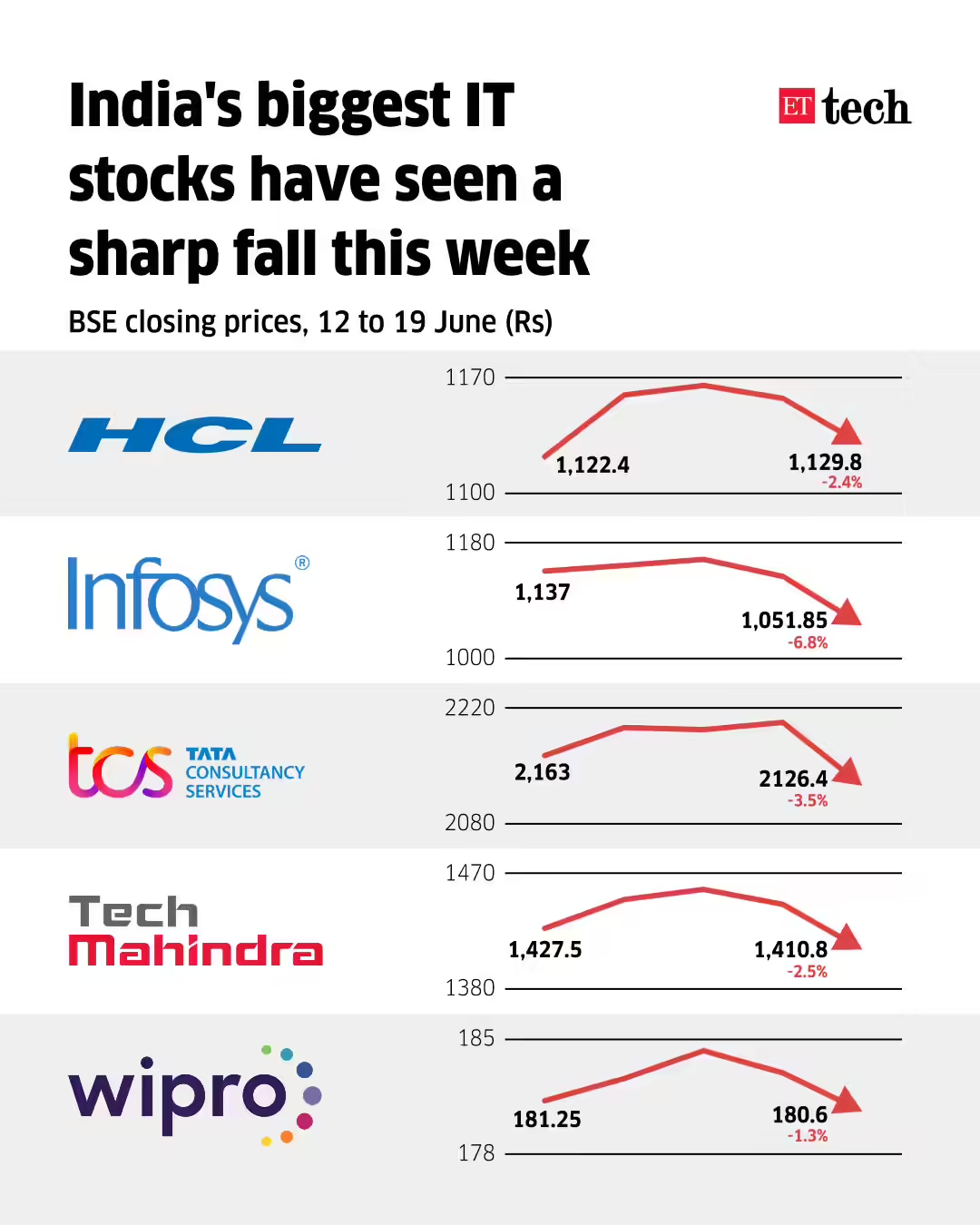
The damage moderated by close. TCS ended at Rs 2,126.4 (down 3.5%), Infosys at Rs 1,051.8 (down 6.7%), Wipro at Rs 180.6 (down 1.2%), HCL Technologies at Rs 1,129.8 (down 2.7%), and Tech Mahindra at Rs 1,410.8 (down 2.5%).
The selloff reflects a persistent anxiety: despite heavy corporate investment in AI and cybersecurity, discretionary IT consulting and digital transformation spending remains weak. Companies are prioritizing essential tech projects while delaying larger transformation initiatives.
Meta doubles down on India infrastructure
Meta's global head of infrastructure, Santosh Janardhan, outlined the company's India expansion plans in an interview. The company recently announced a data centre project in Jamnagar and is advancing Project Waterworth, described as the world's longest and most sophisticated subsea cable system with India as a major component.
“We have a significant presence in Bengaluru, where we build custom silicon. We have engineers there doing highly specialised work that, frankly, the rest of the world cannot do. Our ambitions in India over the next 5-10 years are enormous.”
— Santosh Janardhan, Meta's global head of infrastructure
On chip strategy, Janardhan explained Meta's portfolio approach: working with Nvidia, AMD, and others while running its own silicon program. At the scale of tens or hundreds of gigawatts of compute, no single provider can meet all requirements.
Delhi HC upholds Telegram ban ahead of NEET re-test

The Delhi High Court dismissed Telegram's petition against a temporary restriction on the platform. The ban remains in effect until June 22, one day after the NEET (UG) 2026 re-exam.
The court called the restriction justified to curb circulation of fake exam papers and prevent exam fraud. This marks a significant regulatory action against a major messaging platform, though the temporary nature limits its broader implications for platform operations in India.

What these stories signal for tech in India
Friday's news highlighted three distinct forces shaping Indian tech. Jio's IPO filing represents confidence in domestic digital infrastructure monetization. The IT stock selloff exposes continued vulnerability to global enterprise spending cycles. Meta's expansion plans suggest multinationals still see India as critical infrastructure territory.
For IT services companies, the Accenture warning reinforces that AI investment alone cannot offset broader spending caution. Data centres and infrastructure have emerged as the sector's next growth focus, with companies positioning for the compute demands that AI workloads require.
Detailed coverage of the Jio IPO filing and market reaction
Logicity's Take
The timing of Jio's filing is strategic. With global tech valuations under pressure and Indian IT services facing headwinds, a domestic digital infrastructure play offers investors a different thesis: exposure to India's internal digital economy rather than export-dependent services. The fresh issue structure and debt reduction focus suggest Reliance is prioritizing financial discipline over maximum valuation, which may prove wise if market conditions remain choppy through the IPO process.
Frequently Asked Questions
How much is Jio Platforms raising in its IPO?
Jio Platforms plans to raise approximately $3 billion through a fresh issue of 27 crore new shares. Most proceeds will go toward debt repayment, with Rs 27,500 crore earmarked for loan reduction.
Why did Indian IT stocks fall after Accenture's announcement?
Accenture cut its FY26 revenue growth forecast from 3-5% to 3-4% and projected Q4 revenue below Wall Street estimates. This signaled continued weakness in discretionary IT consulting and digital transformation spending globally.
What is Reliance's stake in Jio Platforms?
Reliance Industries held 66.43% of Jio Platforms' pre-issue paid-up equity share capital as of the DRHP filing date.
Why is the Telegram ban in India temporary?
The Delhi High Court upheld the ban only until June 22, 2025, specifically to prevent circulation of fake NEET (UG) 2026 re-exam papers ahead of the June 21 re-test.
What is Meta building in India?
Meta is developing a data centre in Jamnagar, expanding its Bengaluru custom silicon facility, and including India as a major node in Project Waterworth, its global subsea cable system.
Need Help Implementing This?
Understanding market movements and their implications for your investment or business strategy requires real-time analysis. Subscribe to Logicity for daily tech and business intelligence delivered to your inbox.
Source: Tech-Economic Times
تفاصيل توزيع عائدات اكتتاب Jio وسداد القروض
المقال الجديد يكشف تفاصيل استخدام عائدات الاكتتاب: 27,500 كرور روبية ستُخصص لسداد قروض شركة Reliance Jio Infocomm، مع تحديد أسماء 16 مُقرضاً دولياً شملوا Citibank وStandard Chartered وMUFG Bank. كما يوضح أن الشركة حصلت على قروض بقيمة 676 مليون دولار و44,923 مليون ين ياباني في 2024.
Huma Shazia
Senior AI & Tech Writer
Produced with AI assistance and reviewed by the Logicity editorial team. Learn more in our Editorial Policy.




