Key Takeaways
- Intel repurchased its Ireland fab stake for $14.2 billion after canceling European expansion projects worth $34.6 billion
- Two deadlines converge: customer 14A commitments start H2 2026, and CHIPS Act tax credits require construction to begin before December 31, 2026
- Ohio's first module slipped from 2025 to 2030, raising questions about Intel's ability to compete on High-NA EUV manufacturing
Intel went from canceling fabs to running short of them in 12 months. The company scrapped a €30 billion megafab in Magdeburg, Germany, and a $4.6 billion assembly plant in Poland last July. Then in April, it paid Apollo $14.2 billion to buy back the 49% stake in its Ireland fab it had sold for $11.2 billion in 2024. CFO David Zinsner described "unprecedented demand for silicon" three weeks later. The stock jumped 24% in a single session.
Now Intel's fab roadmap faces two converging deadlines that will shape its 14A future. CEO Lip-Bu Tan told investors that prospective 14A customers will make supplier decisions "starting in the second half of this year and extending into the first half of 2027." The enhanced 35% advanced manufacturing investment credit from the CHIPS Act applies only to fab construction that begins before December 31, 2026. Miss that date and projects get nothing.
Where does each Intel fab stand right now?
Fab 52 at the Ocotillo campus in Chandler, Arizona is the production foundation for Intel's 2026 to 2028 product roadmap. The facility became fully operational in October 2025 as the first high-volume home of Intel 18A. Chief technology and operations officer Naga Chandrasekaran told CNBC the fab is "capable of more than 10,000 18A wafer starts per week." That translates to roughly 40,000 wafer starts per month at full ramp, larger than TSMC's Fab 21 phase 1 and phase 2 combined.
Those are named capacity numbers, not current output. Intel indicated 18A yields will reach industry-standard levels in early 2027. Until then, the company caps CPU output on the node, leaving part of Fab 52's capacity idle. Tan said in May that 18A yields are improving 7% to 8% per month.
Fab 62, the second facility from Intel's $20 billion 2021 Arizona expansion, should be ready around 2028. Intel hasn't officially assigned it a node. It could serve as a stopgap for 14A if Ohio isn't ready, or as additional 18A capacity if external foundry demand materializes sooner. Brookfield Infrastructure holds a 49% stake in both Chandler fabs from a 2022 deal worth up to $15 billion. Every wafer out of Fab 52 and Fab 62 carries revenue share commitments.
Why Oregon matters for 14A development
The D1X complex at Gordon Moore Park in Hillsboro, Oregon is currently the only place Intel develops leading-edge process technology. Chandrasekaran told CNBC that 14A will be developed first in Oregon, targeting risk production in 2028 and high-volume manufacturing in 2029.
Hillsboro houses Intel's High-NA EUV machines, including the first ASML Twinscan EXE:5200B system delivered anywhere. Intel 14A is the first Intel node designed around High-NA. Oregon also carried early 18A production while Arizona ramped up. Intel began permitting work in February 2024 for a multibillion-dollar expansion following air quality permit approval, though no construction start has been announced.
What went wrong with the Ohio megafab?
Intel's Ohio project is its most problematic fab on paper. Construction broke ground in New Albany in 2022 on a $28 billion first phase originally targeting 2025 production. In February 2025, Chandrasekaran reset the schedule. Mod 1 now targets 2030 for operations. Mod 2 won't reach operations until 2032.
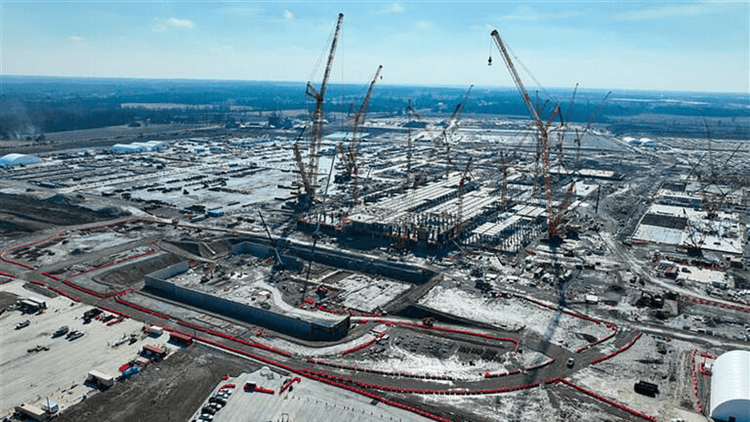
That's a five-year slip for a facility meant to be Intel's flagship 14A production site. The Ohio fabs are assigned to 14A and future nodes. If customer commitments arrive in the H2 2026 to H1 2027 window Tan described, Intel will need to answer hard questions about where those chips will actually be manufactured. Arizona's Fab 62 remains unassigned precisely because it might need to cover for Ohio.
The Ireland buyback signals a strategic shift
Fab 34 in Leixlip, Ireland runs Intel 4 and Intel 3 process nodes. Intel sold a 49% stake to Apollo in 2024 for $11.2 billion. In April 2026, Intel paid $14.2 billion to buy it all back. That's a $3 billion premium to regain full ownership in under two years.
The move makes sense when you look at what Intel canceled. The Magdeburg megafab was slated for 14A-era nodes. Wroclaw was assembly and test. Both gone. Israel's Fab 38 remains paused since mid-2024. Intel is consolidating to facilities it fully controls rather than building new ones it might need to abandon.
Can Intel hit both deadlines?
The customer commit window and the CHIPS Act construction deadline converge in late 2026. A customer evaluating Intel for 14A production will want to know where their chips will be made. If Ohio won't be operational until 2030, and Fab 62 in Arizona is the backup, Intel needs to commit Fab 62 to 14A soon. That means giving up flexibility on 18A external demand.
Meanwhile, any fab project Intel wants to benefit from the 35% tax credit must break ground before December 31, 2026. The Ohio site is already under construction, so it qualifies. But if Intel needs additional capacity to satisfy 14A customers, new construction announcements would need to come within months.
Community discussion on r/hardware and Hacker News reflects skepticism about the 2030 Ohio timeline. Users debate whether Intel can maintain technical competitiveness while managing such extended construction schedules. The two deadlines remain the primary indicators of whether Intel's current strategy will work.
What happens if Intel misses the window?
If prospective 14A customers don't commit by H1 2027, Intel's foundry ambitions face a hard reset. The company would have billions in construction underway for fabs without anchor customers. TSMC and Samsung would capture the design wins Intel needs to justify its capital spending. The stock's 24% single-day jump could reverse just as quickly.
Intel's best case: 18A yields hit targets, customers lock in 14A capacity, and the Ohio project stays on its revised 2030 schedule. The worst case: yields slip, customers hedge with TSMC, and Intel finds itself with overcapacity it can't fill. The next 18 months will determine which path Intel walks.
Another major tech company making long-horizon infrastructure bets
Frequently Asked Questions
When will Intel 14A chips be available?
Intel targets 14A risk production in 2028 at its Oregon D1X facility, with high-volume manufacturing in 2029. Ohio's Mod 1 fab, also assigned to 14A, is expected to reach operations in 2030.
Why did Intel buy back its Ireland fab from Apollo?
Intel paid $14.2 billion to regain full ownership of Fab 34 in Ireland after canceling European expansion projects in Germany and Poland. The move consolidates control over existing facilities rather than building new ones.
What is the CHIPS Act deadline for Intel fabs?
The enhanced 35% advanced manufacturing investment credit applies only to fab construction that begins before December 31, 2026. Projects breaking ground in 2027 receive no tax credit.
How big is Intel's Fab 52 compared to TSMC?
Intel's Fab 52 in Arizona can handle roughly 40,000 wafer starts per month at full ramp, making it larger than TSMC's Fab 21 phase 1 and phase 2 combined, according to Intel.
What is High-NA EUV and why does it matter for Intel 14A?
High-NA EUV is the next generation of extreme ultraviolet lithography equipment. Intel 14A is the first Intel node designed around High-NA machines. Intel's Oregon facility houses the first ASML Twinscan EXE:5200B system delivered anywhere.
Logicity's Take
Intel's fab strategy reveals a company betting it can win back mindshare through consolidation rather than expansion. Paying a $3 billion premium to buy back Ireland while sitting on a five-year slip in Ohio tells you where the confidence actually lies. The real test isn't whether Intel can build fabs. It's whether anyone commits to filling them before the tax credits expire.
Need Help Implementing This?
If you're a hardware startup or enterprise evaluating foundry options for advanced nodes, Logicity can connect you with semiconductor industry analysts and supply chain consultants. Contact our team for introductions.
Source: Latest from Tom's Hardware
Huma Shazia
Senior AI & Tech Writer
Produced with AI assistance and reviewed by the Logicity editorial team. Learn more in our Editorial Policy.