Key Takeaways
- Indian robotics funding nearly doubled to $42.1 million in H1 FY26 from $22.7 million in H1 2025
- India raised less than 1% of US robotics funding and about 2% of China's in 2025
- Average cheque size jumped 94.4% to $3.5 million, but experts say it's too early to draw sector-wide conclusions
Indian robotics startups raised $42.1 million in the first half of FY26, nearly double the $22.7 million they secured in H1 2025, according to data from Tracxn. The average cheque size jumped 94.4% to $3.5 million. But before anyone pops champagne: India captured less than 1% of what US robotics startups raised in 2025, and about 2% of China's haul.
The numbers look good in isolation. They look dire in context. US robotics startups pulled in $5.6 billion in 2025. Chinese startups raised $2.7 billion. India managed $52.9 million for the full year. The gap is not narrowing.
Why are investors warming up to Indian robotics now?
Bhaskar Majumdar, founder of Unicorn India Ventures, points to timing. Global robotics pioneers are approaching public markets and proving commercial viability. That success gives Indian founders confidence to build what he calls 'the next technology stack.'
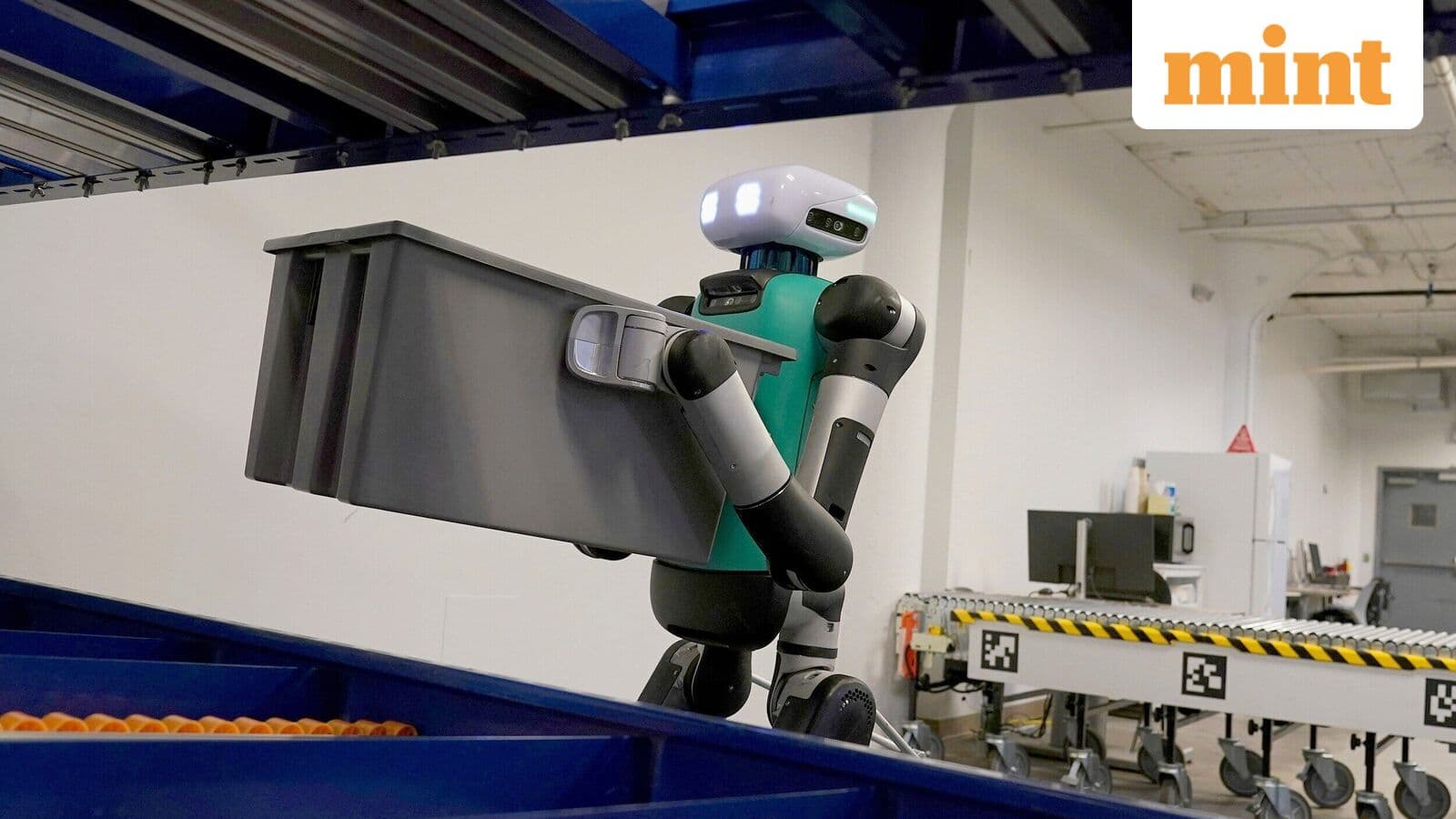
The most visible signal: Agility Robotics, a US humanoid robotics company, announced plans earlier this month to go public through a SPAC merger at a $2.5 billion valuation. When a warehouse robot company commands that kind of number, VCs pay attention.
Government schemes have also stoked demand. Make in India, production-linked incentives, and the broader push to reduce reliance on concentrated supply chains have created a policy tailwind. Global acceptance of Indian innovation in adjacent sectors makes robotics feel less like a moonshot.
Seven years of struggle, now an inflection point
Sumeet Seraf, founder of investment banking firm Equity 360, offers a blunter read. Most Indian robotics companies spent seven or eight years building products with minimal external capital. The funding drought is finally breaking.
'Now, once they get that funding, these companies can see a J-curve kind of growth from here,' Seraf said. 'If that happens, someone has to do a second round of funding, then a third round.'
The logic is straightforward. If seed-stage companies demonstrate traction, follow-on rounds become inevitable. The question is whether Indian founders can execute fast enough to attract that follow-on capital.
Bigger cheques don't mean a mature ecosystem
Average round size jumped from $1.8 million in 2025 to $3.5 million in H1 2026. That sounds like progress. Majumdar urges caution.
'One explanation is that the ecosystem is maturing, and companies have reached stages where larger amounts of capital are required to execute their growth plans,' he said. 'It also depends on the quality and nature of investment opportunities available during a given period. Therefore, it would be premature to conclude that investors are simply becoming more selective.'
Translation: a few larger deals can skew the average. One $15 million Series A changes the math. You cannot extrapolate sector health from half a year of data.
The component problem nobody solved
Building robots in India comes with a structural handicap. Many specialized components do not exist domestically. Founders import from the US and China, which inflates costs and extends timelines.
Rohit Ranjan, founder and CEO of NeoGenTech, a startup that built a female humanoid robot, put numbers to the problem. 'I have spent almost ₹8 lakh to ₹10 lakh on components alone. If a component costs ₹20,000, importing it from the US or China increases the cost to ₹35,000-40,000.'
That is a 75-100% markup on critical parts. For hardware startups operating on thin margins and limited runway, the penalty is punishing.
R&D spending remains the core weakness
India's R&D expenditure hovers below 1% of GDP. The US spends roughly 3.5%. China allocates 2.6%. The gap explains why Indian founders struggle to build locally and often relocate overseas.
One robotics founder, currently raising a seed round, described the bind: 'In India, the focus on R&D is missing. Based on the funding we get, it becomes hard to build in India. That's why people go overseas.'
Even technically strong founders face go-to-market challenges. Testing and iterating in real manufacturing environments requires access, relationships, and capital that many early-stage teams lack.
What would actually move the needle?
Nitin Sharma, an industry observer, summed up the mood: 'Directionally, the trend is positive, but we need far bigger catalysts. Perhaps initiatives like RDIF funding will move the needle.'
The optimism is directional, not absolute. Doubling from a tiny base still leaves India at the margins of a global race. Without structural changes, domestic infrastructure for components, higher R&D spend, and patient capital for hardware timelines, the gap will persist.
Logicity's Take
The 85% funding jump grabs headlines, but the absolute numbers expose the real story. India's entire H1 2026 robotics haul equals what a single mid-tier US robotics startup might raise in a Series B. The component import problem is solvable with targeted policy, think PLI schemes for motors, sensors, and actuators. Until that happens, Indian founders will keep subsidizing foreign manufacturers while trying to compete with them. The J-curve Seraf describes is possible, but it requires execution at a speed Indian hardware startups have rarely achieved.
Frequently Asked Questions
How much did Indian robotics startups raise in H1 FY26?
Indian robotics startups raised $42.1 million in H1 FY26, according to Tracxn data. This nearly doubled the $22.7 million raised in H1 2025.
Why is India's robotics funding so low compared to the US?
India lacks domestic manufacturing for specialized robot components, forcing costly imports. R&D spending remains below 1% of GDP compared to 3.5% in the US. Many Indian robotics companies also spent years building without external capital.
What is driving renewed investor interest in Indian robotics?
Global robotics companies approaching public markets, government schemes like Make in India and PLI incentives, and supply chain diversification away from concentrated geographies are pushing investors toward Indian deeptech.
What is the average funding round size for Indian robotics startups?
The average cheque size increased from $1.8 million in 2025 to $3.5 million in H1 2026, a 94.4% jump. However, experts caution that a few larger deals can skew averages.
How does India's robotics funding compare to China?
Indian robotics startups raised about 2% of what Chinese robotics startups secured in 2025. China raised $2.7 billion compared to India's $52.9 million.
Need Help Implementing This?
If you're a robotics founder navigating funding rounds or a corporate exploring automation partnerships in India, Logicity tracks deeptech investment trends and can connect you with relevant ecosystem players. Reach out to our editorial team for coverage or introductions.
Source: mint / Nabodita Ganguly
Huma Shazia
Senior AI & Tech Writer
Produced with AI assistance and reviewed by the Logicity editorial team. Learn more in our Editorial Policy.




