Key Takeaways
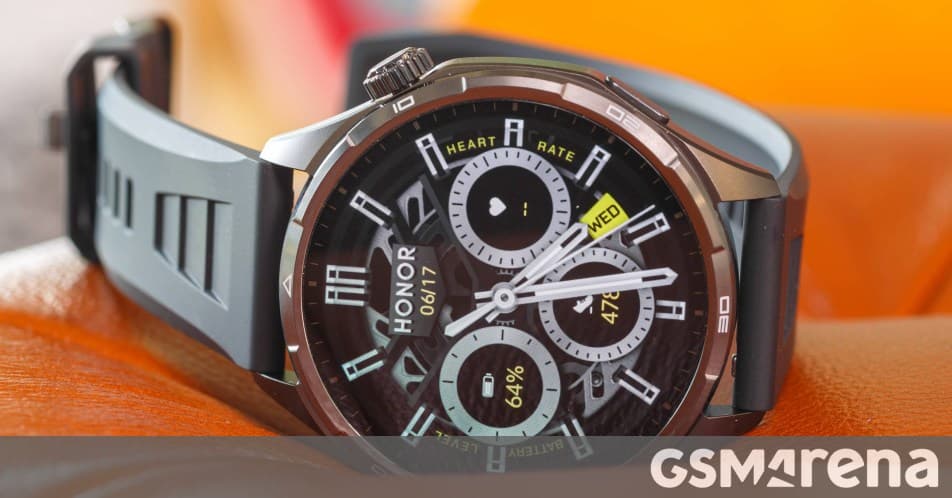
- The Honor Watch 6 has a 980mAh battery, one of the largest in any smartwatch, promising up to 35 days of use
- Launch pricing drops to €170/£150 from €250/£230 for the first month, an €80/£80 discount
- Despite the massive battery, the watch weighs just 68g and maintains a standard 46mm smartwatch profile
Honor's new Watch 6 just landed at GSMArena for review, and the headline number is hard to ignore: a 980mAh battery in a watch that weighs 68 grams. The company claims up to 35 days of runtime on a single charge. For context, most premium smartwatches max out around 400mAh and need charging every few days.
The watch ships in two variants: Shadow Black with a fluororubber strap at €250/£230, and Twilight Brown with leather for €270/£250. But Honor is running a launch promotion that cuts €80/£80 off both models for the first month, bringing the black version down to €170/£150. That's aggressive pricing for what the spec sheet promises.
How does Honor fit a 980mAh battery in a normal-sized watch?
This is the interesting engineering question. A battery that's 20mAh shy of the 1,000mAh milestone typically means bulk. Yet GSMArena's initial hands-on describes the Watch 6 as feeling like "every bit the regular smartwatch that it looks like." The 46mm case doesn't feel heavy, but it doesn't feel cheap either.
Part of the answer is software. The Watch 6 runs Honor's proprietary MagicOS rather than Google's Wear OS. Proprietary systems consume far less power than full Android-based platforms, which is why Garmin and Huawei watches have always led on battery life. The tradeoff is a smaller app ecosystem and no Google Assistant integration.
The display is a 1.46-inch AMOLED at 464x464 pixels with peak brightness of 3,000 nits. That's bright enough to read in direct sunlight, though AMOLED screens can be power-hungry at high brightness. The interface mirrors Honor's smartphone MagicOS with translucent design elements throughout.
Build quality and design details
Honor went with a traditional watch design: twin lugs on both ends, two buttons on the right side, one of which is a rotating crown. The front glass sits flush with the case, but six slightly raised index markers on the aluminum bezel provide some drop protection for the screen.
One minor annoyance: the magnetic charger uses two alignment pins rather than a universal Qi wireless puck. You'll need to pack the proprietary charger when traveling. The charger itself terminates in USB-A, which feels outdated in 2025 but remains more universally compatible than USB-C for plugging into older adapters.
What's missing from this first look?
GSMArena's hands-on is exactly that: an initial impression, not a full review. The publication notes that battery testing alone will take significant time given the 35-day claim. We don't yet have data on GPS accuracy, heart rate sensor reliability, workout tracking precision, or how MagicOS handles notifications from various apps.
Sleep tracking, stress monitoring, and SpO2 measurements are almost certainly included given Honor's typical feature set, but the source doesn't confirm specifics. The full review will likely take weeks to complete properly.
How does the Honor Watch 6 compare to competitors?
At €170 launch pricing, the Watch 6 undercuts the Samsung Galaxy Watch 7 (€319) and Apple Watch SE 2 (€279) by a wide margin. The closest competition comes from Huawei's GT series and Xiaomi's Watch 2 Pro, which occupy similar price points and also run proprietary operating systems optimized for battery life.
The value proposition is clear: if battery life matters more to you than app ecosystem, Honor is offering flagship-level hardware at mid-range pricing. If you want to install Spotify directly on your watch or use Google Maps navigation, you'll need to look elsewhere.
Logicity's Take
Honor's strategy here mirrors its smartphone playbook: aggressive launch discounts to drive early adoption, then let the value proposition speak for itself. The 980mAh battery is a genuine differentiator, not marketing fluff. But the real test is whether MagicOS can deliver reliable notifications and health tracking over that 35-day cycle. A watch that lasts a month but misses message alerts isn't useful. We'll know more when GSMArena publishes the full review.
Frequently Asked Questions
How long does the Honor Watch 6 battery last?
Honor claims up to 35 days of typical use from the 980mAh battery. GSMArena notes this claim will take significant time to verify through testing.
What operating system does the Honor Watch 6 run?
The Watch 6 runs Honor's proprietary MagicOS, not Google's Wear OS. This means longer battery life but a smaller app ecosystem and no Google Assistant.
How much does the Honor Watch 6 cost?
The black model retails at €250/£230, the brown leather variant at €270/£250. Launch promotion pricing drops these to €170/£150 and €190/£170 respectively for the first month.
Does the Honor Watch 6 support wireless charging?
No. The Watch 6 uses a proprietary magnetic charger with two alignment pins, not a universal Qi wireless charging puck.
How heavy is the Honor Watch 6?
GSMArena measured the watch with strap at just under 68 grams, which they describe as appropriately weighted for a 46mm smartwatch.
Need Help Implementing This?
Building connected device strategies or evaluating wearable platforms for enterprise deployment? Logicity's technology advisory can help you assess hardware ecosystems, integration requirements, and total cost of ownership. Contact our team for a consultation.
Source: GSMArena.com / Ivan
Huma Shazia
Senior AI & Tech Writer
Produced with AI assistance and reviewed by the Logicity editorial team. Learn more in our Editorial Policy.