Key Takeaways

- GPT-5.6 Sol Ultra scored 91.9% on TerminalBench 2.1, beating Claude Mythos 5's 88%
- U.S. government required additional testing before approving the public release
- Sol costs $5/$30 per million tokens versus Anthropic's $10/$50 for Fable 5
OpenAI's GPT-5.6 models will ship Thursday after the U.S. Department of Commerce cleared the release. The company first unveiled the models in late June but couldn't launch publicly because the government demanded additional testing. This marks one of the first times a federal agency has directly delayed an AI product launch.
The Center for AI Standards and Innovation ran the tests, according to Axios. OpenAI pushed back publicly, arguing the hold kept its best tools away from developers and companies who needed them. Binding standards for releasing frontier AI models, which Trump's latest AI executive order called for, still don't exist.
How does GPT-5.6 perform against competitors?
OpenAI claims Sol beats Anthropic's Claude Mythos 5 on several benchmarks. The numbers on TerminalBench 2.1, a coding benchmark, show the gap: Sol scored 88.8%, Sol Ultra hit 91.9%, and Mythos 5 landed at 88%. Google's Gemini 3.1 Pro Preview trailed the field at 70.7%.
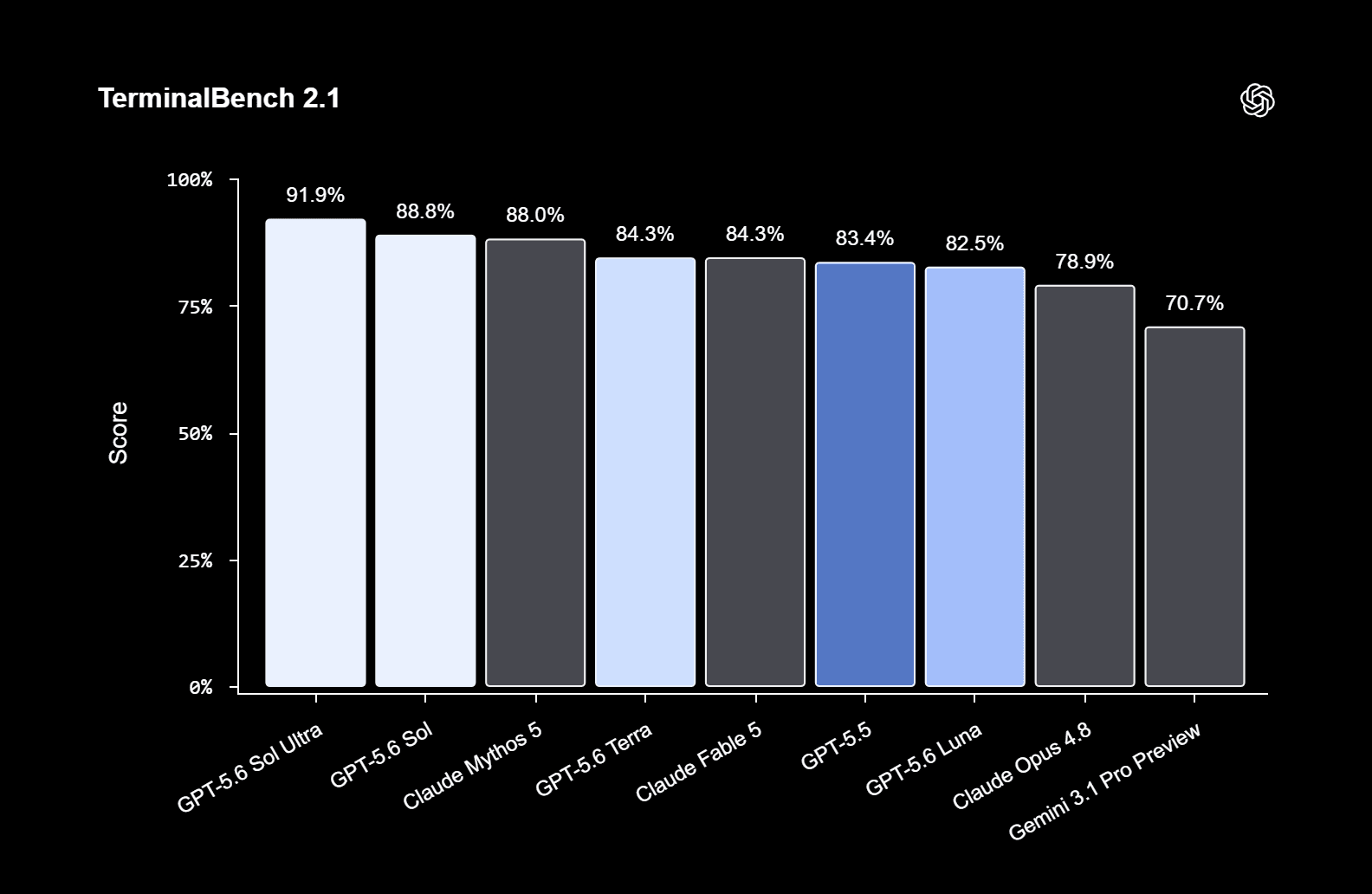
On cybersecurity tasks, Sol matched Mythos 5 in accuracy but used only a third of the tokens. That efficiency gap matters for teams running high-volume inference. Lower token usage means lower costs and faster response times.
What does GPT-5.6 cost?
Sol costs $5 per million input tokens and $30 per million output tokens. Anthropic's Fable 5 runs nearly double at $10/$50, and it likely consumes more tokens per task. For teams building AI-powered products with tools like Zapier or Make for automation workflows, the pricing difference compounds quickly at scale.
Disclosure
Some links in this post are affiliate links — Logicity earns a commission if you sign up, at no extra cost to you. We only link products we have used or actively recommend.
| Model | TerminalBench 2.1 | Input/Output Cost (per M tokens) |
|---|---|---|
| GPT-5.6 Sol Ultra | 91.9% | $5 / $30 |
| GPT-5.6 Sol | 88.8% | $5 / $30 |
| Claude Mythos 5 | 88.0% | Not disclosed |
| Anthropic Fable 5 | N/A | $10 / $50 |
| Gemini 3.1 Pro Preview | 70.7% | Not disclosed |
Why did the government delay this release?
The Commerce Department hasn't published the specific concerns that triggered the review. But the intervention signals a shift in how Washington approaches frontier AI. Previously, labs self-certified their models before release. Now federal agencies want a seat at the table.
Trump's AI executive order called for binding release standards, but Congress hasn't passed enabling legislation. The Center for AI Standards and Innovation operated in a gray zone, able to request tests but lacking clear statutory authority to block a launch indefinitely. OpenAI complied, but the company's public criticism suggests this relationship will stay tense.
What this means for AI builders
Teams planning to integrate GPT-5.6 should watch Thursday's rollout closely. OpenAI typically opens API access within hours of announcement for Plus subscribers, with broader availability following. The token efficiency gains on cybersecurity tasks hint at architectural improvements that might benefit other specialized workloads too.
The government review also sets a precedent. If you're building products on frontier models, factor potential regulatory delays into your roadmap. A two-week hold may not break a project, but it could miss a launch window.
Logicity's Take
The benchmark numbers favor OpenAI, but the pricing gap is the real story for product teams. At half the cost per token and a third of the token usage on security tasks, GPT-5.6 Sol could cut inference bills by 60-80% versus Anthropic for certain workloads. That changes the math on which AI features are economically viable to ship. Teams should run their own evals, though, since benchmark performance rarely predicts production behavior exactly. Anthropic's Mythos 5 and Claude API still lead on certain reasoning tasks and offer better enterprise compliance guarantees.
Frequently Asked Questions
When does GPT-5.6 launch?
OpenAI ships GPT-5.6 on Thursday, July 10, 2026, after receiving Commerce Department approval.
How much does GPT-5.6 cost?
GPT-5.6 Sol costs $5 per million input tokens and $30 per million output tokens.
Is GPT-5.6 better than Claude?
On TerminalBench 2.1 coding benchmarks, GPT-5.6 Sol Ultra scored 91.9% versus Claude Mythos 5's 88%. On cybersecurity tasks, Sol matched Mythos 5's accuracy using only a third of the tokens.
Why was GPT-5.6 delayed?
The U.S. Department of Commerce required additional testing through the Center for AI Standards and Innovation before approving the public launch.
What is TerminalBench 2.1?
TerminalBench 2.1 is a coding benchmark used to evaluate AI model performance on programming tasks. GPT-5.6 Sol Ultra currently holds the top score at 91.9%.
Explains why Anthropic maintains enterprise market share despite open-source competition
Need Help Implementing This?
Building with GPT-5.6 or evaluating it against Claude for your product? Logicity's team helps startups and enterprises architect AI integrations that balance performance, cost, and reliability. Reach out at hello@logicity.in.
Source: The Decoder / Matthias Bastian
OpenAI تطلق ChatGPT Work: وكيل ذكاء اصطناعي جديد يعمل بـ GPT-5.6
The new article reveals that OpenAI has launched 'ChatGPT Work', a new AI agent powered by GPT-5.6 that can execute tasks across different applications and files, operate continuously for hours on complex projects, and create finished materials like documents, spreadsheets, presentations, and web apps. It also announces a new ChatGPT desktop application unveiled during a Thursday livestream.
OpenAI تطلق 'ChatGPT Work': وكيل ذكي جديد يعمل بشكل مستقل على المشاريع
المقال الجديد يكشف عن منتج جديد كلياً يُسمى 'ChatGPT Work' يُطلق مع GPT-5.6، وهو وكيل ذكي يعمل بشكل مستقل على المشاريع المعقدة لساعات. يدمج المنتج تقنية Codex مع تكاملات طرف ثالث عبر 'دليل الإضافات الموحد' الذي يشمل Google Drive وSharePoint وSlack وغيرها. الفوترة تعتمد على الاستخدام وتتناسب مع تعقيد المهام.
Huma Shazia
Senior AI & Tech Writer
Produced with AI assistance and reviewed by the Logicity editorial team. Learn more in our Editorial Policy.