Key Takeaways
- NotebookLM now runs on Gemini 3.5 Flash with a 65% average win rate over the previous version across core evaluation dimensions
- Antigravity integration gives each notebook its own cloud computer for autonomous code execution and research tasks
- New export formats include PDFs, PowerPoint slides, Excel files, and data visualizations
Google's NotebookLM just received its most significant upgrade since launch. The AI research tool now runs on Gemini 3.5 Flash and integrates Antigravity, Google's agentic development framework. The result is a tool that doesn't just read your documents. It can write code, run analysis, and generate professional outputs on its own.
NotebookLM launched in 2023 as a way to analyze documents and webpages using Google's AI models. It carved out a niche as a grounding tool, keeping AI responses tied to your specific sources rather than its general training data. The new update moves it from a static reader into something closer to an autonomous research agent.
“By integrating Antigravity, we've moved NotebookLM from a static reader to an autonomous research agent that can think, code, and visualize insights in real-time.”
— Sundar Pichai, CEO at Google
Gemini 3.5 Flash Brings Measurable Improvements
Gemini 3.5 Flash debuted at Google I/O this year with promises of faster, more efficient processing. Google has pitched it to companies worried about token costs as a way to maintain quality while cutting expenses. Those efficiency gains now extend to NotebookLM.
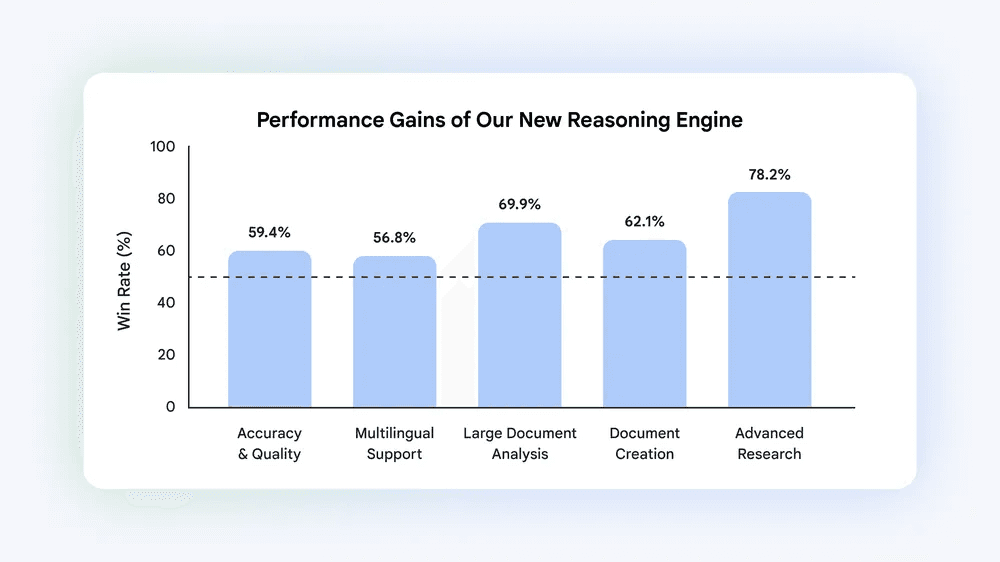
Google ran side-by-side evaluations comparing NotebookLM on the old Gemini 3.1 branch against the updated 3.5 version. The company tested across five core evaluation dimensions: Accuracy and Quality, Multilingual Support, Large Document Analysis, Document Creation, and Advanced Research.

The numbers favor the upgrade. NotebookLM averaged a 65% win rate versus the older model across these tests. Large document analysis showed a 69.9% win rate. Advanced web research tasks hit 78.2%. Google hasn't published the full methodology, but the directional improvement appears substantial.
Antigravity Turns Notebooks Into Cloud Computers
The bigger shift is Antigravity integration. Each NotebookLM notebook now has its own "cloud computer," a secure environment where the AI can write and execute code to serve your research goals. This removes a friction point that previously required jumping between apps or setting up Python environments manually.
Google says NotebookLM ships with over 100 software skills that can help build workflows within your notebooks. These skills handle tasks like data transformation, statistical analysis, and visualization generation. The AI decides which skills to use based on your prompts and source materials.
Early reactions on HackerNews and Reddit's r/MachineLearning have focused on this cloud computer aspect. Users are praising the removal of manual setup for data analysis. The secure, isolated environment means you can run code without worrying about configuration or dependency management.
New Output Formats Beyond Text
NotebookLM previously focused on text outputs. The update expands what the tool can generate. Documents now appear in the Studio Panel alongside audio overviews, infographics, and quizzes. You can prompt NotebookLM to edit these files after creation.
The initial supported formats cover most enterprise needs:
- Data visualizations and charts (PNG, SVG)
- Documents (PDFs, DOCX, Markdown, text files)
- Images with Nano Banana (PNG, JPG, GIF)
- Structured data (CSV, JSON)
- Microsoft Excel (XLSX)
- Microsoft PowerPoint (PPTX)
The PPTX and XLSX exports address a real workflow gap. Previously, you'd analyze documents in NotebookLM, then manually recreate findings in presentation or spreadsheet format. Now the AI handles that translation. Community reactions have called this a "major productivity multiplier for enterprise workflows."
What This Means in Practice
The combination of Gemini 3.5, Antigravity, and new output formats changes how you can use NotebookLM. A few scenarios illustrate the shift.
Research reports: Upload financial filings, prompt NotebookLM to extract key metrics, have it generate comparison charts as SVG files, then export the analysis as a PDF or slide deck.
Data exploration: Feed in CSV files, ask questions about trends or outliers, let the cloud computer run statistical analysis, and receive visualizations alongside explanations.
Content synthesis: Point NotebookLM at multiple web sources, have it summarize findings, and export structured JSON for ingestion into other tools.
The "agentic" framing means NotebookLM decides how to approach these tasks rather than requiring step-by-step instructions. Some users on HackerNews are debating the implications of this autonomy, but the practical benefit is fewer manual handoffs between tools.
Comparing AI coding assistants and their autonomous capabilities
Google's AI Product That Survived
NotebookLM holds an unusual position in Google's product lineup. The company has a reputation for shutting down services, but NotebookLM keeps getting investment. It launched at the beginning of the AI boom and has steadily added features while other Google experiments have disappeared.
The update signals Google sees NotebookLM as a long-term product rather than an experiment. Integrating the latest Gemini model and Antigravity framework requires ongoing engineering commitment. Adding enterprise-friendly formats like XLSX and PPTX suggests a focus on business adoption.
Google plans to add more file types over time. The current list covers the most common needs, but expect expansion based on user feedback and enterprise requirements.

Logicity's Take
Frequently Asked Questions
Frequently Asked Questions
Is NotebookLM free with the Gemini 3.5 upgrade?
Google hasn't announced pricing changes with this update. NotebookLM has offered a free tier with usage limits, but heavy usage or enterprise features may require a paid Google Workspace or AI subscription.
What is Antigravity in Google NotebookLM?
Antigravity is Google's agentic development framework. In NotebookLM, it provides each notebook with a secure cloud computer that can autonomously write and execute code, run data analysis, and generate outputs based on your research prompts.
Can NotebookLM now create PowerPoint presentations?
Yes. The update adds PPTX export alongside PDFs, Excel files, charts, and other document formats. You can prompt NotebookLM to generate slides from your research and edit them after creation.
How much faster is NotebookLM with Gemini 3.5?
Google claims Gemini 3.5 Flash offers faster and more efficient processing than previous versions. The company's internal tests show a 65% average win rate over the Gemini 3.1 version across five core evaluation dimensions.
Does NotebookLM work with Excel and CSV files?
Yes. The update adds support for XLSX (Excel) and CSV files as both inputs and outputs. NotebookLM can analyze structured data and export results in these formats.
Need Help Implementing This?
Source: Ars Technica
Manaal Khan
Tech & Innovation Writer
Produced with AI assistance and reviewed by the Logicity editorial team. Learn more in our Editorial Policy.